
Welding Parameter Monitoring & Data Acquisition
WeldTrace is a welding data acquisition platform that records what the welding machine actually delivers — voltage, current, wire feed speed, and shielding gas flow — synchronized at up to 25 kHz. It's the arc data monitoring and weld parameter logging behind every WPS/PQR parametric record and every production alarm on an out-of-spec weld.
- 25 kHz simultaneous acquisition — voltage, current, wire feed speed
- 4 monitored channels: voltage, current, wire feed speed, gas flow
- Browser-based HMI — no client software to install
What is welding parameter monitoring?
Most weld monitoring asks what the material did with the heat — thermal imaging, weld-pool video, defect scoring. Welding parameter monitoring asks a different question: what did the machine actually deliver? Voltage, current, wire feed speed, and shielding gas flow are the inputs to every weld, and a drift in any one of them can produce a defect long before a camera would see it. WeldTrace records all four continuously, so a WPS or PQR record is built from the equipment's real output rather than an assumption that the machine held setpoint.
Looking for the process-result side instead — thermal, visual, and AI defect scoring? See the full welding monitoring system. The two are designed to run together: WeldTrace's parametric record and the system's thermal/visual scoring share the same HeatCore platform.
Four channels, 25 kHz
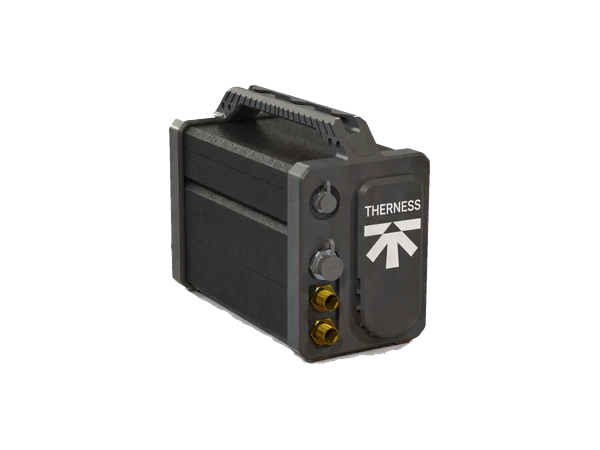
WeldTrace — 210 × 140 × 100 mm, powered and read over one Ethernet cable.
Voltage
±100 V range, 0.01 V resolution and accuracy — the baseline signal for every out-of-spec alarm.
Current
±500 A continuous, ±700 A short-duration peak, 0.1 A resolution — paired with voltage for production QC alarming.
Wire feed speed
±25 m/min range, 0.021 m/min resolution — the channel that catches wire-slip and feed irregularities.
Gas flow
0.1–25 L/min or 0.2–50 L/min range, sampled at 10 Hz — feeds the optional closed-loop gas-saving module.
Thermal vs parametric vs combined weld monitoring
| What it does | Thermal (HeatCam IR-C / IR-S) | Parametric (WeldTrace) | Combined (HeatCore) |
|---|---|---|---|
| Captures | Heat distribution and cooling behavior across the weld and base metal. | Voltage, current, wire feed speed, and gas flow — the machine's actual output. | Both streams on one synchronized timeline, plus PoolDrop's high-speed visual capture. |
| Answers | "What did the material do with the energy?" | "What did the machine actually deliver?" | What happened, and which input caused it. |
| Typical use | Penetration and porosity risk correlated with heat flow. | WPS/PQR parametric records, out-of-spec V/I alarming, wire-slip detection. | A Golden Curve baseline covering electrical, process, and thermal data via the Weld Parameters module. |
| Start here | Welding cameras → | WeldTrace → | See AI-scored defect detection on the broader monitoring platform. |
Swipe to compare →
From arc signal to audit record
1 · WeldTrace hardware
A single Ethernet cable carries both power and data to the WeldTrace unit, which samples voltage, current, and wire feed speed at 25 kHz and gas flow at 10 Hz, calibrated per channel.
2 · Weld Parameters module
The perpetual-licence Weld Parameters add-on displays and records voltage, current, wire feed, and gas in real time, synchronized with the thermal recording. It runs on WeldTrace, or on the separate PLC Integration module.
3 · Golden Curve baseline
HeatCore's reference baseline for a good weld now covers electrical and process parameters alongside thermal data, so a deviation can be traced back to the specific input that caused it.
4 · HeatCore dashboards
Parameter data lands in the same HeatCore dashboards as thermal and visual data, with timestamps synchronized to PoolDrop's high-speed capture, and feeds Therness's AI models as training data.
Where welding parameter monitoring earns its keep
WPS/PQR qualification records
A parametric record of voltage, current, and wire feed against the procedure, filed with the weld.
Production QC alarming
Real-time alarms when voltage or current drifts out of spec, while the weld is still running.
Wire-slip & feed-irregularity detection
Continuous wire feed speed monitoring flags slip and feed irregularities as they happen.
Shielding-gas consumption
Gas flow monitoring, with an optional closed-loop module for gas-saving control.
AI training-data collection
Synchronized parametric data for training and validating Therness's AI models.
R&D waveform analysis
25 kHz waveform capture for process development and arc-behavior analysis.
WAAM and other custom or challenging processes
Wire-arc additive manufacturing builds a part one layer at a time, and every layer changes the conditions the next one starts from — interpass temperature drifts, geometry varies, and a machine setting correct for layer 3 may not hold for layer 30. That variability is exactly why continuous parametric capture matters more here than on a single production seam: a 25 kHz record of voltage, current, and wire feed lets a drift in what the arc actually delivered be traced to a specific layer instead of surfacing as an unexplained defect at the end of the build. WAAM traceability is a documented target application for WeldTrace, and it is also new ground — there is no published WAAM case study, customer, or result to point to yet.
Running WAAM, DED, or another process that doesn't fit an off-the-shelf setup? See WAAM monitoring or talk to us about custom thermal integration work.
WeldTrace specifications
| Acquisition | 25 kHz simultaneous, voltage / current / wire feed speed |
|---|---|
| Voltage | ±100 V range, 0.01 V resolution |
| Current | ±500 A continuous, ±700 A short-duration peak, 0.1 A resolution |
| Wire feed speed | ±25 m/min range, 0.021 m/min resolution |
| Gas flow | 0.1–25 L/min or 0.2–50 L/min range, sampled at 10 Hz |
| Dimensions | 210 × 140 × 100 mm |
| Connectivity | Single Ethernet cable carries power and data |
| HMI | Browser-based, no client software to install |
| Storage & review | Internal storage with online playback and export |
| Calibration | Per-channel |
| Optional | Closed-loop gas-saving module |
Full details and pricing on request: see the WeldTrace product page.
Welding parameter monitoring FAQs
What is welding parameter monitoring?
Welding parameter monitoring is the continuous digital recording of the electrical and mechanical signals a welding machine actually delivers — voltage, current, wire feed speed, and shielding gas flow — as the arc runs. Instead of inferring process stability from the finished bead, it captures the inputs directly, so a WPS or PQR record shows exactly what the equipment produced, weld by weld.
What is a welding data logger, and is WeldTrace one?
A welding data logger is hardware that samples welding process signals at high speed and stores them for review. WeldTrace samples voltage, current, and wire feed speed simultaneously at 25 kHz and gas flow at 10 Hz, storing every reading internally with online playback and export, so a weld's parameter history can be pulled up long after the arc is out.
What parameters does WeldTrace record?
Four channels: voltage (±100 V, 0.01 V resolution), current (±500 A continuous, ±700 A short-duration peak, 0.1 A resolution), wire feed speed (±25 m/min, 0.021 m/min resolution), and shielding gas flow (0.1–25 L/min or 0.2–50 L/min range, sampled at 10 Hz). Each channel is calibrated independently and its acquisition rate is adjustable.
Can WeldTrace alarm on out-of-spec voltage or current in real time?
Yes. Voltage and current are sampled continuously at 25 kHz, so a reading that drifts outside your process window can be flagged while the weld is still running, rather than after the part has already moved on to the next station.
What's the difference between parametric and thermal weld monitoring?
Parametric monitoring, from WeldTrace, records what the welding machine delivered — voltage, current, wire feed, gas. Thermal monitoring, from a HeatCam camera, records what the material did with that energy — heat distribution and cooling. They answer different questions, and are strongest combined: parametric data helps explain why a thermal anomaly happened.
What is the Golden Curve, and how does the Weld Parameters module feed it?
The Golden Curve is the reference baseline HeatCore builds from good welds. The Weld Parameters add-on module adds real-time display and recording of voltage, current, wire feed, and gas, synchronized with the thermal recording, so that baseline covers electrical and process data alongside thermal data — not thermal alone.
Does WeldTrace need OPC-UA, Modbus, or a PLC to work?
No. WeldTrace connects over a single Ethernet cable that carries both power and data, and it's configured and reviewed through a browser-based HMI with no client software to install. OPC-UA, Modbus TCP, and Profinet connectivity are handled by the separate PLC Integration module, not by WeldTrace itself, for lines that need the data inside an existing control system.
Can WeldTrace monitor WAAM or other additive processes?
WAAM traceability is a documented target application. Continuous parametric capture at 25 kHz suits the highly variable, layer-by-layer nature of wire-arc additive builds, where interpass conditions shift on every pass and are hard to characterize from the finished part alone. We don't have a published WAAM case study or customer result to point to yet — talk to us about your process.
Was WeldTrace previously sold under a different name?
SignalMonitor is the designation used in earlier quotations for the same hardware. WeldTrace is the current product name; if you have an older quote referencing SignalMonitor, it refers to this platform.
Ready to see the parametric side of your process? Explore WeldTrace, or pair it with HeatCore AI for scored thermal and visual monitoring on the same platform.
See WeldTrace recording your process
Book a demo to see voltage, current, wire feed, and gas recorded and alarmed on in real time, or explore the hardware spec sheet.
