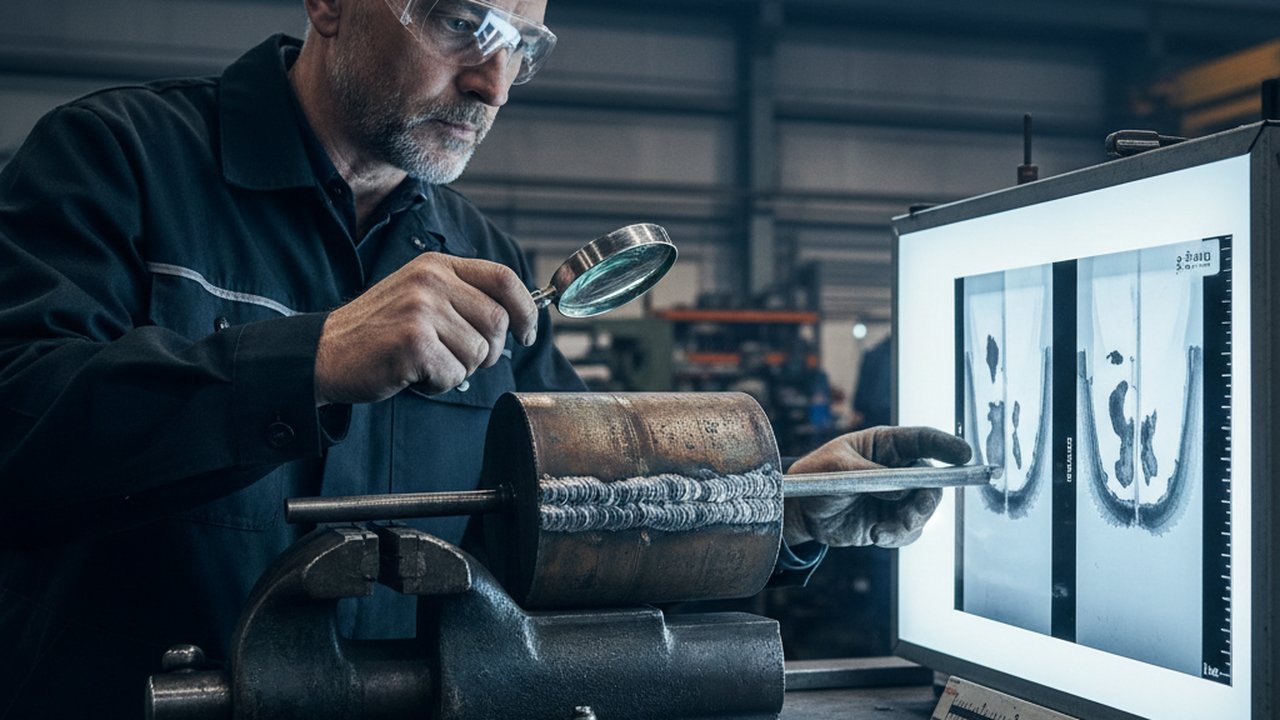
Every fusion weld contains imperfections. The engineering questions are which type, how big, and against what criterion — and that’s what separates a usable defect reference from a photo gallery.
This guide maps all the major welding defect families to one framework: what each defect is (with its ISO 6520-1 code), what causes it, how it’s detected, and how ISO 5817 sentences it at quality levels B, C and D. Each defect links to a dedicated deep-dive with prevention checklists.
Imperfection vs defect — in standards language, every deviation is an imperfection; it’s a defect only when it exceeds the acceptance limit for your specified quality level. The same undercut can be acceptable at Level C and rejectable at Level B. Sentencing happens against a criterion, not against perfection. (How levels are assigned: ISO 5817 acceptance criteria guide.)

Catching that signature during the weld — instead of at end-of-line NDT — is exactly what a real-time welding monitoring system is built to do, with a welding camera reading the thermal and visual signal on every pass. (Watch the full clip.)
The defect map: ISO 6520-1 groups
| Group | Family | Key members | Worst-case behaviour |
|---|---|---|---|
| 100 | Cracks | Hot, cold/hydrogen, crater | Propagate under load — never permitted |
| 200 | Cavities | Porosity, wormholes, crater pipes | Section loss, fatigue initiation |
| 300 | Solid inclusions | Slag, flux, oxide, tungsten | Planar behaviour when aligned |
| 400 | Lack of fusion / penetration | Side-wall, inter-run, root | Planar, crack-like — most dangerous to miss |
| 500 | Imperfect shape | Undercut, misalignment, overlap, excess metal | Stress concentration, fatigue |
| 600 | Miscellaneous | Arc strikes, spatter | Metallurgical damage, surface function |
The defects, one by one
Cracks — never acceptable
The only imperfection family with zero tolerance at every quality level. Three mechanisms with nearly opposite prevention levers: hot cracking (solidification chemistry + bead shape), cold/hydrogen cracking (hydrogen + martensite + stress, appearing up to 48 h after welding), and lamellar tearing (parent plate, through-thickness strain). → Weld cracks: hot vs cold cracking explained
Porosity — the most common volumetric defect
Gas trapped in the solidifying pool. Acceptance scales by level: single pores limited by diameter vs thickness; uniform porosity by projected area (roughly 2% / 4% / 8% at B / C / D). Causes split cleanly into shielding, contamination, and parameters. → Porosity in welding: causes, types, limits
Slag inclusions — the multi-pass tax
Flux residue trapped between passes in MMA/FCAW/SAW. Almost always an interpass-cleaning failure; aligned slag is sentenced severely because it behaves like a planar flaw. → Slag inclusion: causes, prevention, acceptance
Lack of fusion — the inspector’s nightmare
Weld metal touching but not bonded to the joint face or previous pass. Not permitted at any level, hard to detect (RT can miss it; UT/PAUT preferred), and caused by cold parameters or arc placement — the defect that “looks fine” hides best. → Lack of fusion: causes, detection, criteria
Incomplete penetration — the root that wasn’t
The weld doesn’t extend through the designed thickness. Not permitted at Level B for full-pen joints; planar root gap plus undersized throat. Distinct from lack of fusion: penetration is an energy/geometry problem. → Incomplete penetration: causes and acceptance
Undercut — the fatigue starter
A groove melted into the parent metal at the weld toe. The textbook example of level-scaling: h ≤ 0.05t (B), 0.1t (C), 0.2t (D) for the continuous case. Classic symptom of running hot and fast. → Undercut: causes, ISO 5817 limits, prevention
Burn-through — the binary failure
The pool collapses through the joint on thin sections or root passes. Not permitted at any level; on automated lines it’s usually a fit-up variation, not a parameter error — and it has a visible thermal precursor. → Burn-through: causes, prevention, real-time detection · Watch it happen at high speed
Arc strikes — small mark, real damage
A stray arc outside the joint creates a self-quenched, possibly micro-cracked hard spot. Not permitted at B or C; treat as repairable damage everywhere on hardenable steel. → Arc strikes: why they matter
Spatter — the process diagnostic
Ejected droplets; acceptance depends on application (coating, fatigue, hygiene). More valuable as a leading indicator: rising spatter rate means transfer instability — the same instability that produces fusion defects. → Weld spatter: causes and reduction
Shape and dimension imperfections
Misalignment (linear 507, angular 508), excess weld metal (502), overlap (506), and geometric deviations covered by ISO 13920 tolerances. Limits per level are tabulated side by side in the B vs C vs D comparison.
Detection: match the method to the defect
| Defect | Best methods | Weak methods |
|---|---|---|
| Surface cracks | MT (ferritic), PT | VT alone (tight cracks) |
| Subsurface cracks | UT / PAUT | RT (orientation-dependent) |
| Porosity | RT (rounded indications) | UT (sizing scattered pores) |
| Slag inclusions | RT (irregular indications), UT | VT (subsurface) |
| Lack of fusion | UT / PAUT | RT — can miss it entirely |
| Incomplete penetration | RT (root line), UT | VT unless root accessible |
| Undercut, shape | VT + gauges, laser profilometry | Volumetric NDT |
| Arc strikes, spatter | VT (look beyond the weld) | — |
Method selection rules live in ISO 17635; the full comparison including cost-per-detection logic is here: welding inspection methods compared.
The layer post-weld NDT can’t provide
Everything above inspects welds after they’re made — by then, a drifting process has already produced defective metres. The complementary layer is in-process monitoring: thermal imaging and high-speed vision watching every weld as it happens, detecting the conditions that generate defects — shielding loss, cold fusion faces, pool collapse precursors, transfer instability — in real time:
- Real-time weld quality monitoring 101 — how the approach works
- AI defect detection: thermal vs vision vs acoustic — sensor trade-offs
- HeatCore AI — Therness’ production implementation, scoring defect precursors inline during the weld
In-process monitoring doesn’t replace code-mandated NDT — it reduces the defect population reaching the sentencing gate, concentrates NDT where it matters, and generates per-weld evidence for ISO 3834 traceability. See the Therness monitoring and camera products that provide this in-process layer.
Quick reference: never-permitted list
For sentencing discussions, the ISO 5817 zero-tolerance imperfections at every quality level:
- Cracks, all types (100) — micro-crack acceptance is material-dependent
- Lack of fusion (401)
- Incomplete root fusion (4013)
- Burn-through (510)
Everything else is a dimensional conversation against Table 1 of the standard — keep a controlled copy at the inspection station, and the level comparison table next to it.
Catch these defects live, before they reach the inspection gate
Therness thermal-plus-vision monitoring scores defect precursors in real time and generates per-weld ISO 3834 evidence — so fewer non-conformances ever reach sentencing.
Book a demo See real-time weld monitoringTherness solution: Welding monitoring system — Every weld inspected in the cycle, with defect flags and the ISO 3834 / ISO 17635 evidence kept per weld.
Frequently Asked Questions
What are the main types of welding defects?
ISO 6520-1 classifies weld imperfections into six groups: cracks (100), cavities including porosity (200), solid inclusions such as slag (300), lack of fusion and penetration (400), imperfect shape such as undercut and misalignment (500), and miscellaneous imperfections such as arc strikes and spatter (600). The most consequential in practice are the planar defects — cracks and lack of fusion — because they propagate under load.
What is the difference between a welding defect and an imperfection?
In standards language, every deviation is an imperfection; it becomes a defect only when it exceeds the acceptance limit for the specified quality level. A 0.4 mm undercut on 10 mm plate is an acceptable imperfection at ISO 5817 Level C, but a defect at Level B. This distinction drives sentencing: you reject against a criterion, not against perfection.
Which welding defects are never acceptable under ISO 5817?
Cracks (group 100), lack of fusion (401), incomplete root fusion (4013), and burn-through (510) are not permitted at any quality level — B, C, or D. Arc strikes are not permitted at B or C. Most other imperfections (porosity, undercut, misalignment, excess weld metal) have dimensional limits that scale with material thickness and tighten from level D to B.
How are welding defects detected?
By layered inspection: visual testing (ISO 17637) for surface imperfections, penetrant or magnetic particle testing for surface-breaking cracks, radiography for volumetric defects like porosity and inclusions, ultrasonic/PAUT for planar defects like lack of fusion, and in-process monitoring (thermal imaging, high-speed vision) to detect defect-generating conditions in real time during welding, before the part reaches the inspection gate.