
Welding Camera for Thermal and High-Speed Weld Imaging
See the process while the weld is being made. Measure thermal behaviour with a HeatCam LWIR camera, or resolve the weld pool and droplet transfer with PoolDrop at up to 1440 × 1080 resolution or up to 480 fps in high-speed mode. Choose operator-led monitoring, AI segmentation and process-anomaly alerts, or a robot-cell monitoring and integration package.
- Base · KIT-SYS-001: HeatCam C monitoring for a manual line
- AI · KIT-SYS-002: live segmentation and process-anomaly alerts
- Robotic · KIT-SYS-011: robot and PLC monitoring integration

Choose your welding camera

HeatCam IR-C
Cylindrical IP67 stainless-steel LWIR camera for fixed installations and induction pipe welding. 384 × 240 px, −20 °C to 1500 °C, 60 mK thermal sensitivity, and acquisition up to 25 Hz over Ethernet.
Explore HeatCam IR-C →
HeatCam IR-S
Compact LWIR camera for tight, permanent integration in WAAM, DED, and robotic additive heads, with per-pixel radiometric measurement and real-time thermal streaming over Ethernet TCP/IP.
Explore HeatCam IR-S →
PoolDrop
High-speed visual camera with resolution up to 1440 × 1080 px or up to 480 fps in high-speed mode. Its Class 1 laser illumination improves process visibility; USB 3.0 connects it to any HeatCore server, with optional water cooling for the application.
Explore PoolDrop →
HeatCore AI
HeatCore software for HeatCam C systems: Base adds recording, metric extraction and traceability; AI adds weld-pool segmentation and process-anomaly alerts; Robotic adds robot and PLC monitoring integration.
Explore HeatCore AI →Choose the monitoring scope for your welding line
Base · KIT-SYS-001
For operator-led monitoring on a manual line. HeatCam C, HeatCore and Server CU Weld provide live thermal display, recording and playback, threshold-based metrics, control-limit alarms, traceability, and HTML/CSV reports. AI is not included.
Request Base configurationAI · KIT-SYS-002
For segmentation and process-anomaly alerts. HeatCam C and an industrial AI server add live and recorded weld-pool segmentation, AI-metric alerts, adaptive reference curves, seam monitoring, reports, REST API and WebSocket integration.
Request AI configurationRobotic · KIT-SYS-011
For robot-cell monitoring integration. Add the Robot/PLC module and engineering package for recording triggers, process telemetry, cell-readiness checks, and thermal streaming. The robot, welding source, and complete cell are not included.
Request Robotic configurationEvery configuration is price on request. Tell us the welding process, line type, materials, joint geometry, and evidence you need; Therness will scope the camera, optics, mounting, software, and integration.
What is a weld monitoring camera?
A weld monitoring camera is an industrial camera configured to observe the weld zone during production. Thermal imaging measures temperature distribution; high-speed visual imaging shows pool and droplet behaviour. The camera, mounting, protection, software, capture coverage and validation must be specified for the process and documentation workflow.
Monitoring, not just filming
Monitoring software can display, record and extract process metrics from the camera stream. The Base, AI and Robotic packages add different levels of analysis and integration; none replaces the customer's required inspection method or acceptance criteria.
Measurement, not just imagery
A radiometric thermal camera reports temperature per pixel for uses such as interpass temperature, cooling behaviour, and heat-distribution monitoring. A visual camera instead resolves pool geometry and fast process dynamics. Voltage, current, and wire feed speed are separate data streams, covered by welding parameter monitoring.
Configured for the installation
Housing, mounting, cooling, optical protection, interfaces and the planned duty cycle all affect a production installation. HeatCam C has an IP67 stainless-steel housing; other protection and integration details are confirmed for the quoted configuration.
Once you know which modality you need, the field guide to writing the specification covers resolution, frame rate, mounting geometry, and PLC triggering in depth, and the thermal-versus-visual breakdown settles the modality question itself.
How weld monitoring becomes usable process data
1 · Specify the process view
Select the spectral band, field of view, standoff, mounting and protection around the process. HeatCam cameras use LWIR sensing for thermal measurement. PoolDrop combines high-speed visual capture with Class 1 laser illumination designed to improve visibility of the weld-pool process.
2 · Turn the image into measurements
HeatCam C provides 384 × 240 radiometric data, −20 °C to 1500 °C range and 60 mK thermal sensitivity. PoolDrop resolves weld-pool and droplet behaviour at up to 1440 × 1080 resolution or up to 480 fps in high-speed mode; those are separate operating maxima.
3 · Apply the selected analysis tier
Base displays and records thermal data, extracts threshold-based metrics and provides control-limit alarms. AI adds weld-pool segmentation, adaptive reference curves and process-anomaly alerts. Robotic adds recording triggers, process telemetry and cell-readiness checks through the Robot/PLC integration package.
4 · Support quality documentation
HeatCore can retain configured records, lot or serial traceability, and HTML, CSV or Excel reports. AI systems can exchange data through REST API and WebSocket interfaces. These functions support a customer's documentation workflow; inspection methods, acceptance criteria and compliance remain specific to that workflow.
Stages 1 and 2 are where most installations are won or lost, and both are decided at specification time rather than on the shop floor: sensor resolution against the smallest feature you need to resolve, frame rate against how fast the event is, mounting geometry, air purge, and how the PLC triggers capture. Those numbers are worked through in the specification and commissioning field guide.
Thermal vs high-speed visual weld cameras
| What it does | LWIR thermal camera (HeatCam IR-C / IR-S) | High-speed visual camera (PoolDrop) |
|---|---|---|
| What it sees | Heat distribution and cooling behaviour across the weld and surrounding material. | The molten weld pool, droplet transfer, and fast process events at up to 1440 × 1080 resolution or up to 480 fps in high-speed mode. |
| Monitoring role | Radiometric thermal measurement and process-anomaly monitoring when configured with HeatCore. | Visual process study with low-latency livestreaming and recording. |
| Spectral band / sensor | LWIR 8–14 µm. HeatCam C: 384 × 240, 60 mK sensitivity, −20 °C to 1500 °C. | Visible-band high-speed imaging with Class 1 laser illumination to improve process visibility. |
| Typical use | Fixed and pipe-welding monitoring (IR-C); embedded WAAM, DED, and robotic-head integration (IR-S). | Weld-pool R&D, process development, pulsed-MIG analysis and visual documentation. |
| Interfaces / software | Ethernet: up to 25 Hz for IR-C; TCP/IP thermal streaming for IR-S. Other interfaces are configuration-specific. | USB 3.0 data, RTSP video output and OPC UA control. |
Swipe to compare →
Choosing a camera? Start with the welding camera buyer's guide or the visualization vs thermographic AI comparison. Comparing inspection approaches? See the thermography NDT testing guide, which also covers excitation-based inspection after the weld, or read the infrared thermography for welding guide. Prefer to watch? See real-time thermal imaging of welding.
Watch two welding-camera views
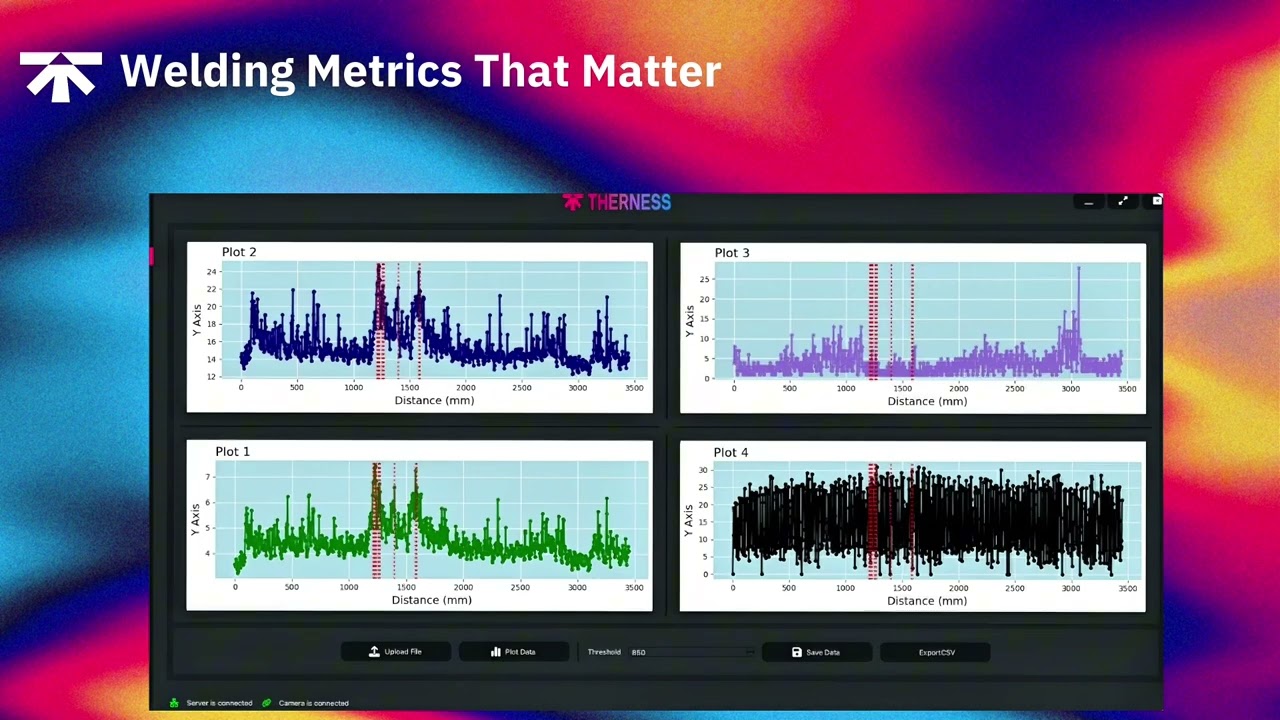
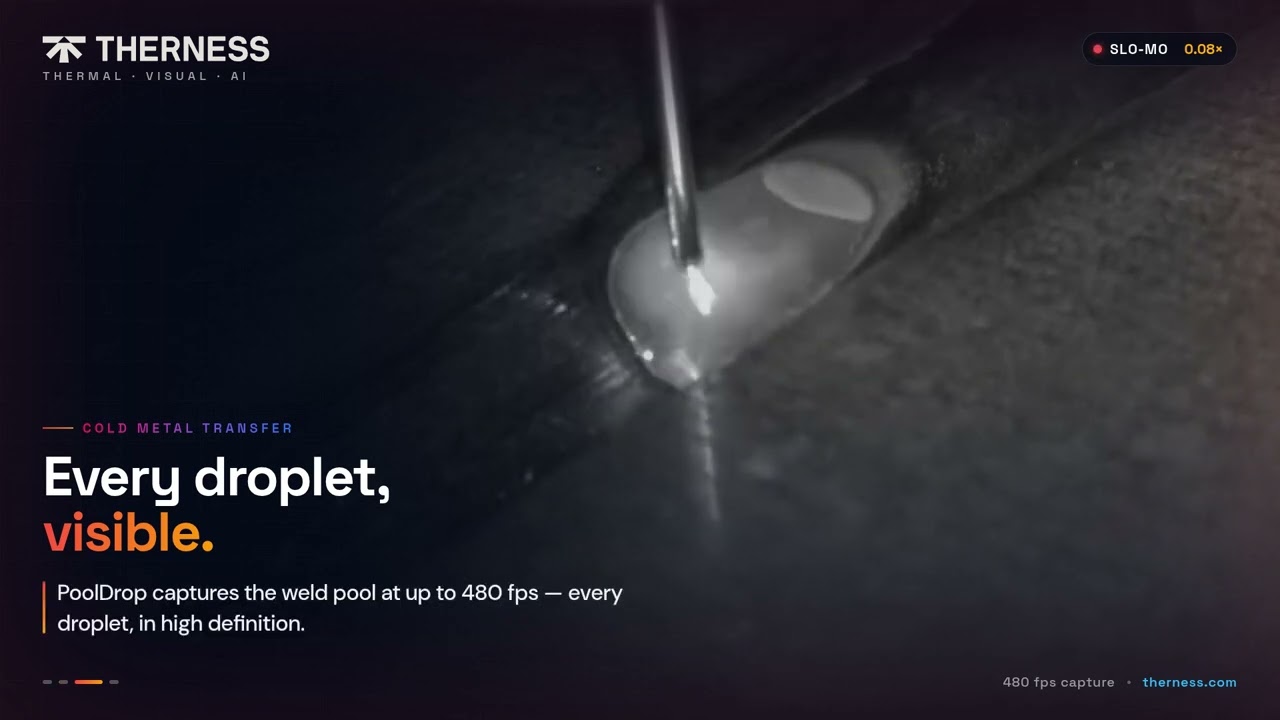
More weld-pool footage: inside the molten pool at 480 fps, droplet transfer in slow motion, burn-through caught up close, and how the pool solidifies.
More real footage in the video library.
Welding camera specs that matter
| Spec | HeatCam IR-C | HeatCam IR-S | PoolDrop |
|---|---|---|---|
| Camera type | LWIR thermal | LWIR thermal | High-speed visual (visible band) |
| Resolution | 384 × 240 px | Confirmed for quoted configuration | Up to 1440 × 1080 px |
| Speed / sensitivity | Up to 25 Hz; 60 mK sensitivity | Confirmed for quoted configuration | Up to 480 fps in high-speed mode |
| Temperature / lighting | −20 °C to 1500 °C | Radiometric measurement; range confirmed for quoted configuration | Class 1 laser illumination to improve process visibility |
| Housing / mounting | IP67 stainless-steel housing | Compact format for integrated installations | Cooling plate and adjustable mounting bracket in the PoolDrop system |
| Interfaces / software | Ethernet | Ethernet TCP/IP; integration SDK | USB 3.0; OPC UA control; RTSP video output |
| Best for | Fixed cells, induction pipe welding | Embedded WAAM / DED / robotic heads | Weld-pool R&D, qualification, pulsed-MIG analysis |
| Details | HeatCam IR-C → | HeatCam IR-S → | PoolDrop → |
Swipe to compare →
Not sure which weld monitoring camera fits your line? Tell us your process and we'll recommend a configuration, or use the buyer's guide to compare requirements like dynamic range, arc-glare handling, and integration.
Where industrial welding cameras earn their keep
Robotic welding cells
HeatCore Robotic connects HeatCam C monitoring with recording triggers, process telemetry and cell-readiness checks through its Robot/PLC integration package. See the full welding monitoring system.
WAAM / additive
The compact HeatCam IR-S embeds in additive heads to track interpass temperature and heat history layer by layer. More on WAAM monitoring.
Induction pipe welding
The cylindrical HeatCam IR-C gives a stable radiometric view of the weld zone and transfers thermal data over Ethernet for continuous in-line pipe-weld monitoring.
R&D and education
A high-speed visual camera at 480 fps reveals droplet transfer and pool dynamics for process development. Read the weld pool geometry analysis guide.
Manual welding stations
Use HeatCore Base with HeatCam C for live thermal display, recording, threshold-based metrics and operator-visible alarms. Robotic integration is a separate package for robot cells.
Automotive & BIW
In high-throughput cells, configured camera records and exports can support the plant's quality-documentation workflow. Read the automotive inline monitoring guide.
Built for welding-process monitoring
A Politecnico di Torino spin-off
Therness develops welding cameras and monitoring software as a spin-off of Politecnico di Torino, with a focus on thermal measurement and weld-process visibility.
Configured records and traceability
HeatCore provides recording, playback, lot or serial traceability and report exports according to the selected tier and configured capture workflow.
Supports quality documentation
Monitoring records and exports can support the customer's quality-documentation workflow. The required inspection method, acceptance criteria and compliance remain application-specific.
Welding camera FAQs
What is a welding camera?
A welding camera is an industrial camera configured to observe the weld zone during the process. Therness offers LWIR thermal cameras for radiometric process measurement and PoolDrop for high-speed visual observation at up to 1440 × 1080 resolution or up to 480 fps in high-speed mode. HeatCam systems use HeatCore; PoolDrop connects to any HeatCore server over USB 3.0.
Is a weld monitoring camera different from a welding camera?
"Welding camera" describes a camera engineered to capture the weld zone. "Weld monitoring camera" usually describes the camera plus software used to observe, measure, record, or analyse the process. Therness HeatCam systems use HeatCore for thermal monitoring; PoolDrop adds high-speed visual recording to a HeatCore server over USB 3.0.
Thermal or visual camera for weld monitoring?
Choose thermal imaging when you need radiometric temperature and heat-flow information. Choose high-speed visual imaging when you need to study the weld pool, droplet transfer, or brief process events. The right choice depends on the signal and acceptance criteria defined in your monitoring or inspection plan.
How is weld visibility handled near the arc?
HeatCam uses LWIR sensing to measure thermal radiation rather than visible light. PoolDrop is a visible-band system with Class 1 laser illumination designed to improve process visibility. Final optics, exposure, mounting, cooling and protection are selected for the welding process during application review.
How does a 480 fps camera help weld-process analysis?
PoolDrop can run at up to 480 fps in high-speed mode, helping engineers review fast events such as droplet transfer and short-lived changes in pool behaviour. The footage supports process development and root-cause work; it does not by itself certify a weld or replace the required inspection method.
Do welding cameras integrate with robots and PLCs?
Integration depends on the selected system. HeatCam S streams thermal data over Ethernet TCP/IP and provides an integration SDK. HeatCore Robotic includes a Robot/PLC integration package, while PoolDrop lists OPC UA control and RTSP video output. The exact signals and interfaces are confirmed for the quoted installation.
How much does a welding camera cost?
Pricing depends on the camera, optics, cooling and protection, software tier, commissioning, and plant integration. Therness quotes three monitoring scopes by use case: Base KIT-SYS-001 for a manual line, AI KIT-SYS-002 for segmentation and process-anomaly functions, and Robotic KIT-SYS-011 for robot-cell monitoring integration. Prices are available on request. See what drives welding camera cost, or tell us your process for a configured quote.
Can I use an action camera or a standard industrial camera to film welding?
A standard camera may be useful for general documentation, but welding-process imaging usually needs purpose-selected optics, exposure, illumination, mounting and protection. PoolDrop adds high-speed capture and Class 1 illumination; HeatCam adds calibrated LWIR measurement. Suitability must be checked against the process and required evidence.
Can a welding camera measure temperature?
A radiometric thermal camera can. HeatCam C measures from −20 °C to 1500 °C with 60 mK sensitivity and a 384 × 240 px LWIR sensor. HeatCam S also provides radiometric temperature data, with the range confirmed for the quoted configuration. PoolDrop is a visual camera and does not measure temperature.
Can welding cameras support traceability?
Yes, when the selected software and line triggers are configured to record the required data. HeatCore can record and export thermal data, process telemetry and monitoring results; PoolDrop adds synchronised visual frames and recordings. The resulting records support the customer's traceability plan, but they do not replace mandatory inspection or certify conformity.
See a welding camera running on your process
Book a live demo to compare HeatCam thermal monitoring with PoolDrop high-speed visualization and discuss the software scope for your line.
