
Innovators in weld quality assurance
We are a team of engineers and researchers dedicated to eliminating weld defects through advanced statistical analysis and custom deep learning systems.
Born as a spin-off of Politecnico di Torino and built for the factory floor, we develop AI-powered thermal monitoring systems for industrial welding quality control.
By combining thermography, process data and artificial intelligence, we help manufacturers detect anomalies in real time, reduce defects and turn thermal data into actionable quality insights.
Therness is led by CEO Luca Santoro, Assistant Professor at Politecnico di Torino.

Weld monitoring at work in industry
- Over40companies and research institutes we have worked with, sent an offer to, or that have evaluated our systems
- Over10customers with orders or invoices
- Over15systems, thermal cameras and software licences shipped
- 70users signed up to QuoteBuddy, our AI quoting software
- Over100technical drawings uploaded to QuoteBuddy for a quote
- Over4pilot and integration projects with industrial customers
- 7industrial sectors served
- 5years of R&D on thermography for welding, from Politecnico di Torino
- Over15peer-reviewed scientific papers by the founding team
Where we operate
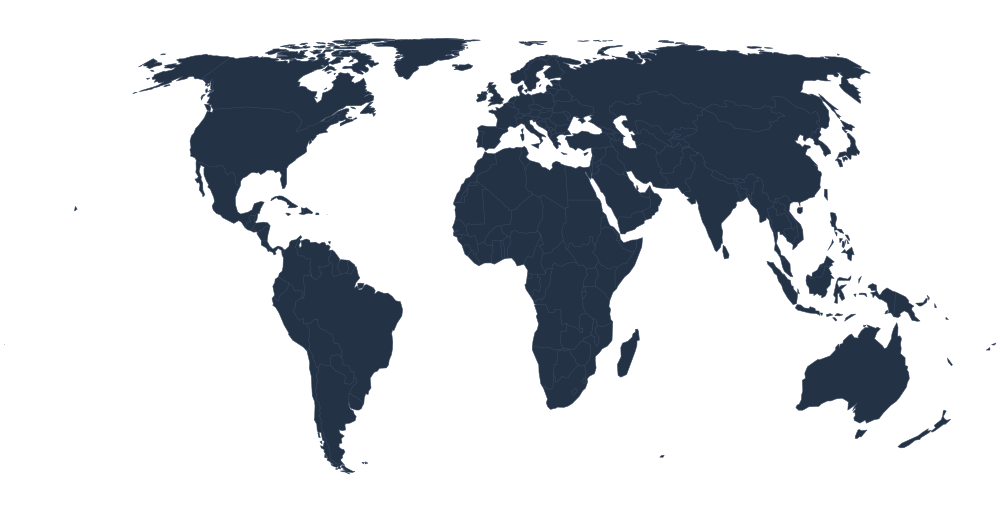
- Installations and projects: Italy
- Markets served: United States, Canada, United Kingdom, Poland, United Arab Emirates, Saudi Arabia, India
- QuoteBuddy users: Hungary, Serbia, Mexico, Vietnam
- Europe: installations, projects and tests (countries grouped)
Markets served: countries we received qualified enquiries from or sent quotes to. QuoteBuddy users: countries of users with an account. Neither counts as a customer. Countries, not cities.
Customers, users and enquiries from 15 countries on 3 continents
Industries served
- Railway
- Automotive and vehicles
- Metalworking and steel
- Oil & gas and energy
- Electronics
- Thermoforming and plastics
- Packaging
Data as of October 2026
Our mission
Eliminate weld defects through intelligent, real-time monitoring systems that combine thermal imaging, proprietary analysis, and seamless integration.
What we build
- Real-time thermography for every seam
- Statistical + AI models trained on production reality
- Evidence packs for audits and customer traceability
What you get
- Earlier defect detection (before NDT or complaints)
- Root-cause timelines tied to process parameters
- Workflows that fit operators and quality teams
How we work with manufacturers
Collaborative deployments that keep production running while quality improves.
1) Map and baseline
Define critical weld paths, capture clean baselines, and design non-intrusive sensing.
2) Pilot and validate
Measure false positives/negatives on a live cell and lock acceptance criteria before scaling.
3) Roll out and train
Scale with operator training, clear SOPs, and dashboards that plug into your workflows.
Proof points we stand behind
Quality and compliance are built into the process — not added later.
Compliance discipline
- ISO-style inspection discipline baked into procedures and training
- Validation with measurable acceptance criteria before scaling
Operational reality
- Secure data retention and audit trails
- Integrations that respect uptime, safety, and maintenance constraints
About Therness FAQs
Quick answers about our mission, what we build, and how deployments work.
What does Therness build?
We build AI-powered weld monitoring systems that combine thermal imaging (and optionally visual/audio sensing) with real-time analysis to detect anomalies during production and generate audit-ready evidence.
Where does the technology come from?
Therness was born from research at Politecnico di Torino and is built for the factory floor—focused on measurable acceptance criteria, traceability, and workflows quality teams actually use.
How do you deploy in a production plant?
We start with a pilot cell: map critical welds, mount sensors without disrupting uptime, validate false positives/negatives, and lock acceptance criteria before scaling across lines.
Do you support compliance workflows like ISO 17635 / ISO 3834?
Yes. Compliance discipline is part of the deployment: evidence packs, traceability, and integrations (e.g. QMS workflows) are designed to support audits and customer requirements.
