
Welding Monitoring System: a Thermal Weld Monitoring System for Every Weld
In‑process weld monitoring with thermal + visual + electrical sensing and AI anomaly flags. Catch anomalies in-line against a reference, and push audit‑ready evidence to your QMS in real time.

Watch HeatCore AI replay a real lab weld
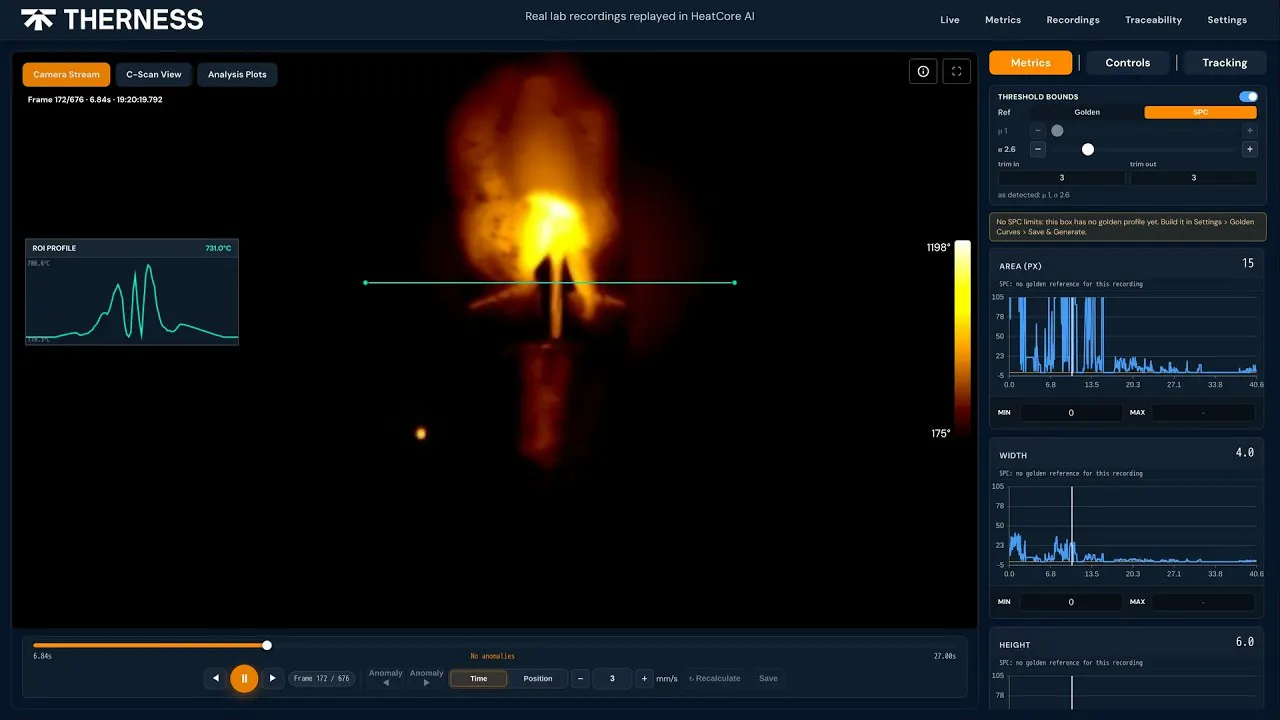
- Weld-pool area, width and temperature charted frame by frame
- Seam tracking: angle, width and offset from a reference line
- Traceability: every recording with date, weld type and anomaly flag
Weld monitoring cameras, AI, and reporting in one platform
Thermal visibility
Inline thermography measures the weld pool (temperature, width, area) and flags a weld that leaves the band learned on reference welds of the same joint. It flags an anomaly, not the defect type: how we validate it.
Visual evidence
High-speed video up to 480 fps records wire, droplet and weld pool next to the thermal stream, so every flagged weld comes with images to review.
Process signals
Current, voltage and wire feed are recorded with every weld and checked against the same reference, together with the thermal data.
Choosing hardware? Compare welding camera systems — including thermal and high-speed weld monitoring cameras — or see how thermographic NDT detects subsurface defects or watch the complete system overview.
What “real-time weld quality monitoring” measures
Thermal signals
Melt pool temperature distribution, cooling rate, and abnormal heat flow—often correlated with penetration issues, porosity risk, and lack of fusion.
Vision geometry
Images of the weld pool and the finished bead, with bead shape and width along the weld, recorded as evidence for review and for spotting process drift. They show what happened; they do not name the defect type.
Electrical / process stability
Current, voltage and wire feed show arc instability and abnormal signatures before defects form—supporting preventive actions, not just detection.
Where weld monitoring pays back fastest
Automotive & EV
Robotic BIW/frames: detect drift early, reduce scrap/rework, and produce PPAP-ready evidence.
Read the automotive guide →Heavy fabrication
Standardize quality across shifts and cells with consistent pass/fail criteria and traceable records.
ISO 3834 / EN 1090 traceability →Pressure vessels & energy
Support ASME/EN workflows with per-weld evidence packs and trend signals tied to defect risk.
Discuss your acceptance criteria →What you get after a pilot
Acceptance criteria + pass/fail
Thresholds and scoring tuned to your WPS/joint types with clear operator guidance for each weld cycle.
Evidence pack templates
Audit-ready PDF exports and structured data outputs aligned to ISO 17635 / ISO 3834 workflows.
Integration checklist
Recommended hooks for QMS/MES (alerts, CAPA triggers, traceability IDs), plus a multi-cell rollout plan.
Pick the monitoring stack that fits your line
Start with thermal monitoring or go full multi-modal—each system ships with AI, reporting, and QMS hooks.
HeatCore Basic
Entry-level thermal monitoring with statistical process control. Operator console, recording, and traceability.
Explore HeatCore BasicHeatCore AI
Thermal monitoring with deep-learning anomaly detection and Kaizen reports. Active thermography to catch subsurface issues.
Explore HeatCore AIHeatCore Robotic
Engineered weld monitoring cell with calibrated thermography, AI analytics, and complete MES/ERP integration.
See HeatCore RoboticEvidence that satisfies auditors and customers
Instant pass/fail
AI grades each weld to ISO 17635 and ISO 3834 thresholds, giving operators a clear next step.
Audit-ready PDFs
One click to generate reports, or sync automatically with your existing QMS via API.
Traceability by default
Operator, parameters, and anomaly flags stay attached to each weld. Perfect for PPAP, EN 1090, or supplier scorecards. For the electrical and feed parameters themselves — voltage, current, wire feed speed, and gas flow — see welding parameter monitoring.
WAAM / DED monitoring: the same platform mindset
WAAM monitoring landing
See how to monitor melt pool behavior, interpass temperature, and heat distribution for wire-arc additive builds.
Explore WAAM monitoring →WAAM thermal visualization
Short clip highlighting bead consistency and heat distribution during a WAAM build.
Watch WAAM thermal monitoring →Titanium WAAM guide
Understand defect prevention and why monitoring is essential for titanium WAAM qualification.
Read the WAAM guide →Get a recommendation for your weld monitoring system
Tell us your process (MIG/MAG, TIG, laser, robotic), defect concerns, and standards. We’ll recommend the best sensor stack and rollout plan.
Deploy a welding monitoring system that prevents defects
Schedule a live demo to see thermal, visual and electrical monitoring running in a real cell, or grab the PDF to share with your team.
HeatCore Basic vs AI vs Robotic
| Capability | HeatCore Basic | HeatCore AI | HeatCore Robotic |
|---|---|---|---|
| Best for | Manual & semi-automated stations | Robotic cells (bolt-on AI retrofit) | Turnkey engineered robotic cell |
| Thermal sensor | HeatCam IR-C: 384 × 240 px LWIR microbolometer, up to 25 Hz | HeatCam IR-C: 384 × 240 px LWIR microbolometer, 17 µm pitch, up to 25 Hz | HeatCam IR-C on the robot wrist or fixture, up to 25 Hz |
| Range & sensitivity | −20 °C to 900 °C standard (up to 1500 °C optional), ≤ 60 mK NETD, IP67 | −20 °C to 900 °C standard (up to 1500 °C optional), ≤ 60 mK NETD, IP67 | Calibrated thermography; monitors gradients & cooling rates; IP67 with air-purge |
| AI anomaly flags | SPC + real-time alarms; AI anomaly flags via HeatCore AI upgrade | Deep-learning anomaly flags against a reference (anomaly, not defect type); scored inline during the weld | HeatCore AI engine; inline alarms to the robot cell |
| Robot compatibility | — | Retrofits existing robotic cells | Common industrial robot controllers; confirmed per cell |
| Integration | Local SPC, no cloud/IT dependency | CSV per job; REST API (OpenAPI 3.1) and WebSocket; PLC integration on project | Complete MES/ERP integration; Panel PC dashboards; exports to MES |
| Evidence & standards | Exportable SPC charts for ISO 17635 | Auto evidence pack per weld — ISO 17635 / ISO 3834 | Real-time evidence + historical analytics, MES exports |
Swipe to compare →
Every tier runs on the same thermal and high-speed weld cameras that feed it. Still weighing options? Browse the full HeatCore product range to see each system side by side.
Automated weld quality monitoring: pass/fail decided in the cycle
Automated weld quality monitoring moves the pass/fail call from an inspector sampling parts downstream to the system itself, inside the weld cycle. The camera stream feeds deep-learning models trained on real weld data, which flag welds that deviate from a reference learned on good welds (an anomaly, not the defect type) and return a decision while the weld is still running, so a bad weld is flagged before the part leaves the fixture. Scoring runs on edge computing in the cell with no cloud dependency, and connects to the PLC through a bidirectional PLC integration set up on project, so your controller can act on an out-of-range weld immediately. Every automated verdict is filed with its evidence — the thermal images, the score, and the temperature timeline used for root-cause analysis — so an auditor can trace any automated decision back to the data behind it. The scoring engine is HeatCore AI; the input is any of the welding cameras in the lineup.
Arc welding monitoring system: a weld monitor at the torch
An arc welding monitoring system has to read the weld while the arc is burning. On MIG/MAG and TIG lines the thermal camera is mounted to follow the torch and works as a weld monitor for each seam: it records the heat distribution of the weld pool and of the bead behind it, and compares each seam with a reference validated in the pilot. The alarm thresholds are set from that reference and checked for consistency with your WPS and acceptance criteria; they are not derived automatically. The set-up is defined per application — joint type, material thickness, torch access and cycle time decide the camera view, optics, protection and mounting — and it is validated in a pilot on one cell, measuring false positives and false negatives before the rollout.
On robotic arc welding cells the weld monitor can exchange signals with the cell controller. Which signals are used, and what the cell does with an out-of-range seam, is defined for each machine and validated in the pilot. Where you also need a record of current, voltage and wire feed speed for each weld, add welding parameter monitoring alongside the thermal channel.
Watch weld monitoring catch defects live
Watch the HeatCore AI live view with its cooling curve and cooling-time analysis (T8/5 and T12/7), see seam angle, width and offset tracked frame by frame, look at a camera view of a live MAG weld, and study what the signature of a reject looks like.
Going further? For post-weld verification, pair inline monitoring with thermography NDT testing. To see how HeatCore is validated today, and what is not yet measured, read how we validate weld monitoring. To build the business case, run the numbers with the welding-quality ROI calculator, weigh inline prevention against rework and scrap costs, or read the ROI case for robotic arc-welding monitoring.
Welding monitoring system FAQs
What is a welding monitoring system?
A welding monitoring system is hardware and software that captures process data — thermal images, visual weld-pool video, arc signals — during welding and uses analytics or AI to flag anomalies in real time. It builds a per-weld evidence record for ISO 3834 and ISO 17635 traceability.
What is an in-process welding monitoring system?
An in-process welding monitoring system measures welding signals during production (e.g., thermal images, bead geometry, electrical/process stability) and uses analytics/AI to flag anomalies in real time—so anomalies are flagged inside the weld cycle, not downstream.
What is weld monitoring equipment?
Weld monitoring equipment is the hardware that watches the weld: thermal cameras such as HeatCam IR-C and IR-S that read heat distribution, a high-speed weld-pool camera (PoolDrop) that resolves fast surface events, and the HeatCore processing unit and software that turn those live signals into alarms, pass/fail scores, and per-weld records. A complete setup pairs at least one camera with the software tier that matches how far you want the scoring to go.
What does a weld monitor do?
A weld monitor continuously measures signals from the live weld — temperature distribution, bead appearance, process stability — and compares them against limits set from your WPS and acceptance criteria. When a signal drifts out of range it alerts the operator during the weld, and it stores each reading with that weld's record, so every alarm can be traced back to the data behind it.
What is automated weld quality monitoring?
Automated weld quality monitoring means the system, not an inspector, evaluates each weld as it is made: AI compares the live sensor stream with a reference, scores the weld pass/fail within the weld cycle, and files the evidence automatically. Automation is what makes 100% inspection practical on production lines where manual checks can only sample.
Why combine thermal, visual, and electrical sensing?
Thermal monitoring shows heat-flow and penetration-related changes, high-speed video shows the weld pool and surface events, and current, voltage and wire feed show process instability early. Together they cover more of the weld and give every flagged anomaly more evidence to review.
Does inline monitoring replace NDT?
Inline monitoring reduces defects and improves traceability by catching issues early, but requirements depend on your standards, customers, and risk profile. Many teams use monitoring to prevent defects and to produce evidence packs that support audits and downstream inspections.
Which defects can a welding monitoring system detect?
It flags an anomaly, not the defect type: a weld whose signals leave the band learned on reference welds of the same joint is flagged for review. Thermal signals such as melt pool temperature distribution, cooling rate and abnormal heat flow are linked to penetration issues and porosity risk. Weld-pool video and bead images are recorded as evidence, and current, voltage and wire feed show arc instability before defects form. How we validate it.
What standards does the evidence support?
Each weld produces a traceable record and pass/fail status with audit-ready PDF exports: per-weld evidence that supports ISO 17635 and ISO 3834 workflows and EN 1090, ASME and PPAP documentation. The ISO 5817 quality-level assessment stays with your weld inspection.
Does it integrate with our QMS or MES?
Yes. The platform exposes pass/fail decisions and evidence to your existing QMS or MES via API, with recommended hooks for alerts, CAPA triggers, and traceability IDs—so audits and supplier scorecards draw from the same real-time data operators see.
Can the system monitor WAAM / DED additive welding?
Yes. The same platform mindset applies to wire-arc additive processes: it tracks thermal history, melt pool behavior, interpass temperature, and layer-by-layer scoring to improve repeatability and support qualification.
Ready to dig into the AI layer? Explore HeatCore AI weld monitoring or watch the welding monitoring system overview video.
