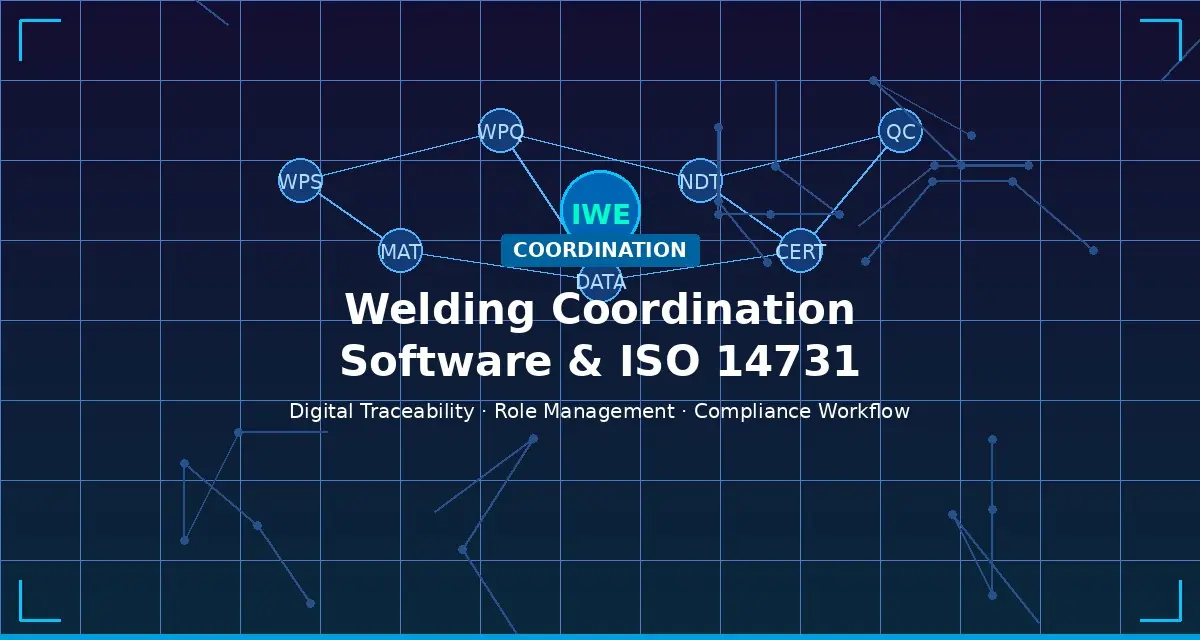
Welding coordination software is becoming essential for manufacturers that need to prove who was responsible for welding quality decisions, which procedures were approved, what qualifications were valid, and how production records connect back to controlled workflows. In plants where this coordination still lives in spreadsheets, email threads, and tribal knowledge, the biggest risk is not only inefficiency. It is loss of control.
That loss shows up during audits, customer complaints, internal deviations, and launch reviews. Teams know the work was done, but they cannot retrieve the full chain of responsibility quickly enough. Which coordinator approved the procedure? Which qualification supported the process? Which revision was active when the part was welded? Which nonconformance triggered the review? If those questions require hours of reconstruction, the system is too fragile.
This matters because welding coordination software is not just a document repository. Done well, it becomes the operating layer that links responsibility, procedure control, traceability, and corrective action. For manufacturers working under ISO 3834 or customer-specific welding requirements, that linkage directly affects audit readiness and production risk.
If you are improving digital welding governance, this article pairs well with our guides on welding procedure specification software, ISO 15614 welding procedure qualification, and welding traceability software with MES and ERP integration.
The value of welding coordination software is simple: it makes responsibility visible, approvals controlled, and traceability retrievable before an audit or quality event forces a scramble.
What welding coordination means in practice
In many companies, welding coordination is discussed as a role but managed as an informal habit. One engineer reviews procedures, another person approves records, a supervisor answers shop-floor questions, and quality steps in when something goes wrong. The plant may have experienced people, but not always a system that clearly shows who owns what and when.
That is where the concept becomes operational. ISO 14731:2019 defines welding coordination in terms of tasks and responsibilities. The standard does not exist to create paperwork for its own sake. It exists because weld quality depends on decisions being assigned, understood, and controlled across production.
In practical terms, welding coordination software should help manufacturers manage:
- assigned welding quality responsibilities,
- procedure approval and revision workflows,
- links between WPS and qualification evidence,
- oversight of welding personnel competence and authorization context,
- nonconformance escalation and corrective action,
- retrieval of records during audits, customer reviews, and investigations.
Without a software layer, many of those tasks are handled manually. That usually works at low volume. It breaks when the business adds more materials, more customers, more weld families, or tighter documentation requirements.
Why spreadsheets and shared folders stop scaling
The hidden problem with manual coordination is not only that it is slow. It is that it creates inconsistent evidence.
A spreadsheet can list who the welding coordinator is. A shared folder can store procedures. A PDF can show approvals. But when a quality event happens, teams need the relationships between those records, not just the files themselves.
Typical failure points include:
- unclear ownership when multiple plants or shifts are involved,
- procedure revisions approved in one place but not communicated everywhere,
- qualification evidence stored separately from released procedures,
- operator or supervisor questions resolved informally with no visible decision trail,
- NCR and CAPA records disconnected from the procedure or approval chain.
When welding coordination is not systematized, manufacturers often overreact to quality incidents because they cannot quickly isolate who approved what, which revision was active, and which production lots were affected. That expands containment cost and slows customer communication.
This is why coordination has to move beyond static documents. It needs workflow, status, ownership, and traceable links.
What good welding coordination software should control
The strongest systems do not just store records. They manage the quality logic that connects them.
1. Responsibility mapping
The system should clearly identify who is responsible for specific welding-quality tasks. That may include approval authority, review authority, technical support, deviation review, and final release responsibility. The exact structure varies by manufacturer, but ambiguity should not.
2. Procedure governance
A coordination platform should link responsibilities directly to WPS approval, revision control, and qualification coverage. That creates a visible chain from technical approval to shop-floor execution.
This becomes even more important when teams are managing digital workflows under ISO 15614 or maintaining complex WPS libraries across multiple product families.
3. Qualification and competence context
Coordination decisions should not float independently from competence records. The software should make it easy to connect procedure families, required knowledge, relevant authorizations, and supporting evidence without forcing teams to search across disconnected systems.
4. Deviation and escalation workflows
When a welding issue appears, the system should route the event into a defined review path. If a parameter goes out of limit, if a record is missing, or if a procedure is questioned, teams need an auditable process for assessment and action.
5. Retrieval and evidence packaging
During an audit or complaint, the plant should be able to retrieve the relevant package quickly: released procedure, supporting qualification record, approval history, related nonconformances, and production context.
If that package takes half a day to reconstruct, the software is not solving the core coordination problem.
Where ISO 14731 and ISO 3834 fit together
A lot of manufacturers treat standards separately when they should think operationally. ISO 14731 focuses on welding coordination tasks and responsibilities. ISO 3834-2:2021 defines comprehensive quality requirements for fusion welding of metallic materials. In practice, the two are connected.
ISO 3834 requires control of procedures, personnel, equipment, records, and quality-related activities. ISO 14731 clarifies the responsibility structure behind many of those activities. Software becomes valuable because it makes that connection visible in day-to-day work.
A digital coordination workflow helps answer questions such as:
- Who approved this welding-related quality decision?
- Which record supports that approval?
- Which procedure revision was valid at the time of production?
- Which deviation triggered review or corrective action?
- Which lots, jobs, or parts are linked to that record set?
That is also why many manufacturers pair coordination workflows with welding NCR management and broader welding QMS software.
Key features buyers should evaluate
Not every system marketed as welding software is designed for real coordination control. Buyers should pressure-test five areas.
Workflow-driven approvals
The platform should support structured review and approval paths, not just file uploads. A released record should show status, approvers, timestamps, and effective date.
Traceable record relationships
The software should connect procedures, qualifications, nonconformances, and production references in a way that can be searched and reported. Flat storage is not enough.
Role-based visibility
Welding coordinators, QA managers, supervisors, operators, and auditors need different views. The right people should see the current released information without gaining uncontrolled edit access.
Change impact visibility
When a procedure or requirement changes, the system should help teams understand what else is affected: active jobs, controlled documents, training needs, or investigations already in progress.
Audit-speed retrieval
This is a practical buying test. Ask vendors to simulate retrieval of a full welding-quality record package in under a minute. If they cannot show it, expect friction later.
How welding coordination software improves daily operations
The operational benefit is usually bigger than the audit benefit.
First, decisions become easier to standardize. Instead of relying on memory or email history, teams work inside consistent workflows. Second, escalation becomes faster. When something is unclear, the system routes the issue to the right owner. Third, customer response gets stronger because the plant can retrieve and explain its records quickly.
This has a measurable impact on quality performance:
- fewer delays caused by approval ambiguity,
- less revision confusion on the shop floor,
- faster root-cause analysis,
- tighter containment during deviations,
- better confidence in customer and certification audits.
In short, the plant spends less time proving control after the fact and more time maintaining control in real time.
The connection to digital welding traceability
Coordination software is most powerful when it does not operate alone. It should connect with production traceability.
That means procedure revisions, approvals, and quality decisions should be linked to the actual weld event, batch, part, or work order when possible. This is where digital systems create a real advantage over paper workflows.
For teams building that digital thread, AWS D1.1/D1.1M:2025 is a relevant code reference for many structural applications, while Wikipedia: Welding procedure specification can help non-specialist stakeholders understand the procedure context. At the broader manufacturing-data level, NIST Technical Note 1820 is a useful reference for digital-thread thinking across production systems.
Once coordination records are linked to execution records, manufacturers can move from reactive document hunting to proactive control.
Common implementation mistakes
Mistake 1: treating coordination as a people-only problem
Experienced personnel matter, but experience without a controlled system does not scale reliably.
Mistake 2: digitizing files without digitizing decisions
Uploading PDFs into a portal is not enough. The value comes from approval logic, status control, and record relationships.
Mistake 3: separating coordination from NCR and CAPA workflows
When quality events live in one system and welding governance lives in another, investigations become slower and weaker.
Mistake 4: no retrieval-speed KPI
Manufacturers should measure how long it takes to assemble a welding-quality evidence package before and after implementation. If retrieval time does not improve, the rollout is incomplete.
Mistake 5: overcomplicating phase one
Start with one plant area, one major process family, or one customer-critical workflow. Prove value before scaling.
A strong pilot is a product family with recurring customer documentation requests, multiple active WPS revisions, and frequent quality review touchpoints. The ROI becomes visible quickly.
A practical rollout roadmap
Most manufacturers can implement welding coordination software in four phases.
Phase 1 — Map current responsibility and approval flows
Document who approves what, where records live, how changes are communicated, and where retrieval breaks down.
Phase 2 — Build the record model
Define controlled objects for procedures, qualifications, responsibilities, deviations, and approval history. Normalize naming and status rules.
Phase 3 — Connect to production and quality events
Link the coordination layer to traceability records, inspections, NCRs, and CAPA workflows so decisions are connected to execution.
Phase 4 — Report on governance performance
Track retrieval time, approval lead time, revision churn, repeated escalation categories, and open risk items.
Where Therness fits
Therness helps manufacturers turn welding governance from a fragmented admin burden into a usable digital workflow.
With the HeatCore QMS workflow, teams can manage controlled records, responsibilities, approvals, NCRs, and CAPA in one structured quality workflow. With HeatCore, manufacturers can link live production-monitoring evidence into the traceability chain, making welding-quality oversight more defensible and more actionable.
Explore the Therness product range or watch a HeatCore platform walkthrough to see how monitoring evidence connects to your coordination records.
Need better control of welding responsibilities, approvals, and traceability?
We can help you map your current coordination workflow, identify control gaps, and design a digital rollout that improves audit readiness without adding more admin overhead.
Book a QMS demoFinal takeaway
Welding coordination software matters because it converts responsibility from something assumed into something controlled. That shift improves traceability, shortens audit retrieval, and reduces the risk that critical welding-quality decisions disappear into inboxes and spreadsheets.
For manufacturers under growing documentation pressure, the next step is not more files. It is a better system for decisions, ownership, and evidence.
Therness solution: Welding monitoring system — Every weld inspected in the cycle, with defect flags and the ISO 3834 / ISO 17635 evidence kept per weld.

![Welding WPS Software: Top Tools Compared [2025]](/assets/images/blog/welding-procedure-specification-software.webp)