
Weld Monitoring Cameras Compared: Visualization vs Thermographic AI
Two distinct approaches sit behind the term "weld monitoring camera." Arc-visualization cameras use visible light to help a person see the weld through the glare. Thermographic monitoring with AI measures the weld's heat signature and grades each weld automatically. They are complementary — and they answer different questions.
What each approach is for
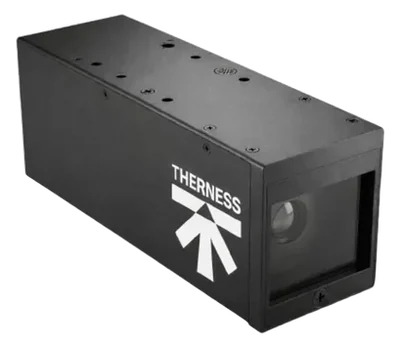
Arc-visualization cameras
Visible-light (and near-infrared) cameras engineered to image the arc and molten pool despite glare, using narrowband illumination and matched filters. They excel at pool geometry, droplet transfer, and arc behavior, and give operators and engineers a frame-accurate view for setup, R&D, and ISO 17637 visual testing. Interpretation of the footage is typically manual.

Thermographic + AI monitoring
LWIR thermal cameras (8–14 µm) measure emitted heat the eye cannot see, paired with AI that scores every weld in real time. They quantify temperature distribution, cooling rate, and heat-driven defect risk, map signatures toward ISO 5817 / ISO 17635, and produce a traceable pass/fail record per weld. This is the basis of the Therness welding monitoring system.
Visualization vs thermographic AI, row by row
| Dimension | Arc-visualization camera (visible light) | Thermographic + AI monitoring |
|---|---|---|
| Imaging principle | Visible / near-infrared imaging of the arc and pool, through filters and illumination. | Long-wave infrared (8–14 µm) imaging of emitted heat; arc does not saturate the sensor. |
| What it detects | Pool geometry, droplet transfer, arc stability, spatter, surface events. | Temperature distribution, cooling rate, HAZ, and heat-correlated porosity / penetration / lack-of-fusion risk. |
| Defect grading | Manual interpretation of footage by an operator or engineer. | Automated AI anomaly scoring against configured acceptance criteria. |
| ISO 5817 / 17635 mapping | Not inherent; supports manual ISO 17637 visual testing. | Thermal signatures mapped toward ISO 5817 / ISO 17635 evidence automatically. |
| Automation / pass–fail | Human-in-the-loop; no automatic verdict. | Real-time pass/fail per weld, suitable for robotic cells with no operator interpretation. |
| Evidence & traceability | Video clips retained for review. | Time-stamped per-weld records linked to weld IDs for audit packs. |
| Typical use | R&D, process qualification, operator guidance, frame-accurate visual evidence. | Production in-process QA, robotic and automated cells, WAAM/DED, code-compliance evidence. |
Swipe to compare →
Therness builds both: a high-speed visual weld-pool camera for visualization, and LWIR thermal cameras with HeatCore AI for automated grading — so you are not forced to pick one axis and lose the other.
When to choose which
Choose visualization when…
You are developing or qualifying a process, tuning parameters, training operators, or you need frame-accurate visual evidence of pool and arc behavior. Start with the PoolDrop high-speed camera.
Choose thermographic + AI when…
You need automated, in-process quality control on a production line — pass/fail per weld, heat-driven defect detection, and audit-ready evidence. Start with HeatCore AI and a HeatCam thermal camera.
Choose both when…
You want maximum defect coverage. Run a thermal and a visual camera on the same weld and fuse the streams under AI scoring for one record — see the full welding monitoring system.
Weld monitoring camera comparison FAQs
What is the difference between arc-visualization and thermographic weld cameras?
Arc-visualization cameras are visible-light sensors that image the arc and weld pool so a person can see the weld through the glare. Thermographic cameras are long-wave infrared (LWIR) sensors that measure emitted heat, so software can quantify temperature and flag heat-driven defects. Visualization shows what the weld looks like; thermographic-plus-AI measures how hot it is and scores it automatically.
Can a weld monitoring camera grade welds automatically?
A camera alone does not grade welds — it produces images. Automated grading requires AI software that scores each weld against acceptance criteria. Thermographic-plus-AI systems map thermal signatures toward standards such as ISO 5817 and ISO 17635 and output a pass/fail decision per weld, whereas visualization footage is typically interpreted manually.
Does camera-based monitoring replace NDT?
No. In-process monitoring catches drift early, prevents defects, and produces traceable evidence, but code-mandated NDT requirements depend on your standards, customers, and risk profile. Most teams use monitoring to reduce defects and to focus expensive inspection where it is actually needed, not to eliminate NDT.
Compare both approaches on your own welds
Book a demo to see visualization and thermographic AI side by side on a real weld cell, and we will recommend the right mix.
