Automotive suppliers face a compliance paradox with welding: the process that joins most safety-critical components is also the one that cannot be fully verified after the fact. An incorrectly welded control arm looks identical to a correctly welded one until it fails. IATF 16949 addresses this by classifying welding as a special process and requiring a set of pre-production and in-production controls that go well beyond a standard quality management system. This guide explains what those controls are, how they translate into audit evidence, and where modern monitoring technology closes the gaps that cause most IATF findings.
Welding as a Special Process Under IATF 16949 Clause 8.5.2
IATF 16949:2016, Clause 8.5.2 states that the organization shall have a documented process for controlling special processes. A special process is defined as one where the resulting output cannot be fully verified by subsequent monitoring or measurement — and where deficiencies may only become apparent once the product is in service.
Welding, heat treating, plating, and coating all qualify. For welding, this means:
- Process approval: Customer approval of the manufacturing process (including equipment, parameters, and environment) before series production. This is separate from product approval under PPAP.
- Qualified personnel: Operators and welding engineers must hold current qualifications with records demonstrating continuity of practice, aligned to ISO 9606-1 or customer-specified equivalents.
- Documented procedures: Welding Procedure Specifications (WPS) qualified through Procedure Qualification Records (PQR) per ISO 15614-1 or ASME Section IX, accessible at the point of use.
- Monitoring evidence: Records demonstrating that key welding parameters were within the approved limits for every production weld — not just a sample.
Scope check: Clause 8.5.2 applies to all welding processes used on regulated automotive programs: GMAW/MAG, GTAW/TIG, resistance spot, projection and seam, plasma arc, laser beam, and friction stir welding. If your customer references IATF 16949 and the part involves welding of any structural or safety-relevant feature, the full Clause 8.5.2 regime applies.
Special Characteristics and Their Impact on Welding Control Plans
IATF 16949 and the AIAG APQP process require suppliers to identify and manage Special Characteristics (SCs) — those product features or process parameters where variation beyond limits could compromise safety, regulatory compliance, or fit/function. OEMs designate SCs using symbols defined in their customer-specific requirements: Ford uses the shield (◆), GM uses the triangle with a D, Stellantis uses a filled diamond.
For welded assemblies, common SCs include:
| Characteristic | Example | Typical control method |
|---|---|---|
| Weld nugget diameter | ≥5√t mm per ISO 14373 | Destructive chisel test or ultrasonic C-scan |
| Weld penetration depth | >60% of thinner sheet | Cross-section metallography (periodic) |
| Heat input | 1.5–2.5 kJ/mm per WPS | Inline parameter monitoring (V × A × 60 / travel speed) |
| Interpass temperature | <250°C for S355 | Thermal pyrometer or thermocouple log |
| Post-weld distortion | <0.3 mm profile deviation | CMM or laser scan at fixture check |
Each SC must appear in the Control Plan with a specific measurement method, sample frequency, control limit, and reaction plan. An IATF auditor will check that the Control Plan is current, that the actual process data matches the plan, and that any out-of-control events triggered the documented reaction.
Common finding: The Control Plan lists interpass temperature as an SC with a 100% measurement requirement, but production records show only one temperature check per lot. The measurement method in the plan and the actual measurement frequency must match — and both must be adequate to detect process drift before non-conforming product is produced.
How CQI-15 Translates IATF 16949 into a Welding Audit Tool
AIAG CQI-15 (Welding System Assessment) is not part of IATF 16949, but it is the primary mechanism by which OEMs verify that a supplier’s Clause 8.5.2 compliance is real rather than documented. Ford, GM, Stellantis, BMW, and their first-tier suppliers reference CQI-15 in supplier quality requirements, making it a practical prerequisite for IATF 16949 approval on automotive programs.
CQI-15 maps directly onto IATF 16949 clauses:
| CQI-15 Category | IATF 16949 Clause |
|---|---|
| Management Responsibility | 5.1, 5.3 (quality roles and responsibilities) |
| Process Control | 8.5.1, 8.5.2 (production controls, special processes) |
| Monitoring and Measurement | 9.1 (performance evaluation) |
| Corrective Action | 10.2 (nonconformity and corrective action) |
| Continual Improvement | 10.3 (continual improvement) |
A supplier that passes CQI-15 without Critical findings has effectively demonstrated alignment with the welding-specific requirements of IATF 16949. The converse is also true: CQI-15 findings almost always correspond to IATF 16949 findings when the certification body auditor reviews the same evidence.
Control Plan Requirements for Welded Components
The AIAG APQP Control Plan is the document that ties IATF 16949 compliance together for welded assemblies. It must list every controlled characteristic — both product (dimensional, material, functional) and process (parameter windows, monitoring frequency) — along with the measurement system, sample plan, and reaction plan.
For a typical GMAW frame assembly, a minimum Control Plan will contain:
- WPS reference for each weld joint, with parameter windows (wire feed, voltage, travel speed, shielding gas flow)
- Welder badge scan or login at the welding station — links operator qualification to the production record
- Inline parameter monitoring for any SC welding parameters — automatic flag if voltage or current drifts outside the WPS window
- Interpass temperature check record if base material requires it per WPS
- Visual inspection criteria per ISO 5817 Quality Level B, C, or D as specified by the customer
- Sample destructive test (chisel, peel, or cross-section) at defined frequency for fillet or resistance welds
Missing any of these columns in the Control Plan — or maintaining the plan without updating it when the welding process changes — generates a finding under IATF 16949 Clause 8.5.2 and CQI-15 Category 2.
Linking IATF 16949 to ISO 3834 for Welding Quality Systems
IATF 16949 sets the automotive-specific requirements. ISO 3834 provides the underlying welding quality management framework. Many Tier 1 suppliers pursue ISO 3834-2 (Comprehensive Requirements) certification as the technical backbone of their Clause 8.5.2 compliance, then overlay CQI-15 as the customer-audit readiness layer.
The three-tier structure most auditors expect:
- ISO 3834-2 → quality system for fusion welding: procedures, qualifications, traceability, inspection
- IATF 16949 Clause 8.5.2 → special process controls embedded in the overall QMS
- CQI-15 → customer-specific audit tool verifying that the above is functional, not just documented
Suppliers without ISO 3834 certification can still comply with Clause 8.5.2, but they must demonstrate the equivalent controls through their internal quality system. ISO 3834 provides a recognized, third-party-audited framework that simplifies this demonstration considerably.
FMEA and PPAP for Welded Parts
Process FMEA (PFMEA) for welding must address failure modes specific to the joining process: lack of fusion, porosity, undercut, distortion, incomplete penetration, and spatter inclusion. The AIAG-VDA PFMEA methodology requires that each failure mode be linked to its detection control — which, for welding SCs, means either inline monitoring or a physical test.
PPAP submission for welded components typically requires:
- Design and process FMEA with welding failure modes addressed
- Control Plan with welding SCs identified and measured
- MSA (Measurement System Analysis) for measurement methods used on SCs — including gage R&R for any manual inspection method
- Initial process capability studies (Cpk ≥ 1.67 for SCs) for measurable parameters
- WPS/PQR documentation in the PPAP package, not just on file internally
The PPAP process for welded components has additional documentation requirements beyond standard machined parts — particularly around the evidence that the welding procedure produces consistent results across the full production parameter window, not just at nominal settings.
Digital Monitoring and IATF 16949 Compliance Evidence
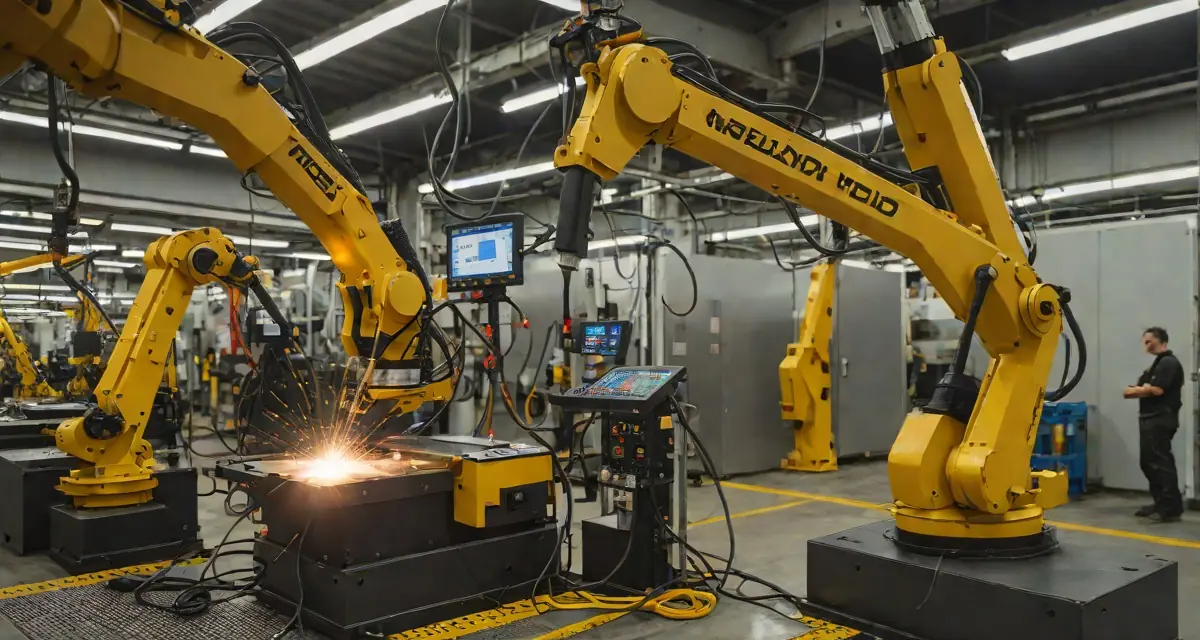
The biggest practical challenge in IATF 16949 welding compliance is generating per-weld process evidence at production volumes. A single shift on a robotic GMAW cell can produce thousands of welds. See an AI weld-monitoring demo on a robotic cell to picture the per-weld evidence generated at that scale. Manual logging at that scale is unreliable and creates audit risk: when an auditor asks for weld records for parts produced on a specific date and shift, the records must exist, be retrievable, and match the WPS parameter windows.
An inline weld monitoring system addresses this directly. Per-weld thermal signatures — recorded at production speed, timestamped, and linked to part serial numbers — provide the continuous process evidence that Clause 8.5.2 and CQI-15 Category 3 require. The same records support PFMEA effectiveness evidence, Control Plan measurement entries, and SPC trend analysis for Cpk monitoring. The HeatCore quality product family provides this monitoring across GMAW, resistance, and laser cells.
The practical output is an IATF 16949 audit where the welding-related evidence review takes minutes rather than hours, because every record is retrievable, indexed, and already structured for the clauses the auditor is checking.
IATF 16949 Welding Compliance Without the Paper Trail
Therness inline monitoring generates per-weld process records that satisfy Clause 8.5.2 and CQI-15 Category 3 requirements automatically — no manual logging, no missing records at audit time.
Book a demoTherness solution: Welding monitoring system — Every weld inspected in the cycle, with defect flags and the ISO 3834 / ISO 17635 evidence kept per weld.
Frequently Asked Questions
What does IATF 16949 require specifically for welding processes?
IATF 16949 Clause 8.5.2 classifies welding as a special process — a process whose output cannot be fully verified by subsequent inspection or testing. This means suppliers must define process controls, maintain qualified procedures (WPS/PQR), keep certified operators, calibrate equipment, and produce per-weld monitoring records. Process approval from the customer is typically required before series production.
Is CQI-15 mandatory for IATF 16949 compliance?
CQI-15 is not part of IATF 16949 itself, but it is referenced as a required special process assessment by major OEMs including Ford (Q1 requirements), GM, and Stellantis. Suppliers on programs from these customers must pass a CQI-15 assessment — effectively making it a contractual condition of IATF 16949 certification in automotive practice.
How do special characteristics affect welding control plans?
Any dimension, parameter, or material property designated as a Special Characteristic (SC) — marked with a shield symbol (◆) or other OEM-defined symbol — must appear in the Control Plan with a specific measurement method, sample frequency, and reaction plan. For welded assemblies, common SCs include weld nugget diameter (spot welding), penetration depth, heat input, and interpass temperature. Each SC requires documented evidence that the control method is effective.
What welding records does an IATF 16949 audit examine?
Auditors typically examine: current WPS documents accessible at the welding station, PQR records supporting each WPS, welder/operator qualification certificates with continuity evidence, equipment calibration records for power sources and measurement devices, Control Plan entries for welded characteristics, and per-lot or per-weld process data records. Gaps in any of these areas generate findings under Clause 8.5.2 or the applicable MSA/SPC clauses.