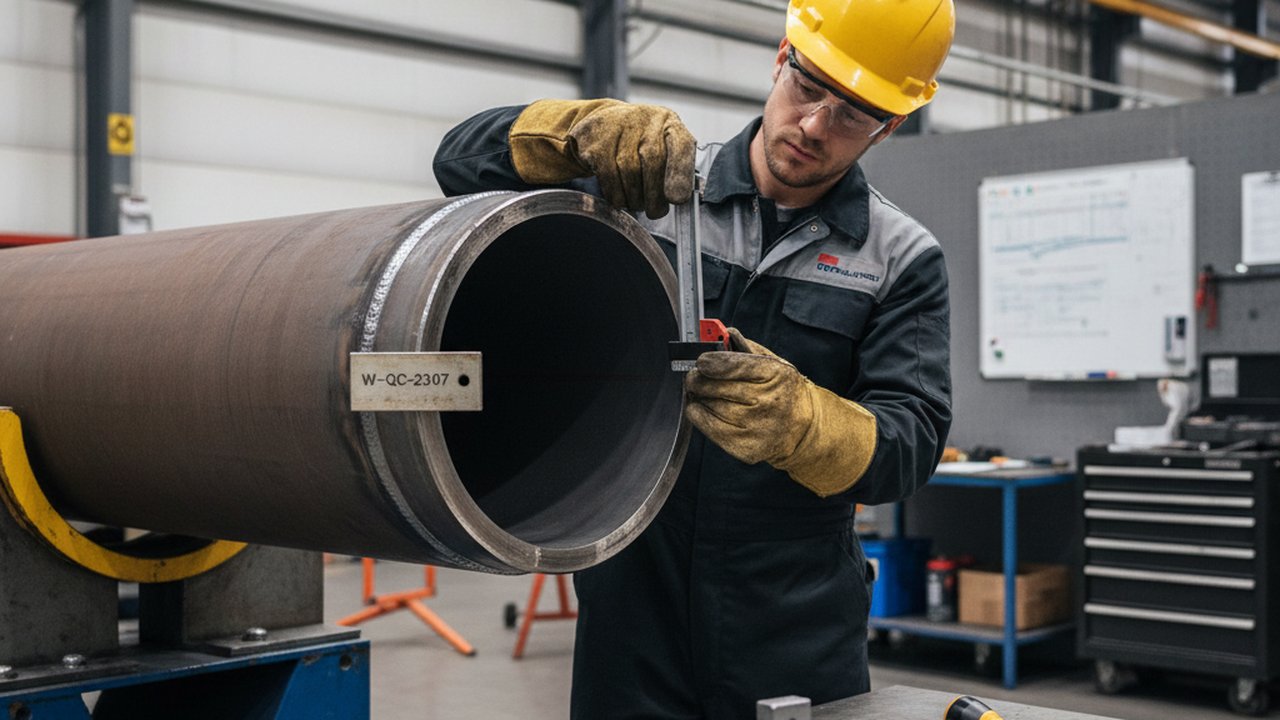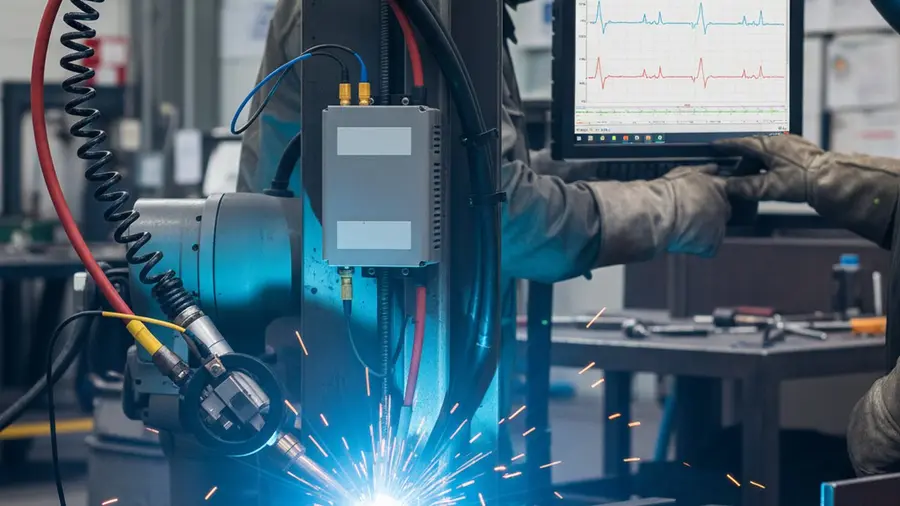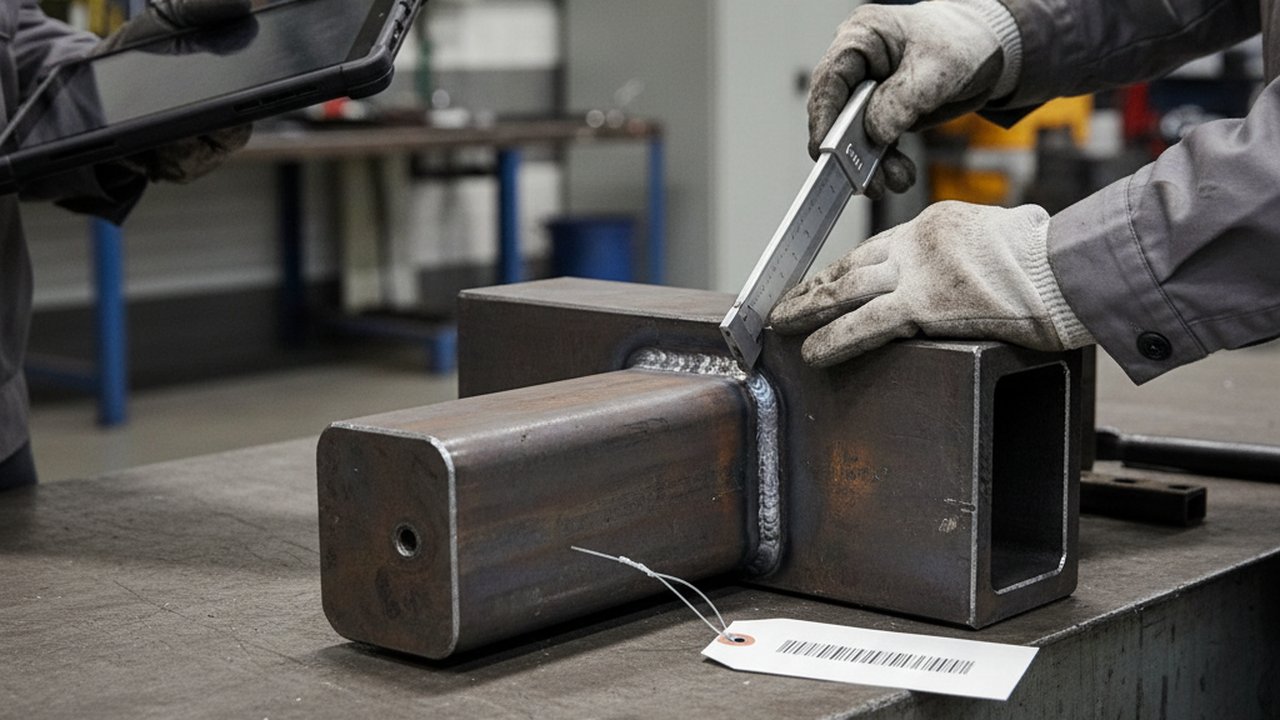
Welding inspection job cards work only when every field, result, and sign-off resolves to the exact joint and production decision it represents. A generic traveler with handwritten initials may follow the part through a workshop, yet still fail when quality personnel cannot prove which WPS revision was used, whether a hold point was released, or who authorized a repair. This guide turns the job card into a controlled traceability record without claiming that one template fits every contract.
Key takeaways
- Give each job card, joint, weld, and pass a stable identity before production begins.
- Separate planned requirements, measured process data, inspection observations, and final disposition.
- Make hold points explicit; absence of a result must never look like approval.
- Record signatures as decisions with role, timestamp, scope, and revision context.
- Link source evidence rather than copying uncontrolled values between systems.
- Validate the job card on normal, repaired, offline, and changed-production cases.
Table of contents
- What welding inspection job cards must control
- Traceability fields and decision framework
- Step-by-step implementation workflow
- Validation and release testing
- Common failure modes and fixes
- Digitizing job cards without losing control
- Frequently asked questions
What Welding Inspection Job Cards Must Control
A job card is the operational bridge between planning and evidence. Before welding, it should state what is authorized: drawing revision, joint reference, WPS, materials, personnel, equipment, inspection plan, and hold points. During production, it records what happened. After production, it carries inspection results and the release, repair, concession, reject, or hold decision.
The ISO 3834-2:2021 catalog entry describes comprehensive quality requirements for fusion welding in workshops and at field installation sites. It is useful context for building controlled production records, but the purchased standard, product rules, contract, and customer specifications decide which records are mandatory for a given job. Never turn a generic blog checklist into a claimed compliance certificate.
Welding coordination matters because record ownership is a technical responsibility, not only an administrative one. The ISO 14731:2019 catalog entry covers essential welding-quality tasks and responsibilities assigned to competent coordination personnel. A plant should map those responsibilities to the job-card workflow: who approves procedures, who verifies qualifications, who releases hold points, and who disposes nonconformity.
The card should distinguish four record layers:
- Requirement: approved drawing, WPS, inspection plan, acceptance basis, and hold point.
- Execution: person or program, equipment, timestamps, consumables, measured parameters, and deviations.
- Inspection: method, coverage, instrument, inspector, observation, result, and evidence.
- Disposition: accept, release, repair, rework, concession, reject, or pending technical review.
An empty field is not a pass. Use explicit states such as not started, not applicable with reason, complete, failed, and awaiting authorization. Blank cells create ambiguity precisely when containment or audit retrieval matters most.
This distinction also prevents a common category error. Process monitoring may flag a parameter excursion, but it does not automatically classify an imperfection or authorize acceptance. The ISO 17635:2025 catalog page provides current general rules for selecting and applying NDT to welds in metallic materials. The approved inspection plan still defines the method and coverage used for the job.
Traceability Fields and Decision Framework
Start with a minimum viable field set, then add only fields required by process risk or governing documents. Too many unused boxes train people to skip fields; missing identifiers force later reconstruction from memory.
| Field group | Minimum useful content | Control question |
|---|---|---|
| Record identity | job-card ID, revision, status, creation and closure time | Can this exact record version be retrieved? |
| Product genealogy | order, part, serial, assembly, drawing revision, joint and weld IDs | Can the result be tied to one physical item? |
| Procedure | WPS ID and revision, process, joint design, position, pass sequence | Was the intended instruction approved and current? |
| Materials | base-material identity, heat or batch where required, consumable batch, shielding gas | Can affected production be contained? |
| Personnel and program | welder/operator ID, qualification reference, robot program and revision | Who or what executed the weld? |
| Equipment | power source, wire feeder, fixture, monitoring and inspection equipment IDs | Was relevant equipment in controlled status? |
| Process evidence | timestamps, setpoints, measured values, alarms, interruption and repair cycle | What did the process actually deliver? |
| Inspection | method, procedure, coverage, location, result, evidence URI, inspector | What was examined and what was observed? |
| Authorization | hold-point release, disposition, role, signature, timestamp, reason | Who made which decision under what authority? |
For procedure context, the ISO 15614-1:2017 catalog page covers qualification of welding procedures by testing within its stated materials and process scope. A job card should reference the actual approved WPS and supporting qualification route used by the manufacturer; it should not duplicate uncontrolled procedure variables in free text.
Personnel identity needs the same discipline. The ISO 9606-1:2012 catalog page covers qualification testing of welders for fusion welding of steels within its scope, while ISO 14732:2025 covers qualification testing of welding operators and weld setters for mechanized and automatic welding. Store the qualification reference and status used by the quality system. Do not infer authorization from a name or employee number alone.
Decide whether a field belongs
Use three questions:
- Does the field control work before or during welding?
- Does it prove an inspection, release, or technical decision afterward?
- Would its absence prevent containment, reconstruction, or audit retrieval?
If all answers are no, keep the field out of the production card. It may belong in an engineering database or analytics dataset instead. The related guide to a production welding dataset for traceability explains how high-rate evidence and label versions can sit behind a concise job card.
Design rule: the card is the controlled index, not the storage location for every waveform, image, certificate, and report. Keep stable links, checksums or version identifiers, and access controls so the indexed evidence cannot silently change.
Step-by-Step Implementation Workflow
1. Freeze the applicable requirements
List contracts, drawings, customer specifications, regulations, product standards, WPS documents, and inspection procedures for the product family. Assign document owners and revisions. If one line serves multiple product classes, create rules that select the correct card variant rather than letting operators choose from memory.
2. Define identifiers and status transitions
Choose immutable keys for job, part, joint, weld, pass, repair cycle, and job card. Define allowed transitions such as planned → released for welding → welding complete → inspection pending → technical review → released. Prohibit a transition that skips an applicable hold point.
A weld map documentation workflow can supply joint and weld identifiers, while digital WPS and PQR records provide controlled procedure context. Reuse those identifiers instead of creating a parallel numbering scheme on the shop floor.
3. Map roles to actions
Build a responsibility matrix for operator confirmation, inspection entry, correction, hold-point release, repair authorization, concession, final release, and record administration. Each electronic permission and paper signature box should match that matrix. Shared accounts and generic initials destroy accountability.
4. Configure fields by process risk
Mandatory fields should change with the job. A manual tack weld, robotic production seam, pressure-containing joint, and repair weld may need different evidence. Use controlled conditional logic: for example, opening a repair cycle requires the affected weld ID, defect or nonconformity reference, authorized repair instruction, new inspection state, and link to the original record.
5. Connect process and inspection evidence
Where production requires measured current, voltage, wire feed, gas flow, travel speed, or temperature, record both source and units. The ISO 17662:2025 catalog entry addresses calibration, verification, and validation of equipment used to control welding process variables in its scope. Link each relevant equipment ID to its valid control status rather than typing “calibrated” into every card.
Therness WeldTrace process-data acquisition can connect measured electrical and wire-feed data to a production identity. The welding parameter monitoring hub explains the difference between recording delivered inputs and evaluating the resulting weld. Neither route should silently overwrite inspector observations or technical disposition.
6. Pilot one representative product family
Run the workflow on enough real jobs to include a normal weld, a stopped cycle, a repair, a rejected inspection, an offline entry, and a shift change. Observe actual operators and inspectors. Remove redundant entry, but do not remove evidence merely because the first pilot happened to pass.
7. Release with version and change control
Approve the form or application version, field dictionary, permission matrix, workflow, training record, export format, backup, and retention policy. Changes to required fields or sign-off routes need controlled release. Historical cards must continue rendering with the definitions used when they were closed.
Validation and Release Testing
Validation proves that the system preserves decisions under normal and abnormal conditions. Test the real interface, permissions, integrations, and exported record—not only the form schema.
Use this acceptance checklist:
- Create a card from an approved order and confirm IDs and current revisions populate correctly.
- Attempt welding release with a missing required qualification, WPS, or equipment-status input; expect a controlled block.
- Record a process interruption and repair cycle; confirm original evidence remains immutable.
- Enter an inspection failure; prove the part cannot reach final release before authorized disposition.
- Correct a mistaken value; retain old value, reason, person, time, and new version.
- Disconnect a station; recover queued records without duplicate cards or reordered events.
- Search by part, weld, person, equipment, WPS revision, and nonconformity reference.
- Export one complete job package and open every linked record with the intended reader role.
Inspection personnel records may refer to the current ISO 9712:2021 catalog page where that certification scheme and method apply. Do not encode “Level 2 always required” as a universal rule: the applicable standard, employer scheme, jurisdiction, contract, and inspection method determine personnel requirements.
For acceptance context, ISO 5817:2023 specifies quality levels for imperfections in fusion-welded joints within its scope. A job card should capture the acceptance basis selected by the governing design or contract, not let an operator choose a quality level from a dropdown without authorization.
After release, track first-review completeness, retrieval time, overdue holds, corrections, out-of-workflow closures, and broken evidence links. Metrics find drift; sampled source records prove whether they are trustworthy.
Common Failure Modes and Fixes
| Failure mode | Consequence | Fix |
|---|---|---|
| One card ID reused across several joints | Results cannot be isolated or contained | Assign stable joint, weld, pass, and repair-cycle IDs |
| WPS title copied without revision | Execution cannot be tied to approved instruction | Resolve WPS from controlled register and freeze revision on release |
| Operator setpoints stored as measured values | Intended and delivered process states become indistinguishable | Store command, feedback, and independent measurement separately |
| Blank inspection box treated as accepted | Unperformed work can pass downstream | Use explicit status and block release until disposition exists |
| Generic initials used for sign-off | Authority and timing cannot be proven | Capture authenticated identity, role, decision, time, and reason |
| Repair overwrites original weld record | Failure history and root cause disappear | Create linked repair cycle and preserve original evidence |
| Attachments copied into uncontrolled folders | Links break and revisions drift | Use managed evidence storage with stable identifiers and permissions |
| Digital form cannot export without vendor UI | Long-term retrieval becomes fragile | Validate open, readable export and retention before release |
Paper is not automatically weak, and digital is not automatically controlled. A numbered paper card with controlled issue, signed corrections, and indexed storage can outperform an editable spreadsheet. A polished application with shared accounts, mutable history, and no offline recovery is not audit-ready.
Digitizing Job Cards Without Losing Control
Digitization should reduce duplicate entry and improve retrieval while preserving technical authority. Start with integrations that remove transcription: order and part identity from MES or ERP, WPS revision from document control, qualification state from the personnel register, equipment status from asset management, and measured values from acquisition systems.
Keep system boundaries visible. ERP can identify an order without deciding acceptance; sensors provide evidence without releasing holds. The workflow should route decisions to authorized roles.
For plants replacing spreadsheets or disconnected forms, quality AI agents and QMS workflow support can help structure controlled fields, evidence retrieval, and responsibility routing. Welding-specific requirements and acceptance decisions still need competent review. The welding process consulting service can map procedures, monitoring, verification, and inspection evidence to the actual production scope.
Security and continuity belong in the release plan. Use least-privilege roles, durable timestamps, audit history, backups, tested restore, offline behavior, and documented ownership. Avoid personal data not needed for traceability; a controlled personnel ID often proves the role.
The final test is simple: select a finished part and ask an independent reviewer to reconstruct the approved requirement, execution context, measured evidence, inspection result, deviation history, and release authority. If that chain depends on tribal knowledge or a person searching several inboxes, the job card is still an index in name only.
Frequently Asked Questions
What is a welding inspection job card?
A welding inspection job card is a controlled production record that connects a specific job, part, joint, weld, procedure, personnel, equipment, inspection step, result, and authorization. It can be paper or digital, but its identity and revision must remain traceable.
Which fields belong on a welding inspection job card?
Core fields include job and part IDs, drawing and joint references, weld and pass IDs, WPS revision, material and consumable traceability, welder or program identity, equipment IDs, inspection method, hold-point status, results, evidence links, disposition, and signatures.
Who should sign off a welding job card?
Sign-off should follow the approved responsibility matrix. Operators confirm execution, inspectors record examinations, and an authorized technical role makes acceptance, repair, concession, or release decisions where required. A signature must identify role, time, scope, and decision.
Can measured welding parameters replace inspection sign-off?
No. Measured parameters show what the process delivered and can support control or investigation. They do not replace required inspection or authorized disposition unless the governing contract, applicable standard, and approved control plan explicitly define that decision path.
How do you validate a digital welding job card?
Test the complete workflow on representative jobs: create records, enforce required fields and hold points, capture offline and corrected data, verify permissions and timestamps, retrieve evidence by weld ID, export a readable package, and prove that unauthorized release is blocked.
How long should welding job cards be retained?
There is no universal retention period for every weld. Set retention from contracts, regulations, product standards, customer requirements, liability needs, and internal policy. Record the rule by job class and ensure linked evidence remains readable for the same period.
Build a Job-Card Workflow That Survives Production and Audit
Therness can help connect welding procedures, measured process data, inspection evidence, hold points, and sign-off authority around your actual production scope.
Discuss Your Welding Traceability WorkflowTherness solution: Welding monitoring system — Every weld inspected in the cycle, with defect flags and the ISO 3834 / ISO 17635 evidence kept per weld.
Frequently Asked Questions
What is a welding inspection job card?
A welding inspection job card is a controlled production record that connects a specific job, part, joint, weld, procedure, personnel, equipment, inspection step, result, and authorization. It can be paper or digital, but its identity and revision must remain traceable.
Which fields belong on a welding inspection job card?
Core fields include job and part IDs, drawing and joint references, weld and pass IDs, WPS revision, material and consumable traceability, welder or program identity, equipment IDs, inspection method, hold-point status, results, evidence links, disposition, and signatures.
Who should sign off a welding job card?
Sign-off should follow the approved responsibility matrix. Operators confirm execution, inspectors record examinations, and an authorized technical role makes acceptance, repair, concession, or release decisions where required. A signature must identify role, time, scope, and decision.
Can measured welding parameters replace inspection sign-off?
No. Measured parameters show what the process delivered and can support control or investigation. They do not replace required inspection or authorized disposition unless the governing contract, applicable standard, and approved control plan explicitly define that decision path.
How do you validate a digital welding job card?
Test the complete workflow on representative jobs: create records, enforce required fields and hold points, capture offline and corrected data, verify permissions and timestamps, retrieve evidence by weld ID, export a readable package, and prove that unauthorized release is blocked.
How long should welding job cards be retained?
There is no universal retention period for every weld. Set retention from contracts, regulations, product standards, customer requirements, liability needs, and internal policy. Record the rule by job class and ensure linked evidence remains readable for the same period.