
HeatCore AI — Automatic Weld Cooling Time Analysis
See HeatCore AI extract T8/5, T12/7, and custom cooling intervals automatically from thermal camera data — enabling microstructure prediction and ISO 13916 compliance without thermocouples.
Key Takeaways
- Automatic T8/5 and T12/7 extraction from live thermal frames — no thermocouples.
- Configurable temperature windows for any alloy procedure or customer spec.
- Per-weld cooling curve logged for traceability and WPS compliance evidence.
- Out-of-range alerts trigger immediate process correction before the part cools.
Deploy with Therness
- Define temperature intervals in HeatCore AI software — T8/5, T12/7, or any custom range.
- Validate against calibrated thermocouples during PQR; use camera-only in production.
- Export cooling-time reports per batch to your QMS or welding data historian.
- Integrate alerts with PLC or robot controller to pause between passes when T too high.
About this clip
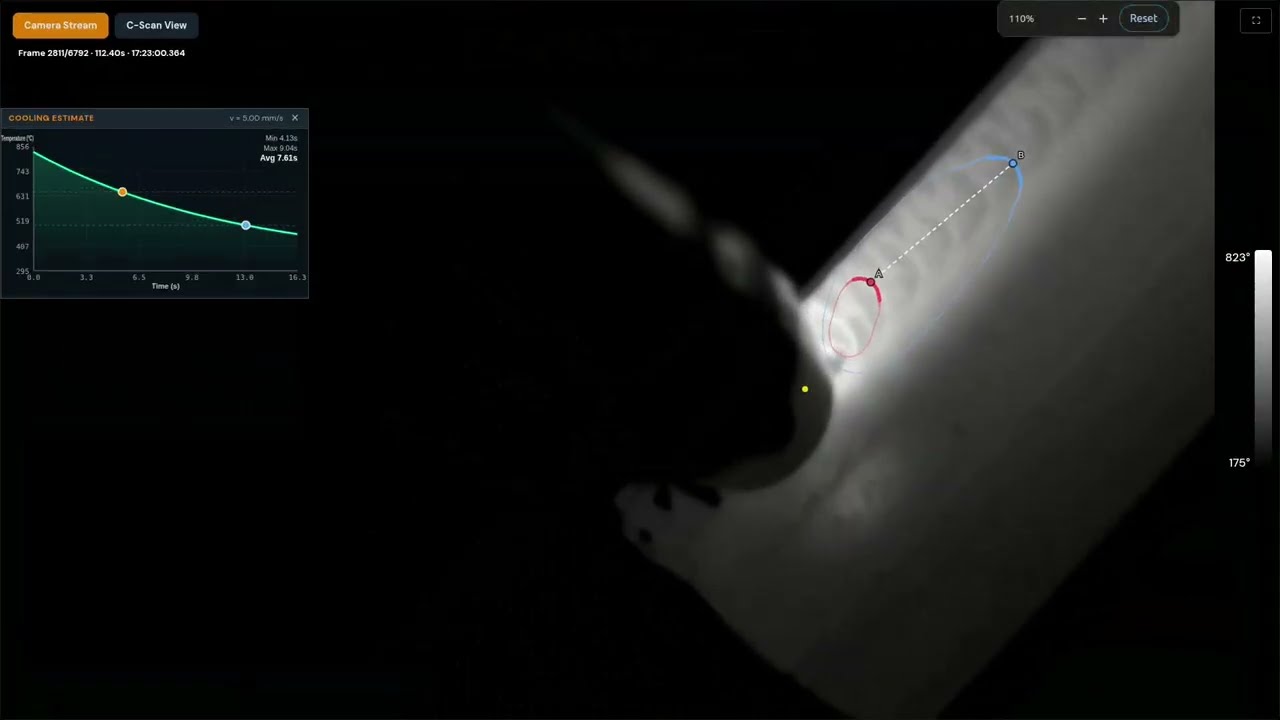
The 800→500 °C window matters because that is where austenite decomposes into the microstructures that decide a weld's fate: fast cooling favours hard, crack-prone martensite in the heat-affected zone, while too slow a traverse can coarsen grains and sap toughness. Conventionally that curve is captured once with a plunged thermocouple on a qualification coupon, then assumed to hold for every production weld afterwards. In this clip HeatCore AI reads the same curve optically from the cooling bead, so the T8/5 is measured on the real part, in the real fixture, at the real interpass temperature — not inferred from a lab coupon welded weeks earlier. Because the whole region of interest is tracked, the software also sees where along the bead the cooling deviates, catching a draft, a heat-sink fixture, or a runaway interpass temperature that a single-point sensor would miss. Keeping the interpass temperature inside its ISO 13916 limits is exactly the kind of control this closes the loop on — decisive for duplex and creep-strength steels, where the acceptable cooling band is narrow.
Related products
Transcript (short)
Show transcript
This demo shows HeatCore AI computing cooling time intervals automatically during arc welding. As the weld pool solidifies and the HAZ cools, the software tracks the time taken to traverse the configured temperature windows — T8/5 by default. Each weld gets its own cooling-time stamp; deviations from the qualified procedure trigger an alert in real time, before interpass temperature or microstructure consequences accumulate.
