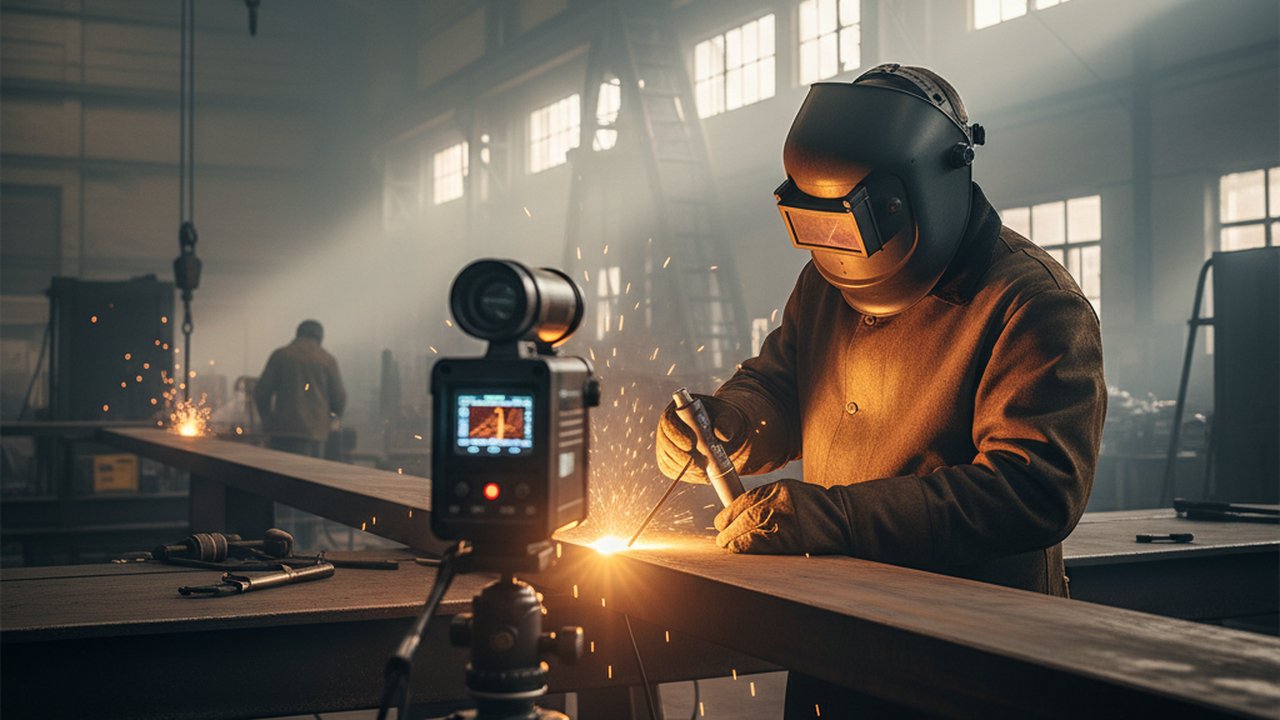
Interpass temperature is one of the most frequently violated welding procedure parameters — and one of the most consequential.
A welder working at production pace on a multi-pass joint has every incentive to skip the temperature check and strike the next arc before the previous pass has cooled to its specified limit. The weld looks fine. The next inspection step is hours away. But if the interpass temperature was 320 °C when the WPS said maximum 250 °C, the grain coarsening in the heat-affected zone (HAZ) is already underway — and the resulting loss of toughness will not be visible until a Charpy test or an in-service fracture reveals it.
This guide covers the physics of preheat and interpass temperature control, the requirements of ISO 13916:2017, the limitations of traditional measurement tools, and how non-contact thermal imaging transforms a manual, error-prone step into a continuous, documented quality gate.
Why Preheat and Interpass Temperature Matter
Before an arc is struck, the base metal temperature — the preheat temperature (Tp) — sets the stage for everything that follows. During a multi-pass weld, the interpass temperature (Ti) governs how much residual heat accumulates between passes. The preheat maintenance temperature (Tm) ensures the workpiece does not drop too cold if welding is interrupted.
These three values appear in every compliant Welding Procedure Specification (WPS) for a reason: they are primary levers for controlling HAZ microstructure, diffusible hydrogen behaviour, and residual stress. They also directly influence weld distortion — interpass temperature in particular affects cumulative thermal shrinkage in multi-pass welds on thick plate.
Hydrogen cracking and the minimum temperature
Hydrogen-induced cold cracking (HICC) is the dominant cracking mechanism in ferritic and low-alloy steels. It requires three conditions: a susceptible microstructure (hard martensite), a hydrogen source (moisture, electrode coatings), and tensile stress. Adequate preheat and interpass temperature attack the first two conditions simultaneously. For a deep dive on the physics and monitoring architecture for HIC prevention, see our dedicated guide on hydrogen-induced cracking prevention with thermal monitoring.
- Slowing the cooling rate keeps the HAZ in a temperature range where austenite transforms to softer bainite or ferrite rather than to brittle martensite.
- Keeping the joint warm prolongs the window for diffusible hydrogen to escape the weld metal before it becomes trapped.
For structural carbon steels, minimum preheat temperatures from 50 °C to 200 °C are typical depending on carbon equivalent (CE) and section thickness. For high-strength low-alloy steels and chromium-molybdenum grades, minimum values of 150–300 °C are common in pressure vessel work.
Sensitization and the maximum temperature
The situation reverses for austenitic stainless steels, duplex grades, and nickel alloys. Here, the risk is not cold cracking from too little heat — it is sensitization from too much.
When austenitic stainless steel spends time in the 450–850 °C sensitization band, chromium carbides precipitate along grain boundaries. The adjacent zones become chromium-depleted and vulnerable to intergranular corrosion. Controlling the interpass temperature to a maximum — typically 150 °C or below — limits the time each pass spends in this dangerous range.
For duplex stainless steels, excessive interpass temperature also shifts the ferrite-austenite phase balance, reducing corrosion resistance and toughness simultaneously.
Rule of thumb: For ferritic steels, preheat temperature is a minimum — go below it and hydrogen cracking risk climbs. For austenitic and duplex stainless steels, interpass temperature is a maximum — exceed it and sensitization risk climbs. Many fabricators work with both material families on the same floor, which makes consistent measurement discipline essential.
ISO 13916: What the Standard Actually Requires
ISO 13916:2017 — Welding — Guidance on the measurement of preheating temperature, interpass temperature and preheat maintenance temperature — defines exactly how and where these temperatures are to be measured. It is referenced by ISO 15614 during procedure qualification and by ISO 3834 as part of the quality requirements framework.
Measurement location
For workpiece thickness up to 50 mm, the standard specifies measurement on the surface facing the welder at a distance A = 4 × t from the longitudinal edge of the groove, where t is the thickness — subject to a maximum of 50 mm. For thicknesses above 50 mm, the required temperature must exist in the parent metal for at least 75 mm in any direction from the joint preparation.
The preferred measurement face is opposite to the side being heated. If that is impractical, the standard requires a thermal equilibration time of approximately 2 minutes per 25 mm of parent metal thickness before the reading is taken.
Measurement timing
- Tp (preheat): Measured immediately before any welding operation begins.
- Ti (interpass): Measured in the weld area immediately before the next run is deposited.
- Tm (maintenance): Monitored continuously during any welding interruption.
Permitted measurement devices
ISO 13916 lists four device categories, identified by suffix codes in the WPS:
| Suffix | Device type | Notes |
|---|---|---|
| TS | Temperature-sensitive materials (crayons, Tempilstik, lacquers) | Indicate only threshold values, no continuous data |
| CT | Contact thermometers (digital contact pyrometers) | Point measurement, requires surface contact |
| TE | Thermocouples | High accuracy, requires permanent or temporary attachment |
| TB | Optical/electrical contactless devices | Pyrometers, infrared cameras |
The TB category — which includes both single-spot pyrometers and full-field infrared cameras — is explicitly permitted by the standard. A thermal camera logs a spatially resolved temperature map, not a single point, and generates a timestamped radiometric image for every frame. That data is directly usable as objective, traceable evidence in a ISO 3834-compliant QMS record.
Limitations of Traditional Measurement Methods
Temperature-indicating crayons and lacquers (TS)
Tempilstik crayons and similar products melt at a known temperature. They are cheap, require no calibration, and are universally available. Their limitations are equally universal:
- They indicate a single pass/fail threshold, not a value.
- They leave no digital record.
- The mark degrades or wipes off before the inspector sees it.
- In a fast-moving shop, the welder marks the plate, reads “melted — OK,” and moves on. No timestamp, no spatial coverage, no audit trail.
Contact thermometers (CT) and thermocouples (TE)
Digital contact pyrometers give a real number. Thermocouples give continuous logging if wired to a data logger. Both require the operator to physically touch the part — a slow and sometimes hazardous step when working near an arc, on overhead joints, or on components at 300 °C.
The bigger problem is measurement gaps. A thermocouple attached to one point on a 3-metre structural beam does not tell you whether the temperature at the mid-span weld is also within specification. A contact thermometer used once per pass misses what happens between passes.
Single-spot pyrometers (TB, single-point)
Non-contact infrared spot pyrometers address the safety issue but not the coverage issue. Their accuracy depends on correct emissivity setting — a value that shifts with surface condition, scale, and oxidation. If the emissivity is wrong by 0.1 on a bright steel surface, the reading error can exceed 30 °C.
More critically: a single-spot reading records one point in time at one location. The WPS may specify a maximum interpass of 250 °C; the pyrometer says 240 °C at the point of measurement; the joint 150 mm away is at 310 °C. The measurement was technically compliant; the weld is not.
Thermal Camera Monitoring: How It Works
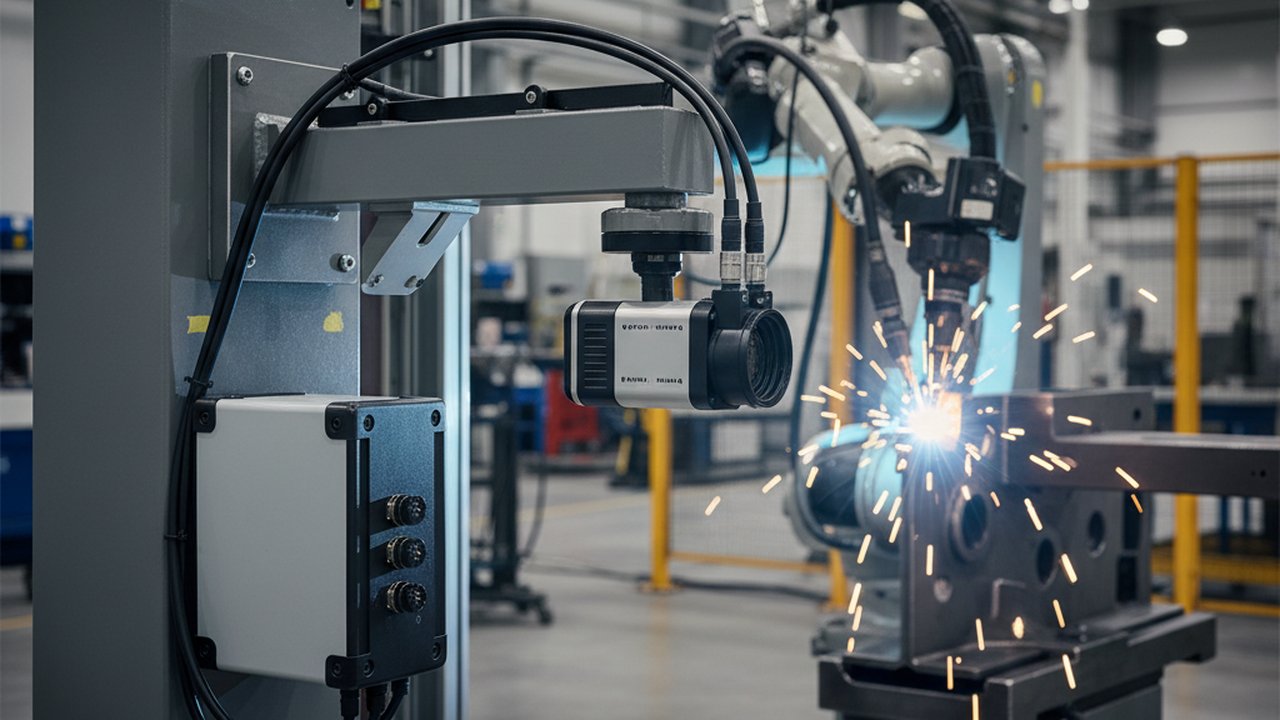
A calibrated infrared camera — such as the HeatCam IR-C LWIR camera, built for continuous interpass monitoring — positioned on a fixed mount or articulated arm above the weld joint captures a full two-dimensional temperature map at frame rates of 25 Hz or higher. Every pixel is a temperature reading. Every frame is timestamped.
For preheat and interpass monitoring, the camera operates in a continuous monitoring mode that:
- Detects the interpass condition — the camera recognises when the arc has extinguished and the weld zone transitions from the arc-active temperature (often above 1400 °C, beyond the camera’s linear range) to the interpass measurement window (typically 50–500 °C depending on material).
- Maps the temperature across the full joint — not just one point. The system identifies the maximum temperature zone and the spatial extent of the heat-affected region.
- Compares against WPS limits in real time — if Ti exceeds the maximum specified for the grade, the system triggers an alert before the welder deposits the next pass.
- Logs a timestamped radiometric record — every measurement cycle produces a data record linking the measured temperature, the timestamp, the pass number, and the WPS limit. This record is automatically stored in the welding data historian and attached to the job traveller.
See thermal cooling-time analysis (T8/5) derived directly from the camera feed for a live example of the radiometric record these systems produce.
Coverage vs single-point: A thermal camera with a 640 × 512 pixel sensor positioned to cover a 300 mm × 240 mm joint area delivers over 300,000 simultaneous temperature readings per frame. A single-spot pyrometer delivers one.
Material-Specific Considerations
Carbon and low-alloy steels (ferritic)
For ASTM A36, S355, P265GH, and similar grades, the primary concern is hydrogen-induced cold cracking. The camera monitors that the joint does not drop below the minimum preheat temperature before the next pass. In cold workshop conditions — winter in northern Europe, unheated fabrication halls — this is a real risk that a one-per-pass spot check misses entirely.
The thermal camera provides a continuous low-temperature alarm: if any zone of the joint drops below the minimum Tp before the arc restarts, the system flags it. The welder is alerted before the next pass rather than discovering the problem during the post-weld inspection.
For high-carbon and high-CE grades (typically CE > 0.43), minimum preheat requirements of 150–250 °C are common. The camera confirms the entire joint — not just the measurement point — meets the minimum before welding resumes.
High-strength and quenched-and-tempered steels (HSLA, Q&T)
Grades such as S690QL, HY-80, or A517 are particularly sensitive to both hydrogen cracking and overheating. Their maximum interpass temperature limits are often set at 200 °C or lower to preserve the strengthening effect of the quench-and-temper heat treatment. The HAZ adjacent to each pass undergoes a local tempering cycle; if Ti is too high, the HAZ is over-tempered and yield strength drops below the minimum required by the design code.
Continuous thermal monitoring with a maximum-temperature alarm is the most reliable way to prevent this.
Chromium-molybdenum steels (P91, P22, 2.25Cr-1Mo)
Used extensively in power generation and petrochemical pressure vessels, Cr-Mo steels require preheat temperatures of 200–300 °C and often must be maintained at temperature (sometimes with post-weld hydrogen bake at 250–350 °C) until post-weld heat treatment (PWHT) is completed. The camera monitors the joint temperature during the entire fabrication sequence and provides documentation that PWHT-relevant hold temperatures were maintained.
Austenitic stainless steels (316L, 304L, 321)
Maximum interpass temperature of 150 °C. The camera catches violations that an intermittent contact thermometer misses. The combination of fast-cooling austenitic material and high-arc-energy GTAW root passes means the temperature swings are rapid; continuous imaging captures the full thermal history.
For sensitization-critical applications — food-grade equipment, chemical process vessels — the camera log provides traceable evidence that the sensitization band (450–850 °C) was transited rapidly and the interpass temperature never exceeded the WPS maximum.
Duplex stainless steels (2205, 2507): Interpass temperature limits are often 100 °C maximum (some procedures specify 150 °C). Exceeding the limit risks sigma-phase precipitation and chloride stress corrosion cracking susceptibility. These are high-value components; the cost of a thermal camera is recovered on a single rework event.
Integration with WPS and QMS
Preheat and interpass monitoring is only useful if the measured data is linked to the correct WPS, the correct welder ID, and the correct weld joint. Therness HeatCore integrates with the the HeatCore QMS workflow workflow to:
- Pull the applicable WPS temperature limits automatically when a job is opened.
- Compare every measured Ti against the limits defined for the specific weld joint and material.
- Flag non-conformances in the NCR workflow for disposition.
- Attach the thermal log to the weld record, satisfying ISO 3834-2 requirements for supplementary weld data.
The inspector does not need to manually enter temperature readings. The camera provides them, timestamped and georeferenced to the weld joint. The digital quality record is complete without paperwork.
Stop relying on crayons to prove interpass compliance
Book a demoPractical Deployment Considerations
Camera placement and field of view
For manual welding on a fixed workstation, a camera mounted on an articulating arm 600–1200 mm from the joint provides a field of view covering 200–600 mm of weld length. This is sufficient for most single-pass and multi-pass bead-on-plate scenarios. For long seam welds on structural sections, two cameras bracketing the joint are preferable. Compare the Therness thermal camera range to match sensor resolution and field of view to your joint length.
For robotic welding cells, the camera is mounted on the robot arm or on a fixed overhead position, with the field of view calibrated to the programmed weld path.
Emissivity correction
Steel emissivity varies from approximately 0.1 (polished, unoxidised) to 0.8+ (heavily scaled or oxidised). Accurate interpass temperature measurement — at 100–300 °C where the surface is not glowing — requires correct emissivity setting. Therness systems apply material-specific emissivity libraries and support in-situ calibration against a reference thermocouple during commissioning.
Training and acceptance
The most common pushback from welders is that the camera will flag violations they would not have caught themselves. This is true — and it is the point. The first weeks of deployment typically reveal a distribution of interpass temperature behaviour that differs from what the welder estimated. This data is constructive: it identifies workstations or procedures where the heat input is higher than expected, cooling fixtures are needed, or preheat lamps are undersized.
Generating ISO 13916 Evidence for Audits
An ISO 3834 audit or an EN 1090 CE marking audit will typically include a review of preheat and interpass temperature records. The auditor wants to see:
- That the measurement device is calibrated and its type is recorded in the WPS (TB, CT, TE, or TS).
- That measurements were taken at the correct location and time as specified by ISO 13916.
- That measured values were within the limits specified in the WPS.
- That non-conformances were identified and dispositioned.
A thermal camera system that logs radiometric images, timestamps, and comparison results against WPS limits satisfies all four requirements without manual paperwork.
Calibration note: TB-category infrared cameras used for ISO 13916 measurement must be calibrated against a traceable reference source. Therness cameras ship with calibration certificates and support field verification against NIST-traceable blackbody sources. Calibration records are stored in the QMS alongside the weld logs.
Summary: From Crayon to Continuous Compliance
| Aspect | Temperature crayon (TS) | Contact pyrometer (CT) | Thermal camera (TB) |
|---|---|---|---|
| Spatial coverage | Single point | Single point | Full-field 2D map |
| Continuous monitoring | No | No | Yes |
| Digital record | No | Manual entry | Automatic |
| Alert capability | No | Manual only | Real-time alarm |
| ISO 13916 compliant | Yes | Yes | Yes |
| Audit-ready evidence | No | With effort | Yes, automatic |
| Emissivity compensation | N/A | Limited | Configurable |
| Integration with QMS | No | Limited | Full integration |
The progression from crayons to cameras is not about replacing the welder’s skill — it is about removing the gap between what the WPS requires and what can actually be verified and documented at production speed. Interpass temperature is a mandatory procedure parameter. Measuring it accurately, continuously, and traceably is a reasonable expectation that thermal imaging makes practical for the first time.
Related Resources
- Heat Input and T8/5 Cooling Rate: Predicting Weld Quality
- ISO 15614 Welding Procedure Qualification: Digital Workflow for Faster WPQR Approval
- SPC for Welding: X-bar/R Charts, Cp/Cpk, and Thermal Limits
- ISO 17662 Welding Monitoring: Calibration, Verification, and Validation Guide
- Pressure Vessel Welding Quality Monitoring: ISO 3834, PED Compliance, and Real-Time Thermal Inspection
- Welding Monitoring System: Continuous Preheat, Interpass and Heat Input Monitoring
Therness solution: Welding monitoring system — Every weld inspected in the cycle, with defect flags and the ISO 3834 / ISO 17635 evidence kept per weld.