
One Pulse, One Drop — Pulsed Arc Welding at 480 fps
Each current pulse pinches off a single droplet and drives it across the arc — synchronized spray transfer, stable and almost spatter-free.

The same clip as a vertical short
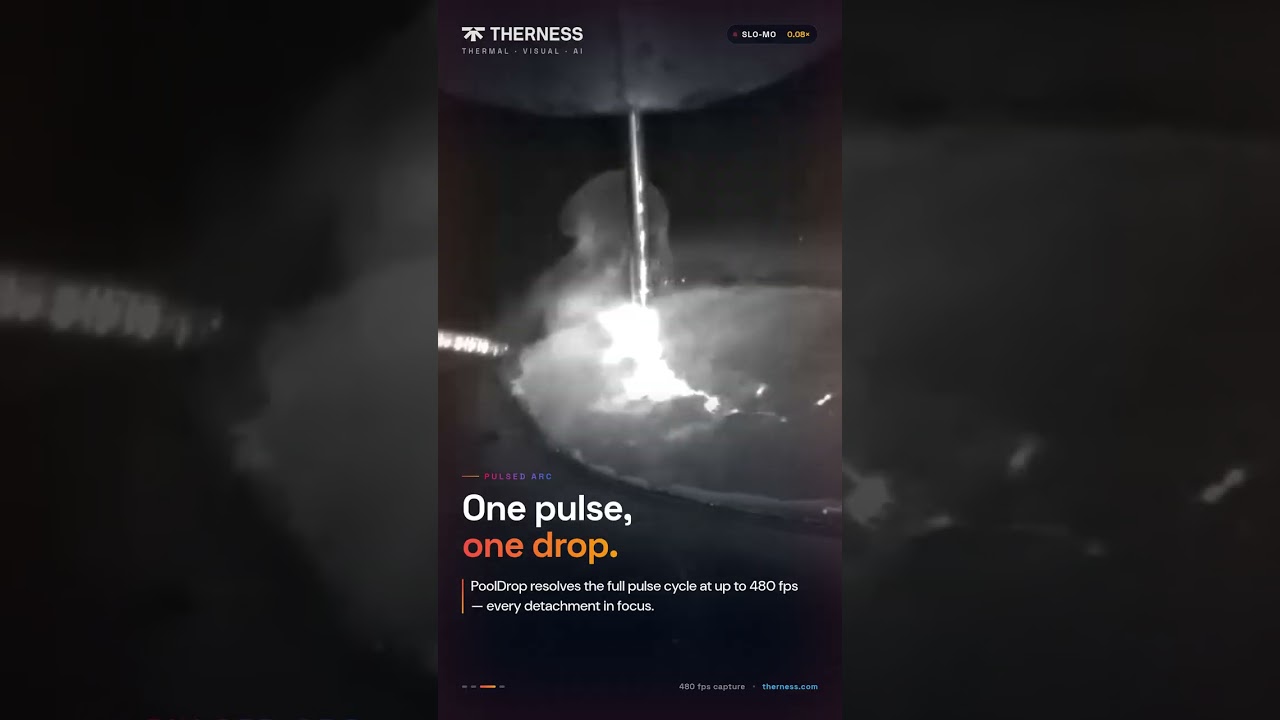
What you see
- One droplet detaching per current pulse, frame by frame.
- Synchronized spray transfer with minimal spatter.
- The wire tip and arc column resolved without glare.
- Reference footage for tuning pulse parameters and droplet timing.
Captured with Therness
- PoolDrop mounts torch-side and films up to 1440 × 1080 px at 240 fps, or 480 fps in high-speed mode.
- Integrated laser-safe lighting suppresses arc glare without extra optics.
- HeatCore AI flags irregular droplet transfer and drift in real time.
- Frame-accurate evidence for ISO 17635 visual testing and parameter optimization.
The physics in each frame
Pulsed spray transfer cycles the welding current between a low background level that keeps the arc alive and a high peak that does the work. Each peak drives an electromagnetic pinch force strong enough to neck the molten tip of the wire and launch a single droplet clear of the electrode — no short circuit, no random globular detachment. At normal speed the eye reads only a smooth, quiet arc; at 480 fps the discrete rhythm resolves, one droplet per pulse, so you can confirm the program is genuinely synchronized. That synchronization is what keeps spatter and fume low and bead width even. When peak current, pulse frequency, or wire-feed speed fall out of step, the camera shows it at once: droplets that detach late, split in two, or drop back into the pool — the same irregularity that seeds porosity and an uneven profile. Frame-accurate footage like this is the reference a 480 fps weld-pool camera exists to deliver, for parameter tuning and for ISO 17637 visual evidence.
Why welders reach for a pulsed program
The appeal of pulsed-MIG is control of heat. Because only the brief current peaks transfer metal, the average current — and with it the heat put into the joint — stays far below what plain spray transfer would demand. That lets a welder run spray-quality transfer on thin sheet, on aluminium, or on an out-of-position joint that would otherwise burn through or sag. The slow-motion view makes the trade-off legible: watch the arc length hold steady as each droplet leaves, and the pool stay small and quick to freeze. Compared with short-circuit dip transfer there is no violent re-ignition and almost no spatter, which is why the finished bead needs little cleanup. For a monitoring system the value is the cadence itself — a healthy program delivers one droplet per pulse like a metronome, so a dropped or doubled transfer becomes a clear, countable event rather than a vague impression. Reading that rhythm reliably comes down to choosing the right frame rate and camera setup.
