
Cold Metal Transfer (CMT) welding at 480 fps
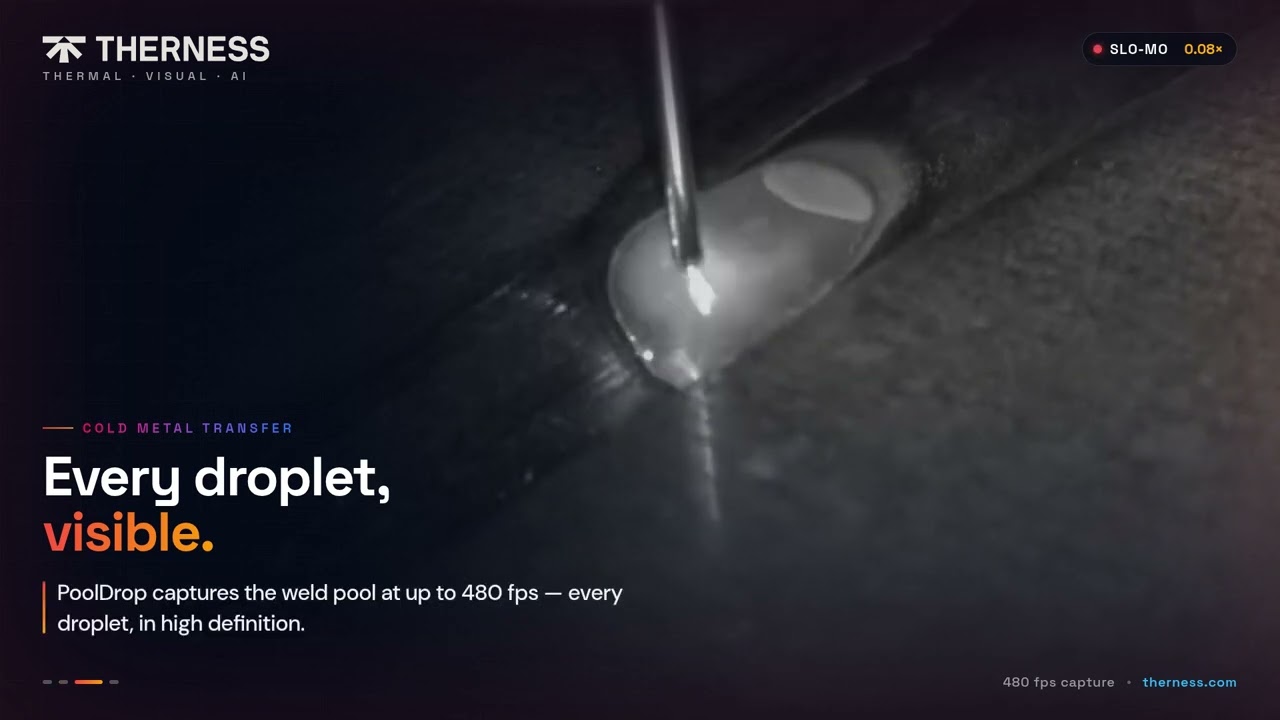
The wire feeds, dips into the pool, then retracts — releasing one clean droplet per cycle. Low heat input, near-zero spatter, exceptional control, filmed at 480 fps.
The same clip as a vertical short

What you see
- The wire dipping into the pool and retracting on each cycle.
- One clean droplet released per short-circuit — no runaway spray.
- Low heat input keeping the pool small and controllable.
- Arc glare filtered out so the transfer stays readable.
Captured with Therness
- PoolDrop mounts torch-side and films up to 1440 × 1080 px at 240 fps, or 480 fps in high-speed mode.
- Integrated laser-safe lighting suppresses arc glare without extra optics.
- HeatCore AI scores transfer regularity and flags instability live.
- Frame-accurate evidence for ISO 17637 visual testing and process tuning.
The physics on screen
Conventional short-circuit MIG relies on the current itself to blow the shorted droplet off the wire, and that violent rupture is what throws spatter. Cold Metal Transfer breaks the cycle differently: the instant the wire touches the pool and the arc shorts, the feeder physically pulls the wire back, and surface tension — not a current spike — draws the droplet into the pool. The heat pulse is switched off during that dip, which is why the pool in this landscape view stays small and the base metal barely glows between cycles. That low, tightly clocked heat input is what makes CMT the go-to for thin sheet, root runs over open gaps, and joining dissimilar or coated metals where burn-through and distortion are the enemy. Reading that one-droplet-per-cycle rhythm frame by frame is the same signal our 480 fps weld pool visualisation guide walks through when tuning a live process.
Why transfer regularity matters
The single most useful thing to watch in this vertical short is the rhythm of detachment: in a healthy Cold Metal Transfer arc exactly one droplet leaves the wire per cycle, at an even beat. That regularity is not cosmetic — it is what keeps heat input constant, pool volume steady, and the bead uniform down the joint. When the beat breaks — a droplet that clings and grows, two cycles that merge, a short that clears too slowly — the arc is dumping heat unevenly, and that is the moment spatter, humping, and localized lack of fusion get seeded. At 480 fps those stumbles are obvious; at production speed they are invisible to the naked eye, which is exactly why a monitoring system scores transfer stability frame by frame rather than trusting a post-weld glance. Captured cleanly, the same footage backs up ISO 17637 visual records and root-cause reviews when a bead is later questioned.
Reading one CMT cycle
Slowed to 480 fps, a single Cold Metal Transfer cycle resolves into two clear phases: a bright arc phase that melts wire and heats the pool, then a dim, controlled short circuit where the wire dips in and the feeder retracts to hand off the droplet. In real time those phases blur into a steady buzz hundreds of times a second; in this vertical short you can actually watch the pool wet out sideways after each hand-off and then relax before the next arc pulse. To a welding engineer that cadence is a quality readout — a droplet that hangs, a short that lingers, or a pool that never fully wets the toe all show up as broken rhythm long before they surface as a lack-of-fusion or cold-lap defect. The vertical framing is deliberately the format reviewed on a phone at the cell, alongside the weld-pool geometry analysis the monitoring stack runs automatically.
