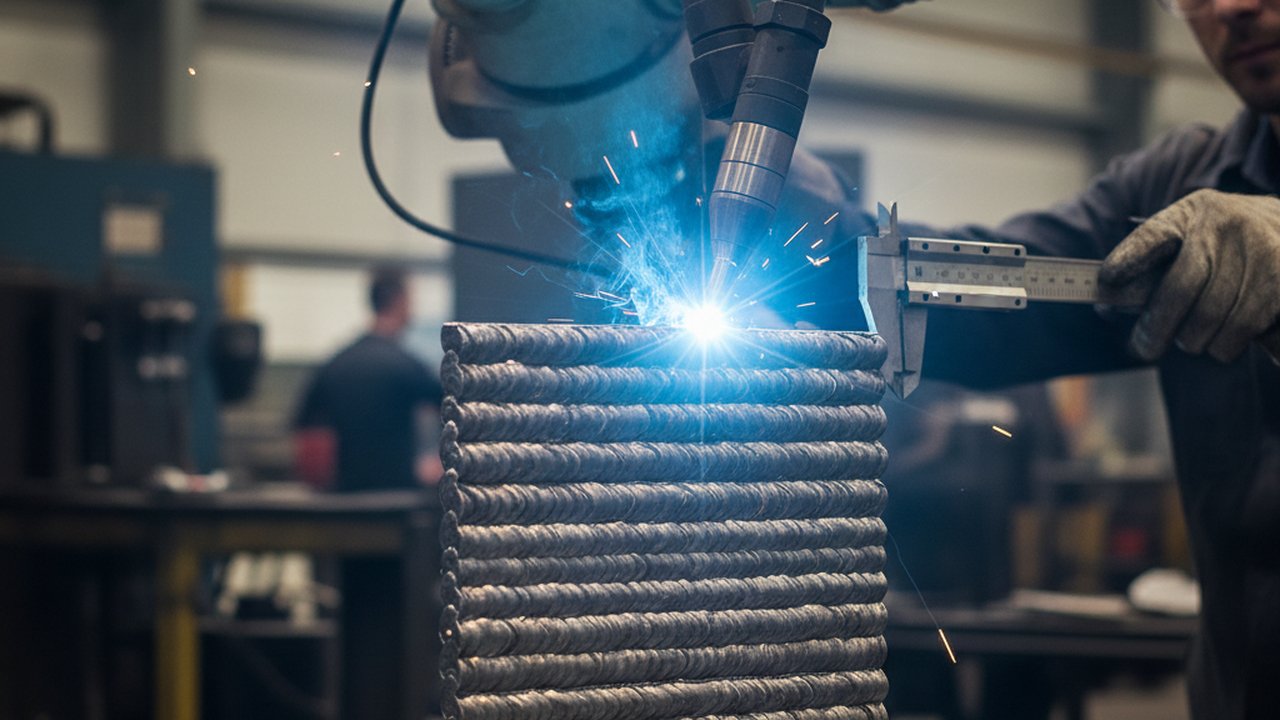
AWS D20.1 WAAM qualification turns wire arc additive manufacturing from a promising process demo into a documented, auditable production capability — the difference between a customer’s quality department signing off on a part and rejecting the whole program for missing paperwork. WAAM sits inside AWS D20.1’s scope as one of the wire-fed, arc-based additive processes the specification covers, but the standard was written for metal additive manufacturing broadly, and fabricators moving from prototype builds to production contracts often discover the qualification requirements only after a request-for-quote already assumes they are in place. This guide walks through what AWS D20.1 actually requires for procedure, machine, and operator qualification, where it overlaps with ISO/ASTM 52920 and DNV-ST-B203, and how to build a qualification package that survives an audit instead of stalling one.
Key Takeaways
- AWS D20.1/D20.1M is the AWS specification for fabricating metal components by additive manufacturing, including wire-fed arc processes such as WAAM, and it governs design, procedure qualification, machine and operator qualification, fabrication, and inspection.
- Qualification under AWS D20.1 runs on three separate tracks — procedure qualification, machine qualification, and operator qualification — and passing one does not substitute for the others.
- ISO/ASTM 52920 qualifies the production SITE (facility, process controls, QMS integration), not an individual part or procedure — many fabricators end up needing a D20.1 procedure qualification running inside a 52920-conformant site.
- DNV-ST-B203 is the standard offshore, marine, and oil and gas buyers typically reference for WAAM parts, and it defines its own qualification levels tied to part criticality.
- Inspection and acceptance criteria for AWS D20.1 qualified parts draw on conventional NDT methods applied to AM-specific defect types — interlayer lack-of-fusion, porosity that varies with build height, near-surface cracking — not defect types copied unchanged from single-pass welding codes.
- The most common reason a WAAM qualification package fails audit is process evidence that documents a target parameter window without proving the window was followed on the actual parts — logged production data, not a paper record, is what an auditor asks for first.
Table of Contents
- What AWS D20.1 Covers — And Why WAAM Fabricators Need It
- The AWS D20.1 Qualification Path: Procedure, Machine, and Operator
- Choosing Between AWS D20.1, ISO/ASTM 52920, and DNV-ST-B203
- Inspection, NDT, and Acceptance Criteria for Qualified WAAM Parts
- Step-by-Step: Building a WAAM Qualification Package
- Common Qualification Audit Failure Modes and How to Fix Them
- Validating and Maintaining Qualification Status Over Time
- Frequently Asked Questions
What AWS D20.1 Covers — And Why WAAM Fabricators Need It
AWS D20.1/D20.1M — Specification for Fabrication of Metal Components Using Additive Manufacturing — is the American Welding Society’s general specification for building structural and functional metal parts by additive processes, covering both powder-bed and wire-fed feedstock. It sets requirements across the full fabrication lifecycle: design responsibility, procedure qualification, machine and operator qualification, in-process fabrication controls, and post-build inspection. Wire arc additive manufacturing falls under the wire-fed, arc-based process family the specification addresses, alongside laser and electron-beam wire-fed systems.
The commercial reason this matters is simple: a growing share of structural and aerospace-adjacent WAAM contracts now cite AWS D20.1 by name in the purchase specification, the same way a conventional welded structure cites AWS D1.1. A shop that has proven WAAM works in the lab but has never run a formal D20.1 qualification package will lose that contract to a competitor with the paperwork already done — not because the parts are worse, but because the evidence trail does not exist yet. This is a particularly sharp gap for shops moving WAAM out of aerospace prototyping (where titanium WAAM builds are common) into structural or pressure-adjacent production, where the buyer’s quality department will not accept a build log that stops at “it looked fine.”
AWS D20.1 is written like a construction specification, not a pass/fail checklist: it defines what the Engineer (the buyer’s technical authority) and the Contractor (the fabricator) must agree on before, during, and after fabrication. Reading it as a single acceptance test misses most of its actual content — the qualification and documentation requirements are where the real compliance work sits.
Because WAAM deposition is fusion arc welding applied layer by layer, an ISO 3834 welding quality management system commonly sits underneath a D20.1 qualification for personnel competency, equipment calibration, and non-conformance handling — AWS D20.1 adds AM-specific requirements on top of a welding QMS, it does not replace one.
The AWS D20.1 Qualification Path: Procedure, Machine, and Operator
AWS D20.1 qualification is not a single certificate — it is three separate, non-transferable tracks that a fabricator has to pass independently, and the most common qualification-audit finding is a shop that treats them as one event instead of three.
| Qualification track | What it proves | Typical evidence |
|---|---|---|
| Procedure qualification | The documented deposition parameters, wire, shielding gas, and build strategy produce a part meeting the required mechanical and metallurgical properties | Procedure qualification record (PQR-equivalent): test coupon build log, destructive test results, NDT results, tied to a specific parameter window |
| Machine qualification | A specific deposition system (robot cell, positioner, wire feeder, power source combination) can reliably execute a qualified procedure within tolerance | Machine capability data, repeatability trials, calibration records for motion and process control axes |
| Operator qualification | The person running or supervising the build can execute the qualified procedure and recognize deviation from it | Operator qualification test build, periodic requalification records, documented process-monitoring competency |
Most of the objective evidence a D20.1 auditor wants for procedure and operator qualification — parameter logs, interlayer condition, weld-pool stability through the build — already has to exist for conventional structural welding under codes like AWS D1.1. The inline monitoring hardware category described on the Therness welding camera page is the same class of equipment WAAM cells increasingly use to generate that evidence automatically instead of relying on an operator’s handwritten log. For thermal-specific evidence at the build surface, HeatCam IR-S is built for exactly this role: it is designed for embedded use inside WAAM and DED cells, reading the deposition zone continuously rather than at spot checks.
A procedure qualification does not carry over automatically when you change wire lot, shielding gas mixture, or deposition strategy (CMT, pulsed, cold-wire-assisted). Each of those changes shifts the heat balance and mechanical outcome enough that AWS D20.1 treats it as a new procedure variable, not a tuning adjustment — see the re-qualification triggers later in this guide.
Choosing Between AWS D20.1, ISO/ASTM 52920, and DNV-ST-B203
Fabricators frequently ask which standard “counts” for WAAM qualification. The honest answer is that these three standards answer different questions, and most production programs end up needing more than one.
| Standard | What it qualifies | When it applies |
|---|---|---|
| AWS D20.1/D20.1M | A specific part-fabrication procedure, machine, and operator | Default reference for general structural and industrial metal AM fabrication, including WAAM, in the US market |
| ISO/ASTM 52920 | The production SITE — facility controls, process monitoring systems, quality management integration | Regulated buyers (automotive, aerospace, rail, medical) increasingly ask for site-level conformance in addition to a procedure qualification |
| DNV-ST-B203 | Parts and processes for offshore, marine, and oil and gas use, with qualification levels tied to part criticality; explicitly covers arc-based directed energy deposition (DED-Arc), which is WAAM | Offshore, marine, and energy-sector buyers, or any contract that names DNV in its specification |
ISO/ASTM 52901 sits alongside these as the standard for what a customer and supplier should exchange at order time for a purchased AM part — order information, feedstock requirements, final part characteristics, and acceptance methods — and it is a useful checklist for structuring a quote even outside a formal audit. ISO/ASTM 52900 supplies the shared terminology across all of these, including the formal classification of WAAM as a directed energy deposition process, which is why the same build can appear in an AWS document as “wire-fed arc AM” and in a DNV document as “DED-Arc” without being a different process.
Do not assume AWS D20.1 qualification satisfies a DNV-ST-B203 requirement, or vice versa. The two standards define qualification levels and evidence requirements differently. Confirm which standard — or combination — the buyer’s purchase specification actually names before you scope a qualification program, not after the coupons are already cut.
Inspection, NDT, and Acceptance Criteria for Qualified WAAM Parts
Once a procedure is qualified, inspection acceptance criteria have to cover the defect population WAAM actually produces, which is not identical to single-pass fusion welding. The standards above draw on conventional NDT methods, applied against AM-specific defect types:
- Radiographic and ultrasonic testing for internal porosity and lack-of-fusion, weighted toward interlayer boundaries — the interface between each deposited layer — rather than a single joint root and cap.
- Penetrant and visual testing for surface-breaking cracking and layer-to-layer stepping, particularly on overhangs and thin walls where geometry control is hardest to hold.
- Porosity gradient assessment through build height, because porosity risk in WAAM is not uniform — it can trend with accumulated thermal mass as a build progresses, which a single mid-build inspection point will miss.
DNV-ST-B203 explicitly defines NDT acceptance criteria for DED-Arc parts, scaled to the part criticality category assigned during qualification scoping — a lower-criticality bracket may accept a documented indication that a higher-criticality part would reject outright. In-process thermal monitoring reduces how much of this burden falls on post-build NDT alone: catching an interlayer condition excursion while the build is running is cheaper and more informative than discovering a subsurface defect after the part is finished and machined. See our companion guide on interlayer temperature control, limits, and defects in WAAM for the process-side half of this picture.
Step-by-Step: Building a WAAM Qualification Package
- Confirm which standard, or combination, the buyer specification names. AWS D20.1 alone, D20.1 plus ISO/ASTM 52920 site conformance, or DNV-ST-B203 — this decision drives every downstream step, so do not skip it.
- Run the procedure qualification test matrix. Build qualification coupons across the parameter window you intend to run in production, and put those coupons through the destructive and non-destructive tests your chosen standard requires.
- Qualify the machine. Demonstrate that the specific deposition system — robot, positioner, wire feeder, and power source combination — repeats the qualified procedure within tolerance, not just once but across a representative production run.
- Qualify operators independently of the procedure. An operator qualification test build confirms the person running or supervising the cell can execute the procedure and catch a deviation before it becomes a rejected part.
- Instrument the cell for continuous, not spot-check, process evidence. Therness’s WAAM monitoring platform is built to generate exactly the kind of per-layer, per-build evidence an AWS D20.1 or DNV-ST-B203 audit expects — logged automatically instead of transcribed by an operator between layers. For a fully engineered cell with monitoring, analytics, and MES/ERP integration built in from the start, HeatCore Robotic covers the hardware side of this step.
- Define the NDT and acceptance plan up front, matched to the defect population described above, not copied from a single-pass welding inspection plan.
- Assemble the documentation package before the audit, not during it. Procedure qualification record, machine capability data, operator qualification records, NDT results, and — critically — production-run evidence that the qualified window was actually followed. A QMS built to hold this evidence together, rather than scattered across spreadsheets and paper travelers, is what quality management consulting for AI-driven QMS is designed to set up.
Common Qualification Audit Failure Modes and How to Fix Them
| Failure mode | Root cause | Fix |
|---|---|---|
| Procedure, machine, and operator qualification treated as one event | Misreading D20.1 as a single pass/fail test rather than three independent tracks | Scope and document each track separately, with its own evidence file, even if they happen in the same test campaign |
| Qualification record shows a target window but no production evidence it was followed | Paper dwell/parameter logs instead of continuous process data | Move to per-layer or per-build automated logging so the qualification window is proven on production parts, not only on coupons |
| Machine qualification not re-run after a cell change | Assuming any robot running “the same procedure” is automatically qualified | Treat a change of positioner, wire feeder, or power source as a new machine qualification, not a like-for-like swap |
| NDT plan copied from a single-pass welding inspection procedure | AM defect population (interlayer lack-of-fusion, height-dependent porosity) not accounted for | Build the NDT and acceptance plan around WAAM-specific defect types, referencing DNV-ST-B203 or the buyer’s AM-specific acceptance criteria |
| Wrong standard referenced for the buyer’s sector | AWS D20.1 assumed sufficient for an offshore or marine contract that actually names DNV-ST-B203 | Confirm the exact standard combination in the purchase specification before scoping the qualification program |
Validating and Maintaining Qualification Status Over Time
Qualification is not permanent. AWS D20.1, like conventional welding procedure qualification, expects re-qualification whenever a controlling variable changes — a new wire lot or supplier, a different shielding gas mixture, a change in deposition strategy such as adding cold-wire assistance, or a significant change in part geometry that moves the thermal history outside the range the original coupons covered. Treating these as tuning adjustments rather than new procedure variables is one of the fastest ways a “qualified” process quietly drifts out of its evidence base.
Ongoing validation, not just the initial qualification event, is what an audit or surveillance visit actually samples:
- Production-run process data compared against the qualified window, with excursions flagged and dispositioned rather than silently absorbed.
- Periodic operator requalification, especially after a gap in running a given procedure.
- Traceability from a specific build’s process record to its NDT results and, where relevant, to destructive test coupons cut from production parts or witness samples.
Treat AWS D20.1 qualification maintenance the same way you would treat a welding procedure specification under an ISO 3834 system: it is a living record that has to match what actually happened on the shop floor, not a document filed once and never revisited. Welding process consulting engagements at Therness frequently start when a re-qualification trigger was missed and only surfaces at the next customer audit.
Frequently Asked Questions
What is AWS D20.1?
AWS D20.1/D20.1M is the American Welding Society specification for fabricating metal components using additive manufacturing. It covers design, procedure qualification, machine and operator qualification, fabrication, and inspection for AM processes built from powder or wire feedstock, including wire-fed arc systems.
Does AWS D20.1 cover wire arc additive manufacturing (WAAM)?
Yes. AWS D20.1 groups WAAM among the wire-fed, arc-based additive processes in its process table, so a WAAM fabricator qualifies procedures, machines, and operators under the same specification a laser or electron-beam metal AM shop would use, with acceptance and inspection requirements adapted to the process.
What is required to qualify a WAAM procedure under AWS D20.1?
A WAAM procedure qualification record documents the deposition parameters, wire and shielding gas, build strategy, and interlayer condition used to produce qualification test coupons, then ties destructive and non-destructive test results on those coupons to the specific parameter window the production procedure must follow.
How is AWS D20.1 different from ISO/ASTM 52920?
AWS D20.1 qualifies a specific part-fabrication procedure, machine, and operator. ISO/ASTM 52920 qualifies the production site itself — facility controls, process monitoring systems, and quality management integration for an industrial additive manufacturing operation. Many fabricators end up needing both.
Does DNV-ST-B203 replace AWS D20.1 for offshore or marine WAAM parts?
Not automatically. DNV-ST-B203 is the standard offshore, marine, and oil and gas buyers typically require, and it sets its own qualification levels tied to part criticality, but contracts can still reference AWS D20.1 for the underlying procedure qualification framework. Confirm which standard the buyer specification calls out before qualifying.
What NDT methods are accepted for AWS D20.1 qualified WAAM parts?
Conventional NDT methods apply — radiographic, ultrasonic, penetrant, and visual testing — selected against the defect types WAAM actually produces, such as interlayer lack-of-fusion, porosity that varies with build height, and near-surface cracking, rather than defect types inherited unchanged from single-pass fusion welding.
Do WAAM machine operators need separate qualification under AWS D20.1?
Yes. Operator qualification is a distinct track from procedure and machine qualification. It demonstrates that the person running the deposition — or supervising an automated cell — can execute the qualified procedure and recognize when a build is departing from it, and it does not transfer automatically between machines or procedures.
Further reading: the AWS D20.1/D20.1M specification page, ASTM F3187’s general guide to directed energy deposition, ASME’s additive manufacturing resource hub, TWI’s overview of arc-based additive manufacturing, NIST’s publication on metal AM standardization for qualification and certification, and a peer-reviewed qualification-oriented cyber-physical framework for WAAM monitoring.
Related on Therness: WAAM monitoring camera setup, field of view, and data integration, wire arc additive manufacturing (WAAM) in titanium aerospace applications, interlayer temperature control, limits, and defects in WAAM, and the ISO 3834/EN 1090 audit checklist for welding manufacturers.
Get Audit-Ready Evidence From Every WAAM Build
Therness inline monitoring logs procedure, interlayer, and build data automatically — the continuous evidence an AWS D20.1 or DNV-ST-B203 qualification audit actually asks for.
Talk to an Engineer See WAAM monitoring on ThernessTherness solution: Welding monitoring system — Every weld inspected in the cycle, with defect flags and the ISO 3834 / ISO 17635 evidence kept per weld.
Frequently Asked Questions
What is AWS D20.1?
AWS D20.1/D20.1M is the American Welding Society specification for fabricating metal components using additive manufacturing. It covers design, procedure qualification, machine and operator qualification, fabrication, and inspection for AM processes built from powder or wire feedstock, including wire-fed arc systems.
Does AWS D20.1 cover wire arc additive manufacturing (WAAM)?
Yes. AWS D20.1 groups WAAM among the wire-fed, arc-based additive processes in its process table, so a WAAM fabricator qualifies procedures, machines, and operators under the same specification a laser or electron-beam metal AM shop would use, with acceptance and inspection requirements adapted to the process.
What is required to qualify a WAAM procedure under AWS D20.1?
A WAAM procedure qualification record documents the deposition parameters, wire and shielding gas, build strategy, and interlayer condition used to produce qualification test coupons, then ties destructive and non-destructive test results on those coupons to the specific parameter window the production procedure must follow.
How is AWS D20.1 different from ISO/ASTM 52920?
AWS D20.1 qualifies a specific part-fabrication procedure, machine, and operator. ISO/ASTM 52920 qualifies the production site itself — facility controls, process monitoring systems, and quality management integration for an industrial additive manufacturing operation. Many fabricators end up needing both.
Does DNV-ST-B203 replace AWS D20.1 for offshore or marine WAAM parts?
Not automatically. DNV-ST-B203 is the standard offshore, marine, and oil and gas buyers typically require, and it sets its own qualification levels tied to part criticality, but contracts can still reference AWS D20.1 for the underlying procedure qualification framework. Confirm which standard the buyer specification calls out before qualifying.
What NDT methods are accepted for AWS D20.1 qualified WAAM parts?
Conventional NDT methods apply — radiographic, ultrasonic, penetrant, and visual testing — selected against the defect types WAAM actually produces, such as interlayer lack-of-fusion, porosity that varies with build height, and near-surface cracking, rather than defect types inherited unchanged from single-pass fusion welding.
Do WAAM machine operators need separate qualification under AWS D20.1?
Yes. Operator qualification is a distinct track from procedure and machine qualification. It demonstrates that the person running the deposition — or supervising an automated cell — can execute the qualified procedure and recognize when a build is departing from it, and it does not transfer automatically between machines or procedures.