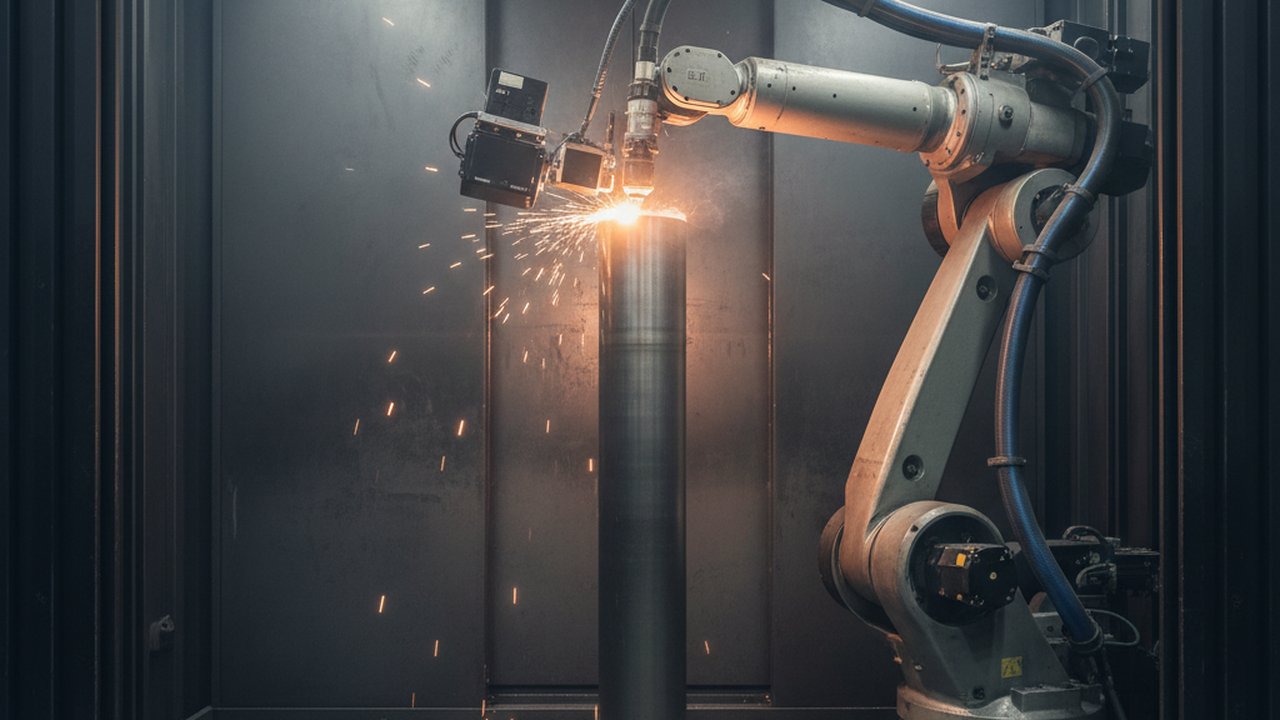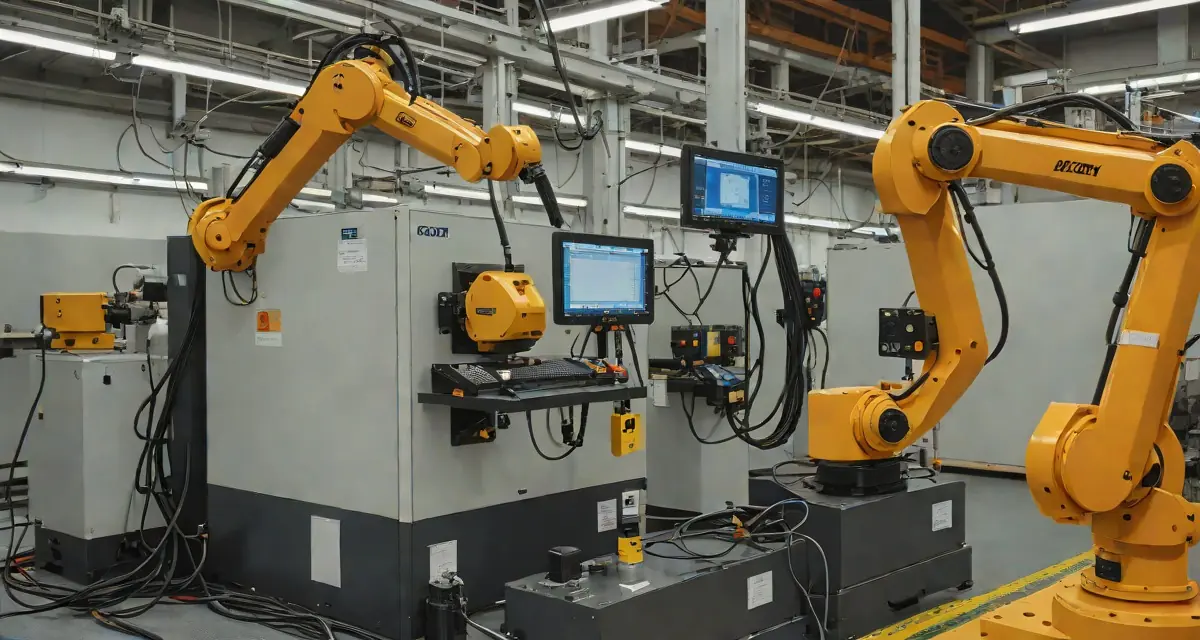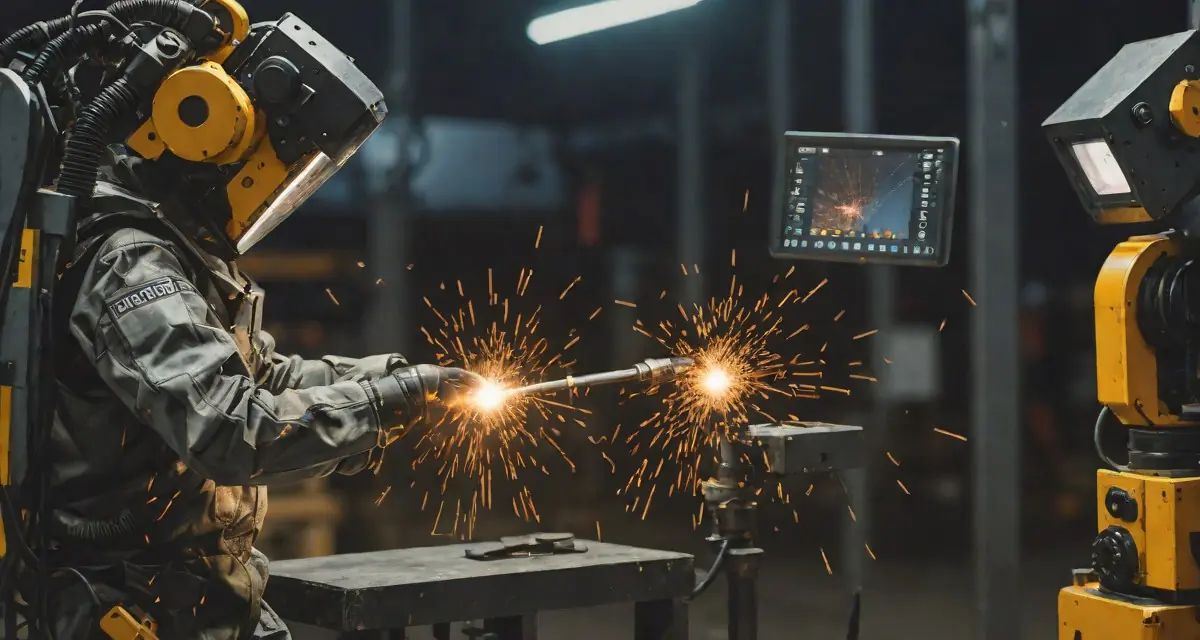
Robotic arc welding has transformed manufacturing—automated cells run around the clock, hold tighter repeatability than any human welder, and scale to high-volume automotive and structural programs without fatigue. Yet the same fixed-program nature that makes robots so productive also creates a blind spot: when something drifts—wire-feed speed, shielding gas flow, fixture geometry—the robot keeps going, building defect after defect until the batch reaches final inspection.
Real-time monitoring closes that gap. By integrating thermal cameras, high-speed vision systems, or hybrid sensor stacks directly into the cell, manufacturers intercept process deviations the moment they appear. The result: defect rates below 1%, rework costs slashed, and documented ROI payback periods of 6–18 months across automotive, structural steel, and pipe-welding applications.
This guide walks through how monitoring works, how to size the business case, and how to integrate it into an existing robotic cell without disrupting production.
The Monitoring Gap in Robotic Welding
Human welders continuously compensate. They see spatter, adjust travel speed, correct torch angle. A robot does none of that—it executes the program. If the program is accurate and the inputs stay constant, quality is excellent. If anything drifts, the robot completes the part and moves to the next one.
Common drift sources in robotic arc welding cells:
| Drift Source | Defect Risk | Detection without Monitoring |
|---|---|---|
| Wire feed instability | Porosity, burn-through | Post-weld RT/UT sampling |
| Shielding gas variation | Porosity, oxidation | Post-weld visual + NDT |
| Fixture wear or drift | Misalignment, lack of fusion | Dimensional inspection |
| Contact tip wear | Arc instability, spatter | Periodic manual checks |
| Part-to-part variation | Incomplete fusion | 100% NDT (rarely economic) |
Without inline monitoring, all these defects reach downstream processes. The cost multiplier from detection at the cell versus detection at final inspection versus field failure is roughly 1x : 10x : 100x—a well-known principle in quality engineering, confirmed by AWS D1.1/D1.1M:2025 structural welding requirements and ISO 3834-2:2021 quality requirements.
Key insight: Monitoring doesn’t replace NDT for conformance—it adds an early-warning layer that prevents defects from propagating, reducing the NDT workload and the cost of non-conformances.
How Real-Time Monitoring Works in a Robotic Cell
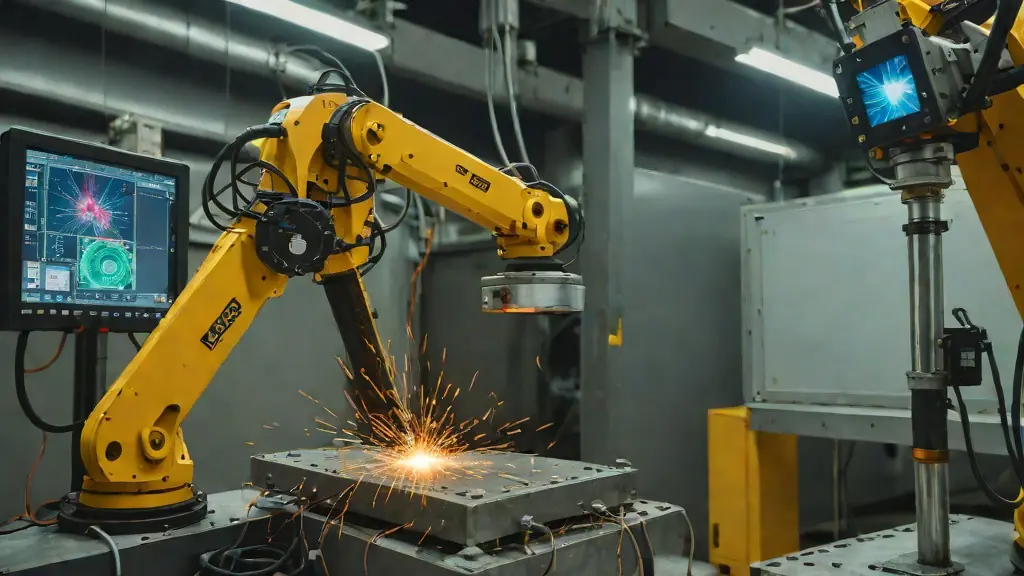
Monitoring systems observe the weld process through sensors mounted near the torch or at the cell perimeter. Data is processed edge-side (on a local compute unit) and either feeds back into the robot controller for adaptive correction, or feeds forward into the quality management system for documentation and traceability.
That diagram is the concept. Here’s what it looks like running on an actual cell—the panel PC interface an operator watches, with the thermal feed, AI defect scores, and process KPIs updating live while the robot keeps welding.

Thermal Imaging: The Workhorse Sensor
Infrared cameras mounted close to the torch capture the weld pool and heat-affected zone (HAZ) at 200–1000 fps. The thermal stream reveals:
- Pool oscillation frequency — a proxy for penetration depth and fusion
- Cooling rate (t8/5) — directly linked to HAZ microstructure and toughness; deviations indicate process excursions (read more on t8/5 and microstructure)
- HAZ width and symmetry — excessive width signals heat input overrun
- Bead toe temperature — predicts solidification cracking risk
HeatCore AI processes these streams in real time, tagging each weld bead with a thermal quality score linked to the WPS parameters and part serial number.
Vision Systems: Bead Geometry and Pool Dynamics
High-speed cameras (500+ fps) with dedicated bandpass filters cut through arc glare to image the weld pool directly. Typical outputs:
- Bead width and reinforcement profile
- Spatter event frequency and intensity
- Wire tip position relative to joint (seam tracking)
- Pool shape asymmetry (arc blow indicator)
Vision and thermal are complementary: thermal sees depth and heat energy; vision sees surface geometry and pool dynamics. Combined, they cover a wider defect space than either alone—a point expanded in detail in AI weld defect detection: thermal vs vision vs acoustic.
Arc Electrical Monitoring: Low-Cost First Layer
Voltage and current monitoring on the welding power supply is the lowest-cost entry point. Arc electrical signatures carry significant information:
- Short-circuit frequency in GMAW → transfer mode stability
- Voltage spikes → contact tip wear or stick-out variation
- Mean current deviations → wire feed issues
Electrical monitoring adds no hardware to the cell (signals come from the power supply) and integrates easily with PLC systems. It’s an excellent complement to thermal or vision monitoring rather than a full replacement.
The ROI Model: Where the Money Comes From
Understanding ROI starts with quantifying what defects actually cost your operation. For a detailed breakdown of weld defect costs by industry sector—automotive, pressure equipment, structural steel, and oil & gas—see our dedicated analysis: Weld Defect Cost: How Real-Time Monitoring Reduces Scrap, Rework, and Liability.
Monitoring ROI comes from four quantifiable categories. For a typical robotic welding cell running two shifts:
1. Rework Reduction (typically 30–50% of savings)
Rework is the largest single cost driver. Industry benchmarks for robotic welding rework range from 2–8% of weld volume in cells without inline monitoring. With thermal or vision monitoring, rework rates drop to below 1% because defects are caught at the cell, not downstream.
Example calculation:
- 500 weld beads/shift × 2 shifts × 250 days = 250,000 beads/year
- At 4% rework rate → 10,000 rework events
- Average rework cost (labor + NDT + scheduling) = €25/event
- Annual rework cost = €250,000
- With monitoring (1% rate) → 2,500 events → savings: €187,500/year
Shops that quote welding work can fold these monitoring savings into their rates — manufacturing quoting software like QuoteBuddy makes that cost build-up explicit.
2. Scrap and Material Cost (20–35%)
When a defective part reaches the end of the line and cannot be reworked, it’s scrapped. In structural and pressure-vessel welding, this means losing the base material, consumables, and all upstream labor. Catching the defect at the cell preserves the part for rework instead of scrapping.
3. NDT Cost Reduction (15–25%)
Real-time monitoring with documented quality data supports a risk-based approach to NDT. Instead of 100% RT/UT on critical joints, manufacturers with inline monitoring can negotiate reduced sampling rates with certifying bodies—often cutting NDT costs by 30–50% while maintaining compliance with ISO 3834 and EN 1090.
4. Throughput and Uptime (10–15%)
Early process drift detection prevents the extended production stops caused by batch rejection. When a drift is caught after 50 beads rather than 5,000, the production impact is contained. Additionally, continuous process data enables predictive maintenance of the welding cell itself—contact tips, liners, and torch bodies replaced on condition rather than on schedule.
Payback calculation: For a monitoring system investment of €40,000–80,000 (hardware + integration), and annual savings in the €80,000–200,000 range for a two-shift robotic cell, payback periods of 6–18 months are routinely documented. Higher-volume cells with tighter quality specs see the shorter end of this range.
Integration Guide: Adding Monitoring to an Existing Cell
Adding monitoring to a running cell is a less disruptive process than most engineers expect. The key is treating it as a parallel data layer, not a replacement for existing controls. You can compare the HeatCore tiers to pick the right monitoring layer for your cell.
Phase 1: Shadow Mode (Weeks 1–4)
Install sensors and begin logging data without triggering alarms or stopping production. This phase:
- Establishes process baseline (what “good” looks like for each joint)
- Maps thermal signatures to NDT outcomes from existing records
- Identifies drift patterns and their lead times
- Lets operators and supervisors see the data without pressure
Phase 2: Alert Calibration (Weeks 5–8)
Enable soft alerts (notifications only, no stops). Tune thresholds to minimize false positives while catching genuine excursions. Key targets:
- False positive rate < 2% (one false alarm per 50 beads maximum)
- True positive rate > 90% on known defect types from Phase 1 ground truth
Phase 3: Full Integration (Week 9+)
Enable automatic cell pause on confirmed excursions. Connect quality scores to the WPS/PQR records per digital welding quality records best practices. Route data into the QMS for CAPA workflows when repeated drift patterns emerge.
Standards Alignment: What Monitoring Evidence Supports
Real-time monitoring data is directly relevant to several key welding quality standards:
- ISO 3834-2:2021 — Quality requirements for fusion welding of metallic materials (comprehensive quality requirements); monitoring directly supports clause 12 (inspection and testing) and clause 14 (records and documentation)
- AWS D1.1/D1.1M:2025 — Structural Welding Code – Steel; monitoring supports WPS compliance verification, prequalified joint conformance, and inspector qualification requirements
- EN 1090 (execution of steel structures) — monitoring data supports the welding coordination and inspection requirements at Execution Classes 3 and 4
Consult your certifying body early to confirm which monitoring outputs can replace or supplement mandatory NDT requirements for your application.
Sensor Selection: Matching Technology to Process
Not every cell needs every sensor. A practical matching guide:
| Process | Priority Sensor | Secondary | Skip |
|---|---|---|---|
| GMAW (MIG) high-volume | Electrical + vision | Thermal | — |
| FCAW structural | Thermal | Electrical | — |
| GTAW (TIG) precision | Thermal (MWIR) | Vision | Electrical |
| Laser welding | Thermal (high-speed) | Vision | Electrical |
| WAAM robotic | Thermal | Vision | Electrical |
For detailed defect-to-sensor mapping, see AI weld defect detection: thermal vs vision vs acoustic.
Getting Started: Three Actions This Week
- Pull your rework log. Calculate actual rework rate per cell for the last 90 days. This is the denominator for your ROI model—if you don’t have the number, monitoring is already justified just to get it.
- Map your drift sources. Walk the cell and list the five most likely drift inputs. Match each to a sensor type from the table above.
- Request a cell assessment. Contact Therness to run a shadow-mode pilot. No production disruption, 4-week baseline, clear ROI projection at the end.
Real-time monitoring in robotic welding is not a research project—it’s an engineering decision with a predictable financial return. The earlier it’s installed, the sooner the payback clock starts.
Watch the demo: Therness AI Weld Monitoring — Robotic Welding & Panel PC Interface
Run a 4-week shadow-mode pilot on one cell
Book a cell assessment and we'll baseline your rework rate, map drift sources, and project the ROI before you commit — no production disruption.
Talk to an engineer See robotic-cell weld monitoringTherness solution: Welding monitoring system — Every weld inspected in the cycle, with defect flags and the ISO 3834 / ISO 17635 evidence kept per weld.