
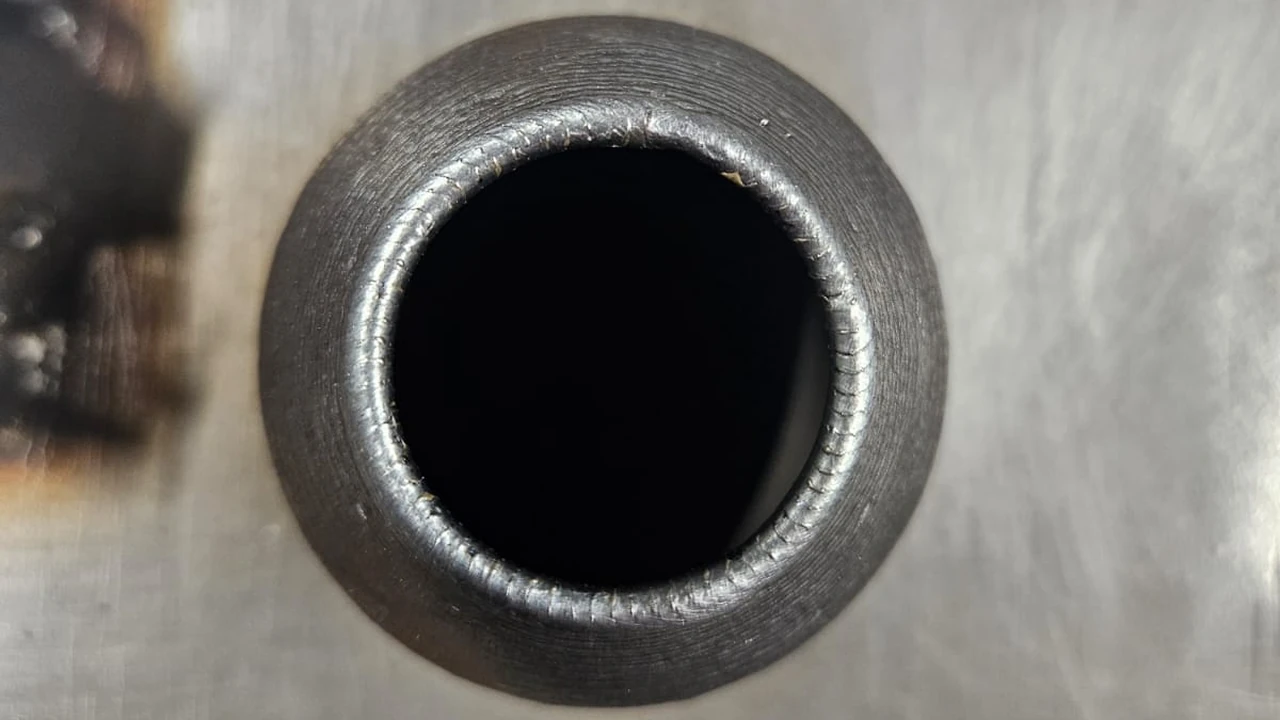
API 650 is the governing standard for welded atmospheric storage tanks used in petroleum, petrochemical, and water storage — covering everything from small lube oil tanks to 100,000-barrel crude oil floating-roof tanks. Its welding requirements span welder qualification, WPS documentation, joint preparation, and a structured NDE matrix that many fabricators underestimate until their first third-party audit.
For quality engineers, the standard’s welding requirements sit at the intersection of fabrication control and integrity assurance. Weld quality in API 650 is not just about preventing immediate leaks — it is about managing fatigue, corrosion initiation, and structural stability over a design life that routinely exceeds 30 years.
This guide covers the key welding requirements under API 650, the NDE obligations by joint category, acceptance criteria, and how real-time in-process monitoring with a welding camera fits into a compliant quality plan.
Scope: when API 650 applies
API 650 covers welded steel tanks for:
- Crude oil, refined petroleum products, petrochemicals, and NGL
- Water, wastewater, and other non-volatile services where a separate specification has not been defined
- Operating pressures up to 2.5 psi gauge (17.2 kPa) — above this threshold, API 620 applies
The standard explicitly does not govern in-service inspection of existing tanks — that is the domain of API 653, which covers tank inspection, repair, alteration, and reconstruction once a tank enters operation.
Understanding where API 650 stops and API 653 starts matters for fabricators who also perform field repair welding. A tank built to API 650 that later requires weld repair during its operational life must be evaluated under API 653 for repair extent and WPS qualification context — a meaningfully different set of requirements.
Welder and WPS qualification
API 650 Annex L specifies that welders and welding operators must be qualified in accordance with ASME Section IX, or an equivalent standard acceptable to the purchaser. ASME IX is the dominant path for North American fabricators; European shops often substitute EN ISO 9606-1 and EN ISO 14732 with purchaser approval.
Key qualification parameters:
| Requirement | ASME IX / API 650 basis |
|---|---|
| Process coverage | Each process qualified separately (essential variable) |
| Position | Limited to test position and lower positions |
| Base material | P-No. 1 (carbon steel) covers the vast majority of API 650 shell materials |
| Preheat | ASME P-No. 1 typically ≥10°C ambient; higher CE steels use ASME or AWS D1.1 preheat tables |
| Continuity | Process must be used within prior 6 months; requalification required if lapsed (ASME IX QW-322) |
ASME IX uses the same 6-month inactivity window as ISO 9606-1, but requires full re-qualification testing when continuity lapses — not just documented employer confirmation. Fabricators qualified under both standards should track continuity against the stricter ASME IX path to avoid surprise re-tests.
WPS qualification requires a Procedure Qualification Record (PQR) generated from a test weld. For API 650 shell seams, the WPS typically covers:
- Processes: SAW and FCAW for shell seams; SMAW or GTAW for nozzle root passes
- Base metals: ASTM A36, A285C, A516 Gr.60/70 (all P-No. 1)
- Joint design: per API 650 detail drawings, groove or fillet as applicable
- Heat input limits: documented where Charpy impact testing is specified for low-temperature service
For pipeline comparison, see the API 1104 welding requirements guide — the qualification framework is similar in structure but diverges on joint geometry and inspection intensity.
Tank joint categories and weld types
API 650 defines weld locations by function. Each carries distinct NDE obligations:
Shell-to-shell joints
Vertical seams (joining adjacent shell plates) are the highest-criticality joints — they carry the full hydrostatic membrane stress. Horizontal seams (joining shell courses) carry lower circumferential stress but require the same documentation discipline.
Bottom plate joints
Tank bottom plates are welded in overlapping or butt configurations depending on plate thickness. Bottom plate welds do not carry hydrostatic head pressure (the foundation supports the load), but they are the primary environmental leak risk. A pinhole in the bottom plate bypasses the entire shell and can cause soil contamination before any level sensor triggers.
Roof and floating roof structure
Fixed and floating roof welds have their own detail requirements, generally with lower NDE intensity than shell seams.
Nozzle and fitting connections
Shell penetrations for inlet/outlet nozzles, instrumentation, and manholes require full-penetration welds with reinforcing pads. NDE requirements scale with nozzle diameter.
NDE requirements by joint type
API 650 Section 8 defines minimum NDE. Purchasers routinely specify additional scope — particularly for large-capacity or high-hazard tanks:
| Joint type | Visual testing | Radiographic / UT | Vacuum box / leak test |
|---|---|---|---|
| Vertical shell seams (T ≥ 10 mm) | 100% both surfaces | 10% minimum RT spot per API 650 §8.1 | — |
| Vertical shell seams (T < 10 mm) | 100% | Spot RT at purchaser option | — |
| Horizontal shell seams | 100% | RT at intersections with vertical seams | — |
| Bottom annular plate welds | 100% | RT of first seam per plate in each lot | Vacuum box (soap solution) |
| Bottom plate butt welds | 100% | — | Vacuum box (soap solution) |
| Nozzles ≥ DN 200 (8 in) | 100% | 100% RT or UT of shell penetration weld | — |
| Nozzles < DN 200 | 100% | Spot RT where accessible | — |
| Repair welds | 100% | RT or UT of entire repaired area | — |
The 10% spot RT figure is a floor, not a ceiling. Purchasers specifying crude oil with H₂S service, low-temperature duty, or seismic zone installations routinely require 100% RT of all vertical seams.
UT as an RT alternative: API 650 permits ultrasonic testing in lieu of radiography for plate thicknesses above approximately 38 mm (1.5 in) where RT geometry is impractical. UT must comply with ASME V Article 4 and meet the acceptance criteria referenced in API 650 §8.1.5.
Weld acceptance criteria
Radiographic acceptance (API 650 §8.1.5)
Radiographic acceptance references ASME Section VIII Division 1, Appendix 4:
- Porosity: individual pore diameter ≤ 20% of weld thickness, max 3.2 mm; clustered porosity within defined area limits
- Slag inclusions: individual length ≤ two-thirds of weld thickness; cumulative in any 150 mm not to exceed weld thickness
- Incomplete fusion / lack of penetration: not permitted
- Cracks: not permitted in any orientation
These limits are broadly comparable to ISO 5817 Level B for the critical imperfection types, expressed in different dimensional terms. Quality engineers familiar with ISO 5817 will find the underlying intent similar — zero cracks, strict limits on volumetric imperfections, absolute prohibition on planar defects.
Visual acceptance
All visible weld surfaces must be free from:
- Cracks in the weld or heat-affected zone
- Undercut exceeding 0.8 mm depth
- Weld reinforcement exceeding 3.2 mm
- Burn-through or unfilled weld craters
- Surface porosity exceeding 1.6 mm diameter
Quality documentation requirements
API 650 fabrication generates a documentation set that must survive the full service life of the tank:
- Weld map: each seam identified with welder ID, WPS reference, and NDE report number
- WPS and PQR records: on file and available for purchaser’s authorized inspector (AI) review
- NDE reports: radiographs or digital RT files with acceptance/rejection status, traceable to seam and individual welder
- Material traceability: mill certificates for shell plate, heat numbers linked to the weld map
- Welder qualification records: current at time of welding, with continuity evidence
All of the above feeds into the Manufacturer’s Data Report (MDR), submitted to the purchaser at handover. Missing documentation after delivery is not recoverable — rebuilding a lost weld map from production records after completion is costly and may require additional NDE to re-establish traceability.
In-process monitoring and API 650 NDE
The API 650 NDE framework is inherently a post-weld sampling approach. Spot RT at 10% identifies defects in the sampled seam locations but cannot detect systematic process drift — a FCAW parameter shift over a 12-hour shift, or SAW flux moisture that progressively increases porosity density below single-film detection thresholds.
Real-time thermal monitoring during shell seam welding — a practical application of thermography NDT — addresses this gap at the source:
- SAW shell seam monitoring: thermal monitoring cameras track heat input distribution and weld pool geometry across the full seam length. Asymmetric cooling signatures indicate lack-of-fusion risk zones before RT sampling occurs — the welder or supervisor can intervene before the full pass is committed.
- FCAW nozzle root passes: continuous temperature profiling detects interpass cooling rate deviations relevant for low-alloy or higher-CE shell steels, where hydrogen-assisted cracking risk increases with inadequate interpass control.
- Multi-pass preheat verification: preheat and interpass temperature compliance per ISO 13916 is directly measurable and loggable, creating an evidence record that supplements the written WPS.
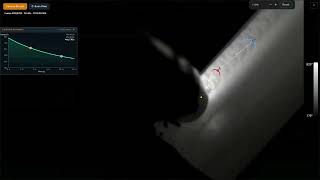
Automated T8/5 (and T12/7 for higher-alloy grades) cooling-time tracking turns the interpass control point above from a spot-check with a contact pyrometer into a per-pass, logged measurement — directly relevant where multi-pass nozzle and repair welds on higher-CE shell steels carry hydrogen-cracking risk. (Watch the HeatCore AI cooling-time analysis.)
The practical outcome is not replacing RT — it is ensuring that an inline weld monitoring system keeps the welds selected for RT sampling representative of a controlled process, and that process deviations trigger corrective action before the inspection point.
After commissioning, the tank moves from fabrication QA into asset integrity, where thermography answers a different set of questions — product level and sludge profile through the shell, insulation breakdown, roof-seal leakage. That work sits under scheduled infrared surveys of plant assets rather than under API 650 NDE, and it is normally set up as a route with a fixed re-inspection interval.
Pre-construction quality planning checklist
Use this as a WPS and quality plan input before first arc:
- WPS and PQR qualified to ASME IX for each process and joint category in scope
- Welder qualifications current — process used within 6 months for each process in scope
- Carbon equivalent calculated for each plate heat; preheat requirements documented in WPS
- Weld map drawn; seam numbering convention agreed with AI before fabrication starts
- RT system calibrated; IQI (penetrameter) type and placement confirmed with AI
- Vacuum box equipment available and leak-check solution qualified for bottom plate joints
- NDE sampling plan documented: which seams are spot-tested and at what frequency per API 650 §8.1
- Repair weld WPS on file — repair welding requires a separate PQR qualification under ASME IX
- MDR format agreed with purchaser before fabrication starts
Key standards references
- API 650 (13th edition) — Welded Tanks for Oil Storage
- API 653 — Tank Inspection, Repair, Alteration, and Reconstruction
- ASME Section IX — Welding, Brazing, and Fusing Qualifications
- ASME Section VIII Division 1, Appendix 4 — Acceptance criteria for radiography (referenced by API 650)
- ISO 5817:2023 — Fusion-welded joints in steel: quality levels for imperfections
- ISO 13916:2017 — Welding: guidance on measurement of preheat, interpass, and preheat maintenance temperature
External references:
- API 650 standard overview — API.org
- ASME Section IX scope and qualifications
- API 653 — in-service tank inspection standard
From API 650 compliance to zero-defect tank fabrication
Therness inline thermal monitoring helps tank fabricators detect process drift in real time — before RT sampling, before repair, before delivery. For continuous thermal monitoring on the shop floor, the HeatCam IR-C is a cylindrical thermal camera for fixed production-line installs — see how it compares to arc-visualization weld cameras.
Book a demo See thermography NDT testingTherness solution: Welding monitoring system — Every weld inspected in the cycle, with defect flags and the ISO 3834 / ISO 17635 evidence kept per weld.


