ASME B31.1 is the Power Piping code. It covers design, materials, fabrication, erection, testing, examination, inspection, operation and maintenance for piping systems within its scope. For a welding job, establish the governing code and edition first; then keep procedure and personnel qualification, production-weld examination, heat treatment and system testing as distinct checks. A qualified procedure or a process-monitoring trace does not, by itself, establish weld acceptance.
Edition check, 27 October 2026: the ASME publisher page lists B31.1-2026. Confirm which edition the contract and jurisdiction adopt for your project. This guide explains the decisions and records to organise; it does not reproduce acceptance tables, prescribe test pressures or claim a clause-by-clause review of the 2026 code.
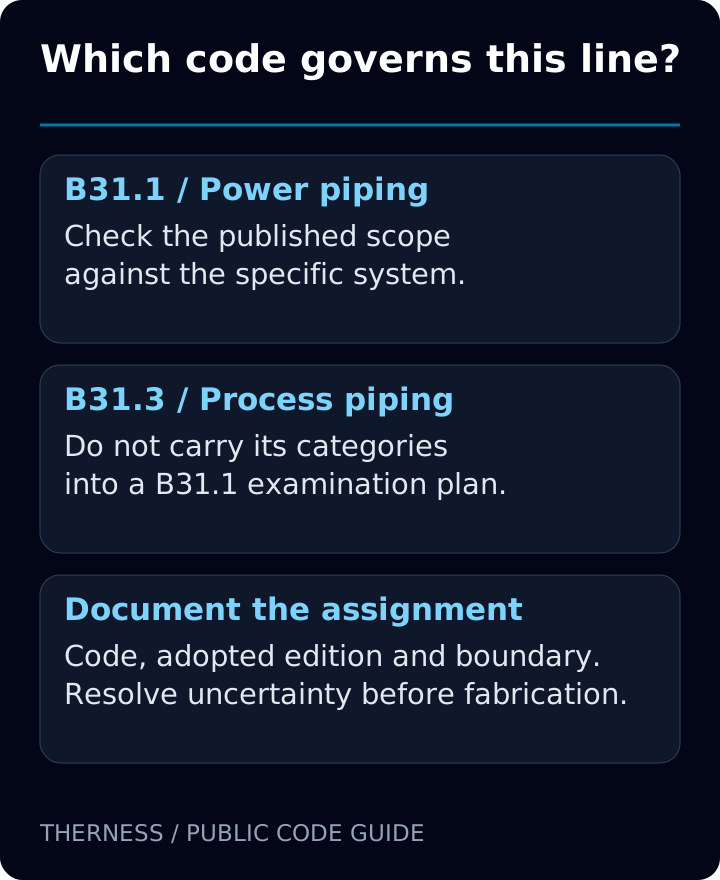
Scope: what puts a piping system under B31.1
B31.1’s published scope includes piping typically found in electric power generating stations, industrial and institutional plants, geothermal heating systems, and central and district heating and cooling systems. It also addresses boiler-external piping within the scope stated by the code.
The practical question is which code governs this particular line and where its boundary lies. Do not decide from pipe size, pressure or the name of the facility alone. Compare the scope with the piping specification and applicable jurisdiction, and have the responsible engineering authority resolve an uncertain boundary before fabrication starts.
Welding procedure and performance qualification
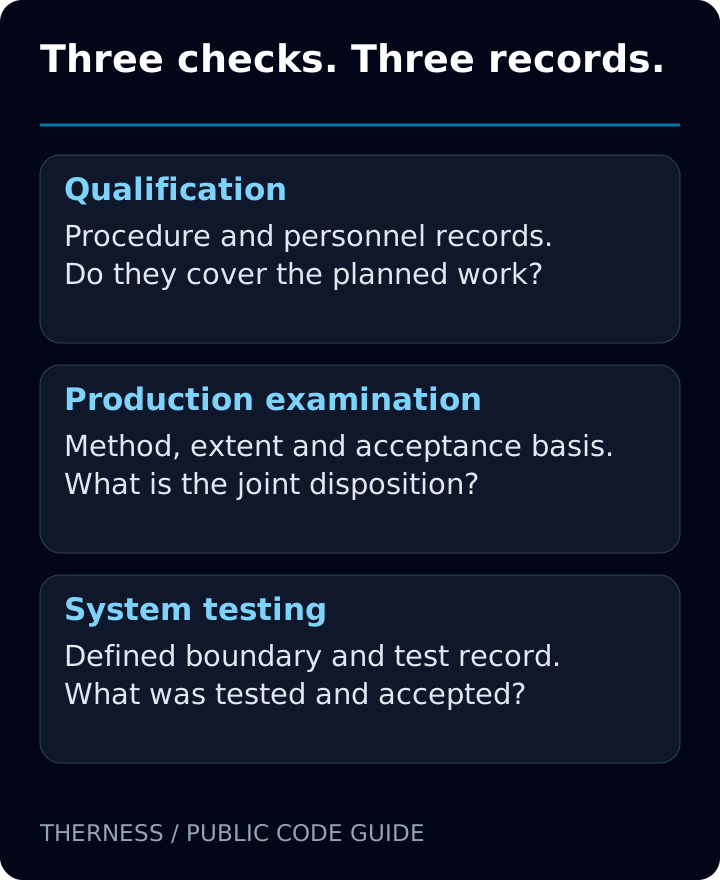
Keep the qualification file separate from the production-weld acceptance file. A Welding Procedure Specification (WPS) describes the procedure; its supporting Procedure Qualification Record (PQR) and the relevant personnel qualification records address qualification. The ASME Section IX guide explains that distinction.
ASME describes Section IX as a qualification standard. Its role is different from the construction code’s requirements for the piping being built. Confirm the applicable qualification references and their editions in the governing B31.1 text, then check that the procedure and personnel records cover the work planned. A qualification record is not an examination report for a production joint.
Examination methods and extent
An inspection and test plan (ITP) should identify the joint, examination method, required extent, acceptance reference and responsible reviewer. Read each requirement from the applicable B31.1 edition and the project specification. Do not import the fluid-service categories or examination percentages of B31.3 into a B31.1 plan.
For each examination result, preserve the method and procedure used, the joint or area examined, the findings and the acceptance disposition with its clause or table reference. A statement such as “NDE passed” without its basis is difficult to review. This guide deliberately gives no standalone numerical acceptance limit: the conditions attached to a code table matter as much as the number.
Post-weld heat treatment
Determine whether PWHT applies from the actual material, joint details, governing edition and project requirements. Do not transfer a temperature, holding time or exemption from a previous job without checking its applicability. The approved procedure and the applicable code text provide the basis for the cycle.
Where PWHT is required, link its procedure and actual temperature/time record to the affected joint or heat-treatment lot. The measurement arrangement must satisfy the applicable requirements. A camera image or a welding-process trace alone does not demonstrate that a required PWHT cycle was completed correctly.
Interpass temperature control
Treat preheat, interpass temperature and PWHT as different controls. Establish the applicable preheat and interpass requirements in the approved welding documentation; do not assume that a PWHT record proves the conditions between welding passes.
The interpass temperature guide explains the measurement question. For a piping dossier, identify which joint and pass a reading belongs to, the measurement basis and the procedure reference. No universal temperature for every B31.1 material can be inferred from the code’s title.
Building the evidence trail
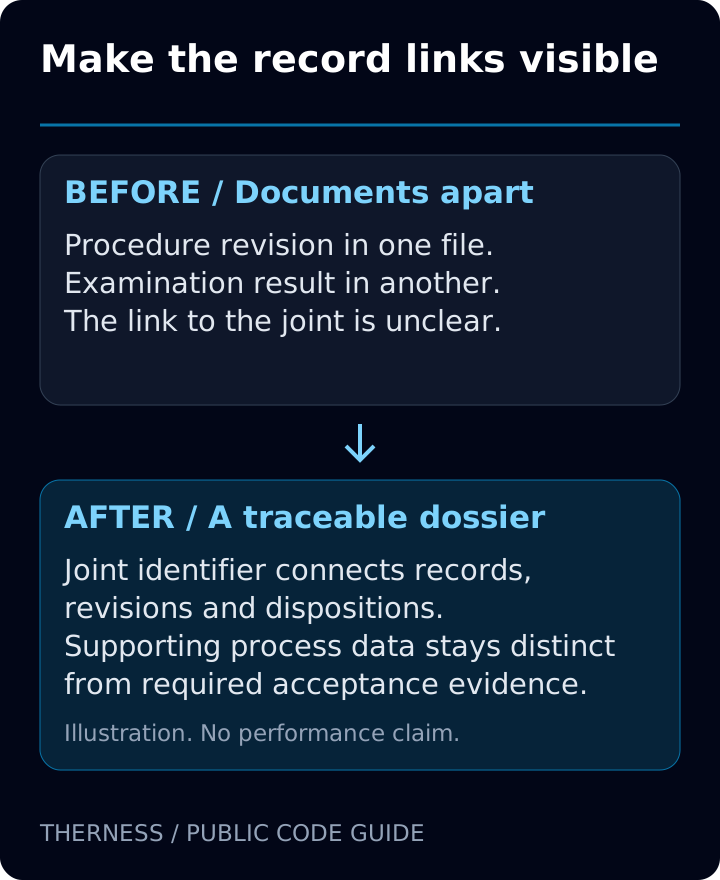
Use the joint identifier to connect the applicable procedure and personnel qualifications, fabrication records, examination reports, repair history and heat-treatment records where relevant. The system test record belongs to the defined test boundary. Keep the record’s revision and acceptance disposition visible.
A welding monitoring system may add supporting process information to that file. Decide which information is useful and how it will be linked before choosing the equipment. Process data supports investigation and traceability; it does not certify a weld, identify a defect type by itself or replace the specified examination and testing.
Practical scoping checklist
Before releasing the work package, check:
- Basis: governing code, adopted edition, jurisdiction, specification and system boundaries.
- Qualification: applicable procedure and personnel records, with the revisions covering the planned work.
- Examination: joint-by-joint method, extent, acceptance reference and hold points in the ITP.
- Thermal and test records: applicable preheat/interpass controls, PWHT requirements and the approved system test plan.
- Traceability: one retrievable link from the joint or system identifier to each record and its disposition.
This is a work-package review aid. It is not a substitute for the governing code or the responsible engineer’s design and acceptance decisions.
Pressure testing
Establish the permitted test method, pressure basis, test boundary, precautions and acceptance requirements in the approved plan using the governing edition. This guide gives no test-pressure multiplier or universal exemption. Pressure testing is a separate activity from welding qualification and weld examination.
Keep a retrievable record of the test conditions, instruments, results and disposition required by the plan. Identify the piping included in the test and any exclusions. A process trace recorded while welding cannot stand in for a system pressure-test record.
Repair and rework of rejected welds
For a rejected indication, document the location, examination finding and disposition before repair. Establish the applicable repair procedure, any heat-treatment requirements and the re-examination requirements from the governing code and project documents. Do not infer a permitted repair count or examination extent from this summary.
The resulting record should connect the original finding, authorised repair, procedure used and post-repair result. Preserve earlier findings rather than overwriting the rejected result with an unexplained “accepted” status.
Where B31.1 and B31.3 boundaries get confused in practice
Auxiliary and interface systems deserve an explicit scope review. B31.1 is Power Piping; B31.3 is Process Piping. A single facility can contain systems governed by different requirements. Neither choosing the apparently stricter rule nor copying the previous project’s ITP resolves a code boundary.
Document the assigned code, edition and boundary in the project piping documents. Where there is uncertainty, obtain the responsible engineering authority’s decision before using that assignment to set welding, examination or testing requirements.
Documentation retention
Set retention, access and handover requirements from the adopted code, jurisdiction and owner’s specification. Do not treat “life of the plant” or a fixed number of years as a universal B31.1 rule. Keep records readable, versioned and associated with their joint or system identifiers for the required period.
Sources and edition basis
- ASME B31.1 publisher scope and edition listing, checked 27 October 2026: B31.1-2026 is listed.
- ASME B31.1 fabrication, examination, testing and maintenance course outline: public overview of the subjects covered, not the code’s acceptance tables.
- ASME BPVC Section IX publisher page: qualification standard, distinct from production acceptance.
Use the licensed text of the project’s governing edition for normative decisions. The checklists and illustrations here organise that review; they do not add code requirements.
Plan the Evidence for Your Piping Welds
Discuss welding process consulting for your piping work: the process information you need, its link to joint records and the limits of the proposed measurement.
Discuss welding process consultingTherness solution: Welding monitoring system — Each weld compared with a reference in the cycle, with anomaly flags and the ISO 3834 / ISO 17635 evidence kept per weld.
Frequently Asked Questions
What is ASME B31.1?
ASME B31.1 is the Power Piping code. Its scope includes piping typically found in power generating stations, industrial and institutional plants, geothermal heating, and central or district heating and cooling systems. Establish the governing code and edition for the particular system before planning fabrication or examination.
Is B31.1 the same as B31.3?
No. B31.1 is Power Piping; B31.3 is Process Piping. A site's name or a pipe's appearance alone does not settle the assignment. Check the scope, system boundaries, jurisdiction and project specification instead of carrying examination rules from one code into the other.
What is the latest ASME B31.1 edition?
ASME's publisher page lists B31.1-2026 as of 27 October 2026. The edition governing a particular project must still be established from its contract and applicable jurisdiction; a newly published edition does not automatically replace the project's adopted edition.
Does welding procedure qualification prove a B31.1 production weld is acceptable?
No. Procedure and personnel qualification, production-weld examination and system testing address different questions. Keep their records distinct and review each against the applicable construction code, edition and project requirements.
Where do I find B31.1 weld acceptance criteria?
Use the applicable B31.1 code text for the project's edition and the specific examination method and joint. A general guide or a table copied from another piping code is not a basis for accepting a weld. Record the exact clause or table used in the inspection and test plan.
Can a welding process trace replace B31.1 examination or testing?
No. A process trace can support traceability, but does not establish compliance with weld acceptance criteria or replace required qualification, examination, heat-treatment records or system tests. Link supporting process data to the relevant joint and retain the separate acceptance records.