English version
When a welded component could be read as steel structure or as industrial piping, which European standard governs its execution, EN 1090-2 or EN 13480, and which welding records follow from that choice? The question comes up on every plant job: pipe racks, supports, platforms, jacketed lines, round hollow sections used as columns. Both standards ask for qualified procedures, qualified welders and a quality system, so a shop can weld the part either way. The paperwork, the third-party involvement and the inspection plan are different, and the choice has to be made before the WPS list is frozen.
This guide covers only the boundary between structure and piping. The execution classes and the detailed EN 1090-2 requirements are in the EN 1090-2 structural steel welding guide. Neither standard’s tables are reproduced here: confirm every requirement in the edition your contract cites.
Two legal routes, not two styles
The two standards sit under different European legislation, and that is what decides the outcome.
- EN 1090-1 and EN 1090-2 cover structural steel components and their execution. Components placed on the market carry the CE marking under the Construction Products Regulation (EU) 305/2011, based on a certified factory production control.
- EN 13480 covers metallic industrial piping. It is a harmonised standard under the Pressure Equipment Directive 2014/68/EU: Part 4 covers fabrication and installation, Part 5 inspection and testing. Following it gives a presumption of conformity with the directive’s essential safety requirements.
So the real first question is not “which standard do we prefer?” but “is this item pressure equipment?”. If it is piping that contains a fluid at a maximum allowable pressure above 0.5 bar, the directive applies and the piping route follows. If it carries load and contains no pressurised fluid, it is a structure, whatever its cross-section looks like.
Four questions decide the route
| Question | Points to EN 1090-2 when… | Points to EN 13480 when… | Evidence to keep |
|---|---|---|---|
| Does it contain a fluid under pressure? | No: it carries load, or holds fluid only at or near atmospheric pressure | Yes: the maximum allowable pressure is above 0.5 bar | Design basis with fluid, maximum allowable pressure and temperature |
| What is its job in the system? | Column, beam, bracing, platform, pipe rack, handrail, even when made of round hollow section | Pipe, fitting, branch, flange joint or welded attachment that is part of the pressure boundary | Line list or structural drawing that names the item |
| Where does the support end? | The steel structure that carries the pipe support | The support elements designed with the piping and the attachments welded onto the pipe | Interface drawing with the split point marked |
| Which conformity route is invoked? | CE marking of structural components, execution class in the specification | Piping category under the directive and the module the purchaser invokes | Purchase specification and the declared route |
The table is a decision aid. Where the drawing leaves the split point open, ask the designer to mark it before production: a weld that sits on the boundary needs one owner.
The awkward cases
Round hollow sections. A tube used as a column or a truss member is a structural member. Its shape does not make it piping. It follows EN 1090-2 and the structural design.
Welded attachments on the pipe. A lug, trunnion or shoe welded directly onto a pressure pipe is welded onto the pressure boundary. That weld belongs to the piping route: the procedure must be qualified for the pipe material, and the examination follows the piping rules. The steel that the lug bolts to is structural.
Pipe racks and platforms. The rack is a structure. The piping it carries is pressure equipment. Two quality plans run on the same site, and the welding coordinator must know which joint is under which plan.
Low-pressure lines. A line at or below 0.5 bar is outside the directive. EN 13480 can still be applied by contract, and many purchasers do. Read the specification rather than assuming the structural route.
What changes for welding and records
Both routes rely on the same family of welding standards:
- procedures qualified to the EN ISO 15614-1 scope reference;
- welders qualified to the EN ISO 9606-1 scope reference;
- quality requirements framed by EN ISO 3834. EN 1090-2 links the part of EN ISO 3834 to the execution class; for pressure work the EN ISO 3834-2 scope reference is the usual basis.
What differs is who has to see the evidence and when:
- Structural route. The factory production control certificate, the execution class, the welding coordination and the inspection records per execution class. The certified factory production control is audited periodically.
- Piping route. The directive asks, for the higher piping categories, that welding procedures and welding personnel be approved by a competent third party, and that NDT personnel be approved for the highest categories. The examination extent, the pressure test and the final assessment come from EN 13480-5. The weld records end up in the documentation that supports the declaration of conformity.
A weld record that serves both routes carries the same core: joint identity, WPS, welder, the parameters delivered and the inspection result. Which route it sits in decides how much of that record the third party reviews and how long it must be kept.
Make the decision auditable
An auditor asks two things: why this standard, and can you show each weld was made inside it? Keep the design basis and the interface drawing with the route decision. Then tie each joint to its WPS, welder and recorded process data.
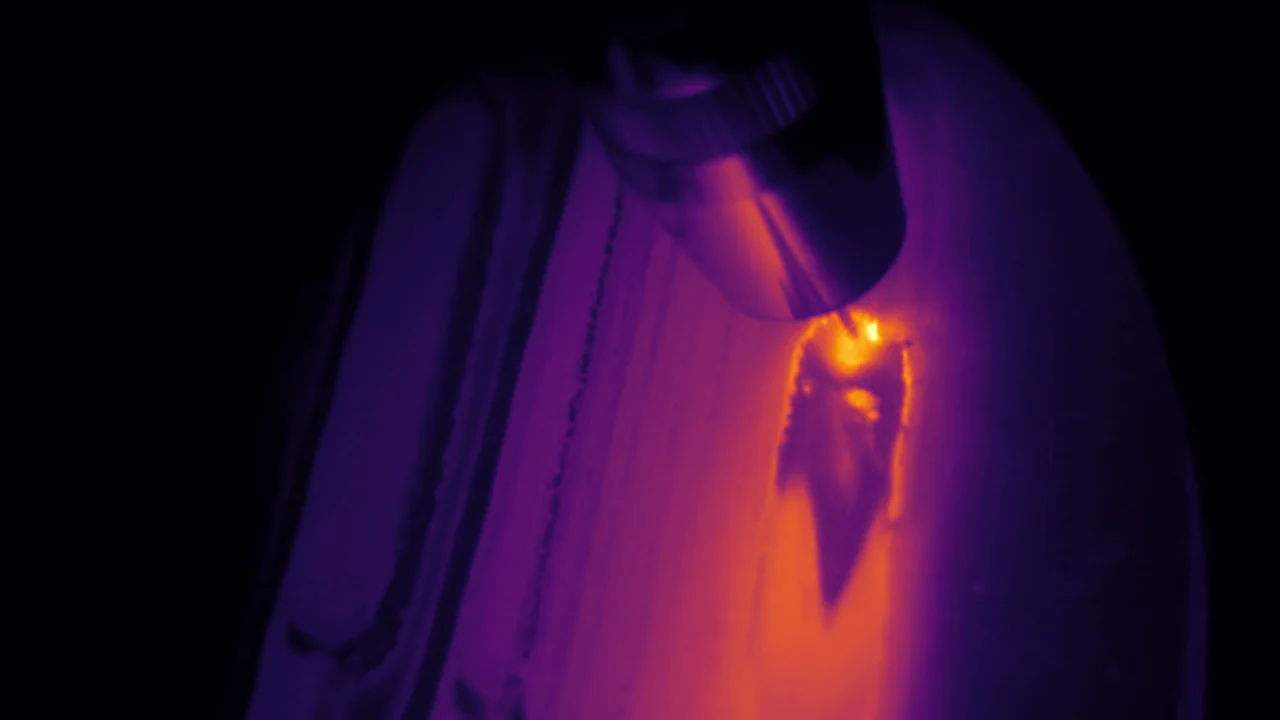
WeldTrace records the current, voltage, wire feed and gas the machine delivered on each weld, and HeatCore AI adds the thermal record of the bead, so the evidence exists per joint whichever route applies. For structural programmes see the structural steel welding application; for pressure work, the pressure vessel welding and PED guide. The data supports the quality decision. It does not choose the standard and does not replace the inspection either standard requires.
Versione italiana
Quando un componente saldato può essere letto come struttura in acciaio o come tubazione industriale, quale norma europea ne governa l’esecuzione, EN 1090-2 o EN 13480, e quali registrazioni di saldatura ne derivano? La domanda torna in ogni commessa di impianto: rack per tubazioni, supporti, piattaforme, linee incamiciate, profili cavi tondi usati come colonne. Entrambe le norme chiedono procedure e saldatori qualificati e un sistema qualità, quindi l’officina sa saldare il pezzo in tutti e due i modi. Cambiano documentazione, intervento di terzi e piano dei controlli, e la scelta va fatta prima di congelare l’elenco delle WPS.
Questa guida riguarda solo il confine fra struttura e tubazione. Classi di esecuzione e requisiti di dettaglio di EN 1090-2 sono nella guida EN 1090-2 sulla saldatura delle strutture in acciaio. Le tabelle delle norme non sono riprodotte: conferma ogni requisito sull’edizione citata dal contratto.
Due percorsi di legge
- EN 1090-1 ed EN 1090-2 riguardano i componenti strutturali in acciaio e la loro esecuzione. I componenti immessi sul mercato portano la marcatura CE secondo il Regolamento Prodotti da Costruzione (UE) 305/2011, sulla base di un controllo della produzione in fabbrica certificato.
- EN 13480 riguarda le tubazioni industriali metalliche. È norma armonizzata della Direttiva Attrezzature a Pressione 2014/68/UE: la parte 4 tratta fabbricazione e installazione, la parte 5 controlli e prove.
La prima domanda vera è quindi: il pezzo è un’attrezzatura a pressione? Se è una tubazione che contiene un fluido a pressione massima ammissibile superiore a 0,5 bar, si applica la direttiva e il percorso tubazioni. Se porta carichi e non contiene fluido in pressione, è una struttura, qualunque sia la sua sezione.
Le quattro domande
| Domanda | Verso EN 1090-2 se… | Verso EN 13480 se… | Evidenza da conservare |
|---|---|---|---|
| Contiene un fluido in pressione? | No: porta carichi, o contiene fluido solo a pressione atmosferica o quasi | Sì: pressione massima ammissibile oltre 0,5 bar | Base di progetto con fluido, pressione e temperatura massime ammissibili |
| Che funzione ha? | Colonna, trave, controvento, piattaforma, rack, parapetto, anche se in profilo cavo tondo | Tubo, raccordo, stacco, giunzione flangiata o attacco saldato sul confine in pressione | Lista linee o disegno strutturale che identifica il pezzo |
| Dove finisce il supporto? | La struttura che porta il supporto | Gli elementi di supporto progettati con la tubazione e gli attacchi saldati sul tubo | Disegno di interfaccia con il punto di separazione |
| Quale percorso di conformità è richiesto? | Marcatura CE dei componenti strutturali, classe di esecuzione in specifica | Categoria della tubazione secondo la direttiva e modulo richiesto | Specifica d’acquisto e percorso dichiarato |
I casi difficili
Un profilo cavo tondo usato come colonna è un elemento strutturale e segue EN 1090-2. Un attacco (orecchia, perno, scarpa) saldato direttamente sul tubo in pressione è saldato sul confine in pressione: quella saldatura appartiene al percorso tubazioni, con procedura qualificata sul materiale del tubo e controlli secondo le regole delle tubazioni. Il rack è una struttura, la tubazione che porta è un’attrezzatura a pressione: sullo stesso cantiere corrono due piani qualità. Una linea a 0,5 bar o meno è fuori dalla direttiva, ma il contratto può comunque richiamare EN 13480.
Saldatura e registrazioni
I due percorsi usano la stessa famiglia di norme: procedure qualificate secondo la EN ISO 15614-1, saldatori secondo la EN ISO 9606-1, requisiti di qualità secondo EN ISO 3834 (per i lavori in pressione di solito la EN ISO 3834-2). Cambia chi deve vedere le evidenze. Nel percorso strutturale contano il certificato del controllo della produzione in fabbrica, la classe di esecuzione e i controlli per classe. Nel percorso tubazioni la direttiva chiede, per le categorie più alte, procedure e personale di saldatura approvati da un terzo competente, e personale dei controlli non distruttivi approvato per le categorie più alte; estensione dei controlli, prova a pressione e valutazione finale vengono da EN 13480-5.
Rendi la decisione verificabile
Conserva base di progetto e disegno di interfaccia accanto alla decisione sul percorso, poi collega ogni giunto a WPS, saldatore e dati di processo registrati. WeldTrace registra corrente, tensione, filo e gas erogati su ogni saldatura; HeatCore AI aggiunge il record termico del cordone. Vedi anche l’applicazione strutture in acciaio e la guida sui recipienti a pressione e la PED. I dati sostengono la decisione qualità, ma non scelgono la norma e non sostituiscono i controlli richiesti.
Sources
- EN 1090-2 scope reference — Therness
- EN ISO 3834-2 scope reference — Therness
- Pressure Equipment Directive 2014/68/EU — EUR-Lex
- Construction Products Regulation (EU) 305/2011 — EUR-Lex
Give every boundary weld one owner and one record / Un responsabile e un record per ogni giunto di confine
Therness helps plant fabricators keep the route decision, WPS scope and per-weld process records together for structural and piping work. / Therness aiuta i costruttori di impianti a tenere insieme scelta del percorso, ambito WPS e record di processo di ogni giunto, per strutture e tubazioni.
Talk to an expert / Parla con un espertoTherness solution: Welding monitoring system — Every weld inspected in the cycle, with defect flags and the ISO 3834 / ISO 17635 evidence kept per weld.