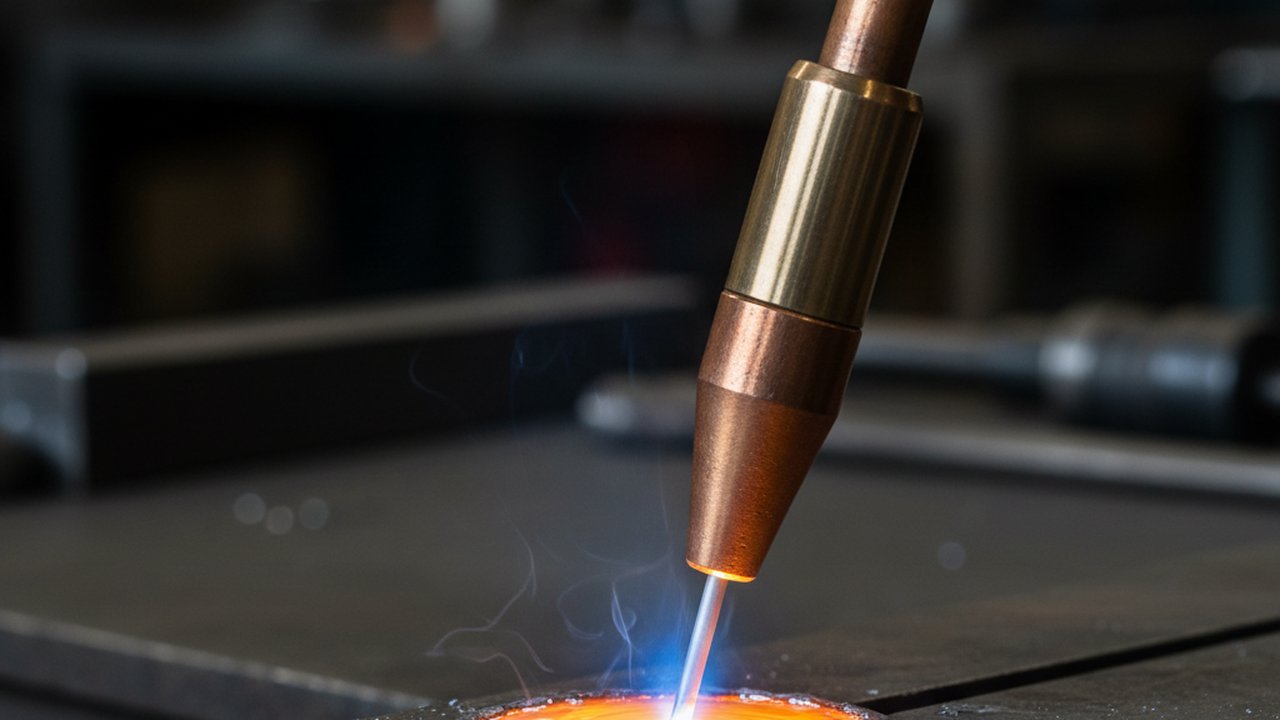
Watched at normal speed, a CMT arc looks like a small, steady point of light with no visible structure at all. At 480 fps the same few milliseconds split into six phases — arc growth, approach, contact and short, retract, detachment, re-ignition — and once you can name them, the difference between a healthy cycle and a broken one stops being a guess and becomes something you can point at on a paused frame.
That distinction matters beyond curiosity. A dip-retract cycle that holds a steady beat is the visible signature of low, even heat input; a cycle that drifts off that beat is the visible signature of the current-driven pinch that throws spatter when it lands somewhere it should not. This article reads the cycle in the CMT footage in the video library frame by frame, names each phase, and shows what a stable cycle and a broken one each tell you about the weld being made.
Key takeaways
- A CMT dip-retract cycle at 480 fps resolves into six phases: arc, approach, contact and short, retract, detachment, re-ignition.
- A stable cycle holds a fixed frame interval between dips; an unstable one drifts, clings, or merges two cycles into one.
- The retract phase happens while current is cut, which is the mechanism behind CMT’s low, even heat input — a steady beat means that low-current window repeats consistently.
- Spatter on an unstable cycle traces to current still present at the moment of separation — the current-driven pinch normal CMT is designed to avoid needing.
- At typical CMT cycle rates, 480 fps gives roughly 4 to 10 frames per cycle: enough at the slow end for six separate frames, and enough at the fast end to keep the short-and-detach sequence visible even as it compresses toward one shared frame.
- Reading rhythm and clearance on video gives a reliable qualitative call; confirming current at the moment of separation needs the waveform alongside the footage.
The six phases of a CMT cycle, frame by frame

Pausing the clip above frame by frame separates the cycle into six phases that repeat, cycle after cycle, for as long as the process stays stable.
Phase 1 — arc phase, droplet growing
The wire tip glows and a droplet builds at the end of it in the ordinary GMAW way, fed by the arc’s heat. Nothing about this phase looks different from any other gas metal arc process yet.
Phase 2 — wire approaching the pool
The droplet and the wire tip move down toward the pool surface, driven by the wire feed. This phase is brief and easy to miss without stepping frame by frame, since nothing visually dramatic happens until contact.
Phase 3 — contact and the short circuit
The wire touches the pool, the circuit shorts, and the control loop cuts current sharply. This is the frame that starts the low-heat part of the cycle: from here until re-ignition, very little electrical energy is going into the joint.
Phase 4 — mechanical retract
The wire feed reverses and physically pulls the wire back and away from the pool. This is the phase that has no equivalent in standard short-circuit GMAW, where nothing pulls the wire back and separation is left to current alone.
Phase 5 — detachment into the pool
Surface tension and the retracting motion draw the droplet cleanly off the wire tip and into the pool. On a stable cycle this transition is quiet — no flash, no visible arcing — because current is still low or absent at this exact instant.
Phase 6 — arc re-ignition
The gap left by the retracted wire re-establishes the arc at a controlled, low energy level, and the wire feed reverses again to begin the next dip. The cycle then repeats from phase 1.
The video page for this footage puts it plainly: the wire “feeds, dips into the pool, then retracts — releasing one clean droplet per cycle.” Reading the six phases above is the same statement broken into frames you can actually point to.
Doing the frame-count arithmetic honestly
CMT cycle frequency depends on wire feed speed and material, commonly cited in the 50 to 120 Hz range. At 480 fps, a 70 Hz cycle spans about 480 ÷ 70 ≈ 7 frames; a fast 120 Hz cycle spans about 480 ÷ 120 = 4 frames; a slow 50 Hz cycle spans about 480 ÷ 50 ≈ 10 frames.
Those frames are not shared evenly across the six phases. Most of a cycle’s duration is the arc phase, where the droplet simply grows — a comparatively slow stretch that claims several frames even in a fast cycle. The contact-retract-detachment-re-ignition sequence that follows is much shorter in real time, because a brief short is the entire point of the mechanism. At a 7-frame, 70 Hz cycle, that typically leaves four or five frames for arc growth and approach, and two or three for the rest of the sequence.
At the fast end, near 120 Hz and four frames total, that budget gets tight enough that contact, retract and detachment can compress toward a single shared frame rather than three separate ones — still a visible, blur-free transition, just not one with a dedicated frame for each step. Re-ignition usually keeps its own frame regardless of speed, since it marks the return to the long arc phase.
The honest summary: 480 fps reliably shows the six-phase structure and separates the slow arc-and-approach part of the cycle from the fast short-and-detach part. It does not always give a clean, separate frame for each of the six phases at CMT’s fastest cycle rates, and treating the footage as if it did would oversell what it shows.
Reading a stable cycle: what the steady beat actually means
A stable CMT cycle looks, on paused footage, almost mechanically regular: the same six phases, landing at the same frame interval, cycle after cycle. That regularity is not just aesthetically clean — it is the visible signature of the process doing what CMT is designed to do.
Because current is cut during phases 3 through 5, a cycle that holds its beat means that low-current window is repeating at the same point, for the same duration, every time. The energy delivered per droplet stays close to constant, which is what keeps heat input even along the length of the weld — the same quantity the heat input calculator computes from voltage, current, and travel speed, here shown as a visual rather than a number. A steady beat is also, by construction, one droplet per cycle: no runaway growth, no merged dips, nothing for the pool to absorb unevenly.
Reading an unstable cycle: what drift and clinging mean for heat input and spatter
An unstable cycle breaks the same rhythm in a small number of recognisable ways: a droplet that clings past its usual detachment frame and separates late and unevenly, a short that clears slowly enough to show visible arcing instead of a clean cutoff, or two dip cycles that visibly merge into one longer event. None of these need a trained eye once you have a clean cycle to compare against — the deviation from the established beat is the diagnostic.
The heat-input consequence follows directly from the phase structure above: if the short clears late, or clears with visible arcing, current was present at a moment the process is designed to run without it. That is the same electromagnetic pinch standard short-circuit GMAW relies on for every droplet, showing up inside what should have been a low-current window in a CMT cycle — which is also exactly the mechanism that throws spatter. A cycle that drifts off-beat is therefore a frame-by-frame record of extra, uneven energy landing at the instant the short cleared late.
The causes behind that drift — contact tip wear, shielding gas condition, torch angle, a parameter set running outside its qualified window — and the fixes for each are covered in full in why CMT welding droplet transfer becomes unstable; this article stops at reading what the footage shows, not diagnosing why it happened.
What frame-by-frame reading confirms and what it does not
Watching rhythm and clearance on video answers a specific, useful question well: is this cycle behaving like the other cycles around it, or has it drifted? That qualitative call is reliable and does not need instrumentation.
It answers a narrower question less completely: exactly how much current was present when a droplet separated, or whether a borderline case is within tolerance. There, the visual record and the electrical waveform are complementary, not substitutes — a point how to identify GMAW transfer mode from high-speed video makes for transfer mode generally, and one that applies here too.
FAQ
What are the visible phases of a CMT dip-retract cycle at 480 fps?
Six, in order: arc growth at the wire tip, approach toward the pool, contact and the short circuit, mechanical retract, detachment into the pool, and re-ignition at low energy. At 480 fps the phases stay visually distinct: the arc phase, which takes up most of the cycle, spans several frames, while the short-retract-detachment sequence that follows compresses to as little as one frame at the fast end of CMT’s frequency range.
How is the 480 fps frame budget split across a CMT cycle?
Unevenly. The arc phase, where the droplet grows, takes up most of the cycle’s real time and claims most of the frames. The contact-retract-detachment sequence is much shorter, so it gets far fewer — several at the slow end of CMT’s 50 to 120 Hz range, one shared frame at the fast end. That split is why a 4-to-10-frame cycle can still show six phases without needing several frames for each one.
Which single frame should you check to judge whether a cycle is clean or spattering?
The detachment frame — the instant the droplet leaves the wire tip. On a clean cycle that frame is quiet: no flash, no arcing, because current is already cut. On a cycle throwing spatter, that frame shows a bright flash or visible arcing, meaning current was still present at separation. Checking that one frame across a few cycles is faster than scanning the whole clip.
Why does a stable dip-retract rhythm mean lower and more even heat input?
Because the retract phase is timed to the moment current is already cut, so the droplet separates from surface tension and mechanical pull, not an electrical pulse. A steady beat means that low-current window repeats at the same point every cycle, so energy delivered per droplet stays close to constant along the joint.
What in the cycle actually produces spatter when CMT is unstable?
Spatter appears when the short does not clear as the control loop expects, and current is still present when the droplet finally separates — the same current-driven pinch standard short-circuit GMAW relies on for every droplet, occurring in a cycle not supposed to need it. On video this shows as a bright flash or visible arcing at clearance instead of the quiet transition a clean cycle shows.
Can cycle stability be read from video alone, without current and voltage data?
The rhythm and the visible clearance event give a reliable qualitative read: a steady beat and a quiet clearance both indicate a normal cycle. Confirming exactly how much current was present at separation, or ruling out a borderline case, needs the electrical waveform alongside the footage.
What does the retract phase actually look like on a paused frame?
The wire tip visibly moves upward and away from the pool between two frames, instead of holding at a fixed dip depth — the mechanical signature that separates CMT from ordinary short-circuit GMAW, where current alone does the separating and the wire stays put. On a stable cycle that frame lands at the same beat every time; on an unstable one it can land late, or barely show at all if the droplet clings.
Capture this cycle on your own line
PoolDrop camera films the same 480 fps dip-retract cycle on a production cell, so a drifting beat shows up on camera before it shows up as spatter or a heat-input outlier.
Talk to us about PoolDropTherness solution: Welding camera — Thermal and high-speed imaging that watches the arc, the pool and the cooling seam while the weld is made.
Frequently Asked Questions
What are the visible phases of a CMT dip-retract cycle at 480 fps?
Six, in order: arc growth at the wire tip, approach toward the pool, contact and the short circuit, mechanical retract, detachment into the pool, and re-ignition at low energy. At 480 fps the phases stay visually distinct: the arc phase, which takes up most of the cycle, spans several frames, while the short-retract-detachment sequence that follows compresses to as little as one frame at the fast end of CMT's frequency range.
How is the 480 fps frame budget split across a CMT cycle?
Unevenly. The arc phase, where the droplet grows, takes up most of the cycle's real time and claims most of the frames. The contact-retract-detachment sequence is much shorter, so it gets far fewer — several at the slow end of CMT's 50 to 120 Hz range, one shared frame at the fast end. That split is why a 4-to-10-frame cycle can still show six phases without needing several frames for each one.
Which single frame should you check to judge whether a cycle is clean or spattering?
The detachment frame — the instant the droplet leaves the wire tip. On a clean cycle that frame is quiet: no flash, no arcing, because current is already cut. On a cycle throwing spatter, that frame shows a bright flash or visible arcing, meaning current was still present at separation. Checking that one frame across a few cycles is faster than scanning the whole clip.
Why does a stable dip-retract rhythm mean lower and more even heat input?
Because the retract phase is timed to the moment current is already cut, so the droplet separates from surface tension and mechanical pull, not an electrical pulse. A steady beat means that low-current window repeats at the same point every cycle, so energy delivered per droplet stays close to constant along the joint.
What in the cycle actually produces spatter when CMT is unstable?
Spatter appears when the short does not clear as the control loop expects, and current is still present when the droplet finally separates — the same current-driven pinch standard short-circuit GMAW relies on for every droplet, occurring in a cycle not supposed to need it. On video this shows as a bright flash or visible arcing at clearance instead of the quiet transition a clean cycle shows.
Can cycle stability be read from video alone, without current and voltage data?
The rhythm and the visible clearance event give a reliable qualitative read: a steady beat and a quiet clearance both indicate a normal cycle. Confirming exactly how much current was present at separation, or ruling out a borderline case, needs the electrical waveform alongside the footage.
What does the retract phase actually look like on a paused frame?
The wire tip visibly moves upward and away from the pool between two frames, instead of holding at a fixed dip depth — the mechanical signature that separates CMT from ordinary short-circuit GMAW, where current alone does the separating and the wire stays put. On a stable cycle that frame lands at the same beat every time; on an unstable one it can land late, or barely show at all if the droplet clings.
Related Video