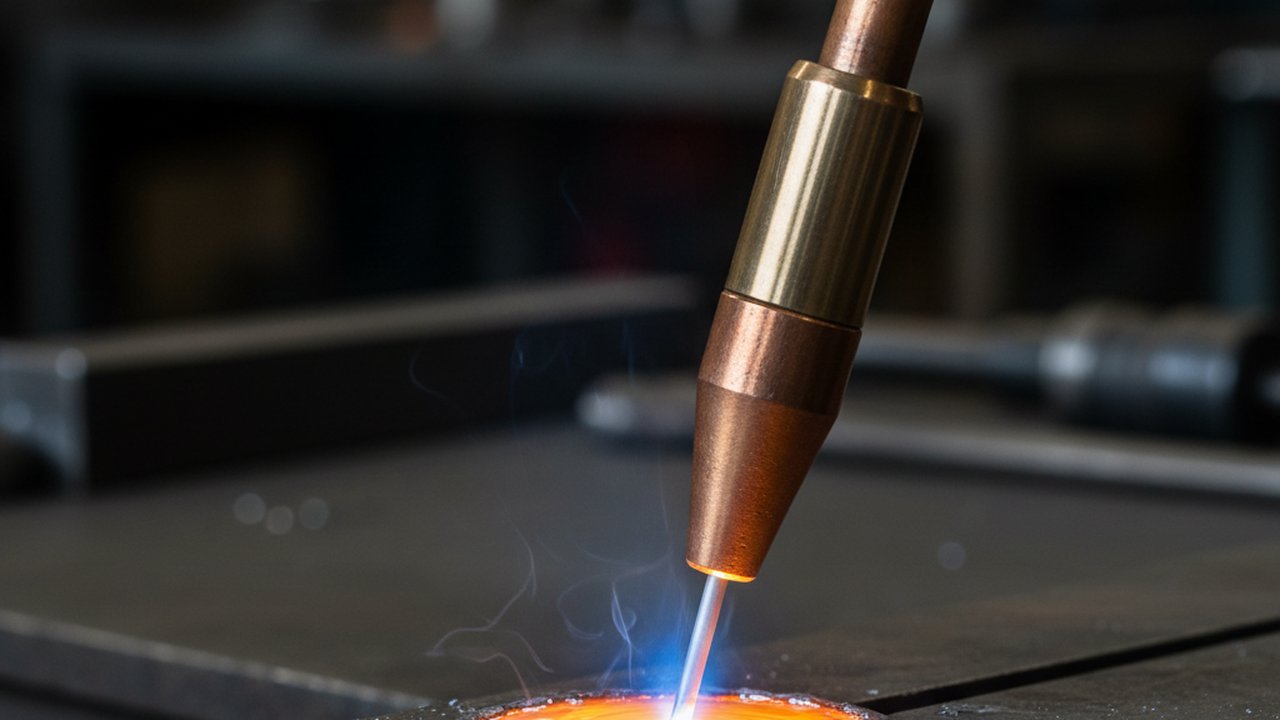
How to identify GMAW transfer mode from high-speed video is a practical skill, not a theoretical one: the same footage that makes a weld pool camera useful for defect analysis also tells you, frame by frame, whether the arc you are looking at is running globular, spray, or short-circuit transfer — and whether that is the mode the procedure was actually qualified against. Reading the footage correctly turns a video record into a parameter-verification tool, not just a visual log.
The high-speed weld pool and droplet transfer footage in the video library shows all three signatures clearly once you know what to look for. This guide walks through the visual pattern each mode leaves on camera, the parameters that put an arc in one mode rather than another, the cases that are genuinely easy to misread, and a workflow for turning that visual read into a documented, defensible verification step.
Key takeaways
- The three classical GMAW transfer modes — globular, spray, and short-circuit — each leave a distinct, repeatable pattern on high-speed video, visible without instrumentation once you know the signature.
- Short-circuit transfer is the only mode where the wire physically touches the pool; that contact event is the single most reliable visual marker to anchor a classification on.
- Pulsed spray is the most commonly misread mode at low frame rates, because its background current phase can resemble an extinguished arc.
- Current, voltage, wire diameter, and shielding gas jointly determine which mode an arc runs in — the footage shows the effect, the parameters explain the cause.
- 240 fps reliably separates the three classical modes; individual droplet and pulse structure benefits from 480 fps or higher.
- Under ASME BPVC Section IX, transfer mode is treated as a variable in procedure qualification, so a mode identified on camera that does not match the WPS is a finding worth escalating, not just noting.
- Cross-checking a visual call against current/voltage waveform data resolves the genuinely ambiguous cases footage alone cannot.
Why transfer mode identification from footage actually matters
Transfer mode is not a label on a datasheet — it is the mechanism that determines heat input, penetration, spatter, and bead geometry for a given GMAW setup, and it can drift without anyone changing a dial on the power source.
What “transfer mode” actually is
Metal transfer mode describes how molten metal physically moves from the end of the wire electrode into the weld pool. The three classical modes are separated by droplet size and detachment mechanism: globular transfer detaches large, irregular drops under gravity and arc force; spray transfer breaks the wire tip into a fine, continuous stream of small droplets projected axially down the arc; short-circuit transfer has no free-flight droplet at all — the wire touches the pool directly and the short circuit itself severs the connection. Which mode an arc runs in is set primarily by current, with voltage, wire diameter, and shielding gas composition all shifting where the transitions between modes occur. ISO 4063 is the nomenclature standard that assigns GMAW itself a distinct process reference number; transfer mode sits inside that single process designation rather than as a separate numbered variant.
Why it is a qualification variable, not a preference
Because transfer mode changes heat input and penetration behavior even at nominally similar current and voltage settings, welding codes treat it as a variable that matters to procedure qualification rather than an operator preference. A weld that was qualified running spray transfer and is now, for whatever reason, running short-circuit transfer at the same nominal parameters is not the same process the qualification proved out — even though the power source display may show numbers that look unchanged.
The three transfer modes and their visual signature at high frame rate

Globular transfer: large, irregular drops under gravity
At low current for a given wire diameter, the arc runs globular. Droplets grow noticeably larger than the wire itself before gravity and arc force overcome surface tension and pull them free. On camera this looks irregular: drop size and detachment timing both vary from cycle to cycle, the drops visibly wobble in flight, and landing on the pool is frequently uneven enough to throw spatter. There is no steady rhythm to lock onto, which is itself part of the signature.
Spray transfer: a fine, continuous axial stream
Push the current above the transition threshold for that wire and gas combination and the arc snaps into spray transfer. The signature is a continuous, needle-fine stream of droplets close to or smaller than the wire diameter, leaving the wire tip in a straight axial line too fast to count individually even at high frame rate. The arc itself looks steadier and more tightly focused than in globular transfer, and spatter drops sharply because there is no large, irregular droplet to throw material on an uneven detachment.
Short-circuit transfer: the only mode with physical contact
Short-circuit transfer is the easiest of the three to identify with certainty, because it is the only mode where the wire visibly touches the weld pool. The cycle runs: the wire dips into the pool, the arc extinguishes at the moment of contact, current rises to pinch off the connection, the short clears, and the arc re-establishes before the next dip. That physical contact event — arc off, then a distinct bright clearance, then arc on — has no equivalent in globular or spray transfer and is the single most reliable anchor point for a visual classification.
Do not classify from a single frame or a single cycle. Watch several consecutive cycles: a genuinely stable mode repeats its pattern; a marginal or drifting parameter set shows a mode that wanders between two signatures, which is itself diagnostic information worth recording.
Reading the parameters behind what you see
The visual pattern is the effect; the electrical and consumable setup is the cause, and understanding the link is what turns a video observation into an actionable finding.
Current and voltage windows that separate the modes
For a given wire diameter and shielding gas, increasing current moves an arc from globular, through a transition region, into spray transfer — the heat input calculator is a useful way to see how much that current shift moves heat input, independent of transfer mode. Voltage sets arc length and interacts with current to determine where those transitions sit for the specific consumable in use. Short-circuit transfer operates at the low-energy end of the same current range, distinguished from globular not by current alone but by the deliberately short arc length that lets the wire physically reach the pool between droplet growth cycles.
Wire, gas, and diameter interaction
Shielding gas composition shifts where the transition thresholds fall — a gas blend richer in argon typically supports spray transfer at a lower current than a CO2-rich blend, which tends to favor globular or short-circuit transfer across a wider current range. Gas blends themselves are grouped by composition under ISO 14175 rather than by trade name, which is the reference point when a gas swap turns out to be the actual cause of a mode shift. Wire diameter changes the current density for a given amperage, so the same current can sit in different transfer regimes depending on the wire size actually loaded — a common, easily overlooked cause of an unexpected mode when a wire lot or size is changed without re-verifying the parameter set against it.
Common misreads and edge cases
Most classification errors happen at the boundary between modes, or when the frame rate is not quite fast enough to resolve what is actually happening.
Pulsed spray transfer can be misread as short-circuit at low frame rate
Pulsed GMAW alternates a high-current spray pulse with a low background current, and at an inadequate frame rate that background phase can look like an extinguished arc — resembling the arc-off moment of short-circuit transfer. The distinguishing check is contact: pulsed spray never shows the wire physically touching the pool, and at an adequate frame rate the arc is visibly present, just dimmer, through the background phase.
Mixed-mode transitions during arc starts, stops, and travel-speed changes
Arc initiation and termination routinely pass through a brief globular-like phase even on a process nominally qualified for spray, simply because current ramps through the lower range on the way up or down. Classifying the steady-state portion of a weld separately from the start and end transients avoids misreading a normal transient as a steady-state fault.
Failure modes and fixes
| What the footage shows | Likely cause | Corrective action |
|---|---|---|
| Mode is globular when the WPS specifies spray | Current below the transition threshold, or shielding gas drifted toward a CO2-rich blend | Verify actual current at the arc, not just the setpoint; check gas cylinder and flow against the specified blend |
| Mode wanders between globular and spray within one weld | Voltage or wire feed speed at the edge of the transition region | Move the parameter set further from the transition boundary, not just onto the qualified nominal value |
| Short-circuit transfer where spray was expected | Arc length collapsed, often from stick-out or torch-height drift | Re-check torch standoff and stick-out against the WPS-specified value |
| Pulsed spray reads as intermittent short-circuit on review footage | Frame rate too low to resolve the background pulse phase | Re-capture at a higher frame rate before concluding the process is faulted |
| Mode is correct in the middle of the weld but wrong at start/end | Normal transient through arc initiation or termination | Confirm the deviation is confined to the transient window before treating it as a steady-state fault |
| Mode differs between two nominally identical cells running the same WPS | Wire diameter or wire lot difference between cells | Verify wire diameter and lot against the WPS on both cells, not just the programmed parameters |
Verifying a transfer mode call before acting on it
A visual classification is only useful once it has been checked against something independent of the same footage it came from.
- Watch several consecutive cycles, not one frame or one cycle, before committing to a classification — a wandering pattern is itself a finding.
- Cross-check against current and voltage waveform data where a parametric acquisition system is available, since the electrical signal resolves the ambiguous cases footage alone cannot, particularly pulsed spray at marginal frame rates.
- Confirm the frame rate matches the event being classified — re-capture at a higher rate before ruling on a borderline case rather than accepting a low-confidence read.
- Separate steady-state weld from arc start/end transients before flagging a deviation, since a normal transient can otherwise be misread as a fault.
- Compare the identified mode against the WPS-specified mode, not just against “does the weld look acceptable,” since a mode mismatch can produce an acceptable-looking weld while still invalidating the qualification basis.
- Escalate a genuine mismatch through procedure review, checking the applicable code — ASME BPVC Section IX treats transfer mode as a qualification variable — rather than deciding informally that the difference does not matter.
Step-by-step: setting up video-based transfer mode verification
- Mount the camera to see the wire-to-pool region clearly, close enough to distinguish individual droplets in spray transfer and to see wire contact in short-circuit transfer — the PoolDrop camera is set up this way for the reference footage above. See the high-speed camera weld defect analysis setup guide for frame-rate and mounting choices in more depth.
- Filter arc glare so the sensor is not saturated during the brightest phase of each mode — spray transfer’s continuous arc is the most demanding case for this.
- Record reference clips of each transfer mode actually qualified for production, at the frame rate that will be used for ongoing review, so future footage has a same-process baseline to compare against.
- Capture footage across the full length of representative production welds, including start and stop, so transients are recorded alongside steady state rather than only sampled mid-weld.
- Classify steady-state segments against the WPS-specified mode, treating any mismatch as a finding to route to procedure review rather than resolving it informally.
- Pair the video record with parametric data — voltage, current, wire feed speed — using WeldTrace or an equivalent acquisition system, so an ambiguous visual call has an independent check.
- Retain the classification with the weld identifier and WPS reference, so a mode-mismatch finding is traceable to the specific weld, cell, and production order it applied to.
FAQ
How do you identify GMAW transfer mode from high-speed video?
Watch the droplet pattern across several cycles: large, irregular drops falling under gravity mean globular transfer; a continuous fine stream of tiny droplets leaving the wire tip axially means spray; and a repeating dip-short-clear-retract cycle with the wire touching the pool means short-circuit transfer.
What does globular transfer look like on camera compared with spray transfer?
Globular transfer shows drops noticeably larger than the wire diameter, detaching irregularly under gravity with visible wobble and inconsistent timing, often with spatter on release. Spray transfer shows droplets near or smaller than the wire diameter, leaving in a steady axial stream too fast to count by eye.
Why does short-circuit transfer look different from spray transfer at the same frame rate?
Short-circuit transfer is defined by physical contact — the wire visibly touches the pool, the arc extinguishes, and a bright clearance event follows before it restrikes. Spray transfer shows no such contact: the arc stays continuously lit and droplets leave the wire tip without ever touching the pool.
Can you tell GMAW transfer mode from footage alone, without current and voltage data?
For the three classical modes, usually yes, because each has a visually distinct and repeatable pattern. Ambiguous cases — pulsed spray at a marginal frame rate, or a transitional condition between modes — are where cross-checking against the current and voltage waveform removes doubt that a visual call alone cannot.
Why does pulsed spray transfer sometimes look like short-circuit transfer on video?
Pulsed spray drops current to a low background level between pulses, which can look like an extinguished arc if the frame rate is too low to resolve the pulse frequency. At an adequate frame rate the arc stays visibly present, just dimmer, through the background phase, with no wire-to-pool contact.
Does a change in metal transfer mode require requalifying the welding procedure?
Under ASME BPVC Section IX, the metal transfer mode used in GMAW is a variable the code accounts for when a procedure is qualified, and switching modes can require requalification depending on the applicable code. Check the governing code before assuming a mode switch is a free parameter change.
What frame rate is needed to correctly classify GMAW transfer mode from video?
240 fps is usually enough to distinguish globular from spray and short-circuit reliably. Resolving individual droplet detachments in spray transfer, or the pulse structure of pulsed spray, benefits from 480 fps or higher, since the events being classified last only a few milliseconds each.
For related footage, see the CMT droplet transfer instability guide for the short-circuit-family process at the low-energy end of this same range, and GMAW/MIG welding quality monitoring with thermal imaging for the broader process-monitoring picture. On the imaging side more generally, see the 480 fps weld pool camera visualisation guide, the welding camera overview, and the welding parameter monitoring hub.
For independent background, TWI’s technical knowledge library and job knowledge series cover the operator and defect-control side, the American Welding Society covers the US code and certification side, ASM International covers materials, NIST’s manufacturing program covers measurement science, OSHA covers arc-process operator safety, and the Journal of Materials Processing Technology carries peer-reviewed GMAW transfer research.
Verify transfer mode on your own GMAW cells
PoolDrop camera captures droplet transfer at up to 480 fps, so a mode mismatch shows up on camera instead of only at final inspection.
Talk to us about PoolDropTherness solution: Welding camera — Thermal and high-speed imaging that watches the arc, the pool and the cooling seam while the weld is made.
Frequently Asked Questions
How do you identify GMAW transfer mode from high-speed video?
Watch the droplet pattern across several cycles: large, irregular drops falling under gravity mean globular transfer; a continuous fine stream of tiny droplets leaving the wire tip axially means spray; and a repeating dip-short-clear-retract cycle with the wire touching the pool means short-circuit transfer.
What does globular transfer look like on camera compared with spray transfer?
Globular transfer shows drops noticeably larger than the wire diameter, detaching irregularly under gravity with visible wobble and inconsistent timing, often with spatter on release. Spray transfer shows droplets near or smaller than the wire diameter, leaving in a steady axial stream too fast to count by eye.
Why does short-circuit transfer look different from spray transfer at the same frame rate?
Short-circuit transfer is defined by physical contact — the wire visibly touches the pool, the arc extinguishes, and a bright clearance event follows before it restrikes. Spray transfer shows no such contact: the arc stays continuously lit and droplets leave the wire tip without ever touching the pool.
Can you tell GMAW transfer mode from footage alone, without current and voltage data?
For the three classical modes, usually yes, because each has a visually distinct and repeatable pattern. Ambiguous cases — pulsed spray at a marginal frame rate, or a transitional condition between modes — are where cross-checking against the current and voltage waveform removes doubt that a visual call alone cannot.
Why does pulsed spray transfer sometimes look like short-circuit transfer on video?
Pulsed spray drops current to a low background level between pulses, which can look like an extinguished arc if the frame rate is too low to resolve the pulse frequency. At an adequate frame rate the arc stays visibly present, just dimmer, through the background phase, with no wire-to-pool contact.
Does a change in metal transfer mode require requalifying the welding procedure?
Under ASME BPVC Section IX, the metal transfer mode used in GMAW is a variable the code accounts for when a procedure is qualified, and switching modes can require requalification depending on the applicable code. Check the governing code before assuming a mode switch is a free parameter change.
What frame rate is needed to correctly classify GMAW transfer mode from video?
240 fps is usually enough to distinguish globular from spray and short-circuit reliably. Resolving individual droplet detachments in spray transfer, or the pulse structure of pulsed spray, benefits from 480 fps or higher, since the events being classified last only a few milliseconds each.
Related Video