
Real-Time Thermal Imaging in Welding: One Cladding Pass
A thermal camera mounted on the torch follows one robotic cladding pass in the Therness lab: the weld pool, the heat it leaves behind and how the bead cools.
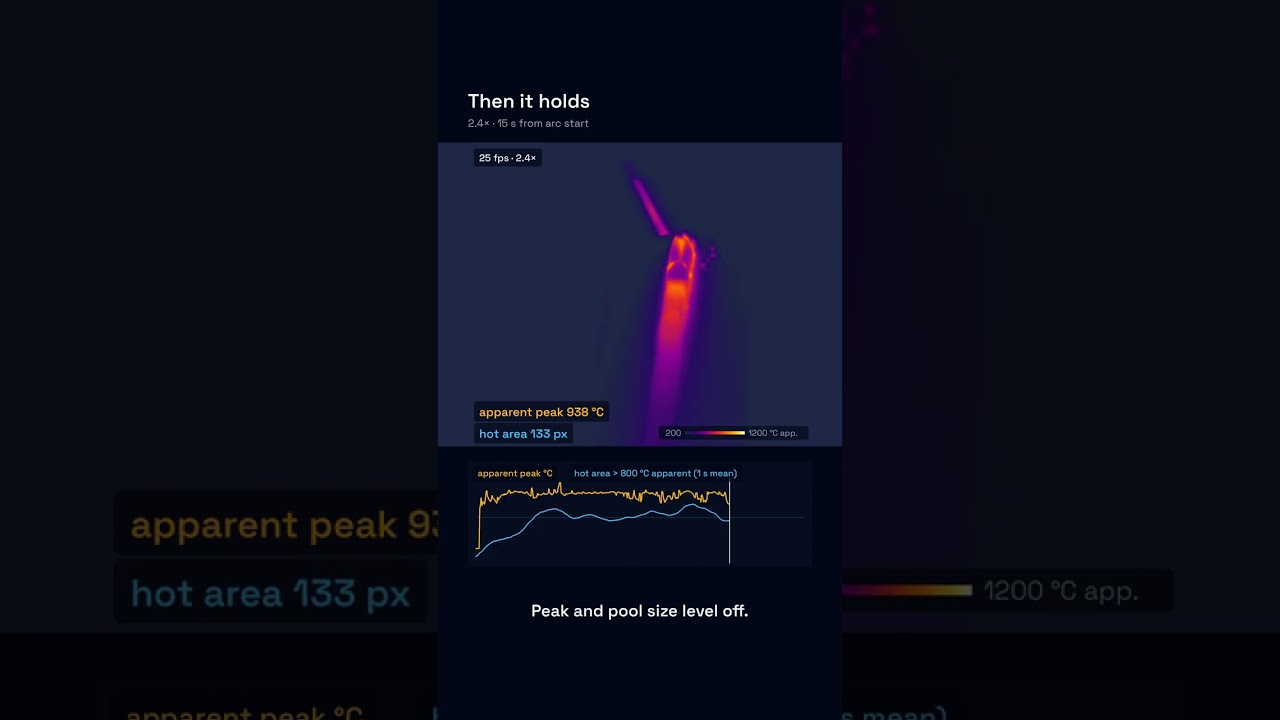
What the clip shows
One robotic cladding pass, filmed by a thermal camera mounted on the torch at 25 frames per second. The temperature scale is apparent °C with emissivity set to 0.77. The arc is on from the first frame, but the weld pool needs about 2.9 seconds to form: until then the energy goes into heating the base metal. Once the pool is there, the camera follows it along the bead, together with the heat trail it leaves behind and the bead cooling as the torch moves away.
A clip like this is a lab recording, not a production line: it shows what the camera sees, not a measured defect rate.
Reading temperature, not just brightness
A thermal camera does not see the weld the way a visible camera does — it measures the infrared radiation each point emits and converts it to temperature, so the picture is a live temperature map rather than a glow. Three features on that map carry most of the quality information. The peak temperature and the width of the bright pool track how much energy the arc is putting into the joint, a proxy for penetration and fusion. The heat-affected zone — the coloured band flanking the bead — shows how far that heat spread into the base metal. And the rate at which each point fades as the torch moves away is the cooling curve that governs microstructure and hardness. Because these are measured continuously along the bead, a lack-of-fusion cold spot, a burn-through hot spot, or a slow drift in travel speed shows up as a change in the pattern the moment it happens — not after a coupon is cut. Getting trustworthy numbers depends on setting emissivity correctly for the surface being welded.
What you can do with it
- See how long the pool takes to form at the start of each pass, and compare it pass to pass
- Keep a temperature record of every bead, not only of the coupons that get cut
- Decide which welds to send to NDT first
- Thermal imaging for weld inspection: what it sees and what it does not
Related products & guides
- HeatCam IR-C Thermal Camera
- HeatCam IR-S Compact Thermal Camera
- Turning thermal footage into NDT evidence
- Welding Camera vs Thermal Camera — Blog
Related thermal clips
- Two welds compared side by side in thermal
- Thermal monitoring of overlay cladding
- AI weld pool and arc detection, frame by frame
Transcript (short)
Show transcript
The video has no narration. On-screen text: the arc is on, but the pool needs 2.9 seconds. A thermal camera on the torch follows one robotic cladding pass at 25 fps, with temperatures in apparent °C at emissivity 0.77: the pool forms, moves along the bead and leaves a heat trail that cools behind it.
