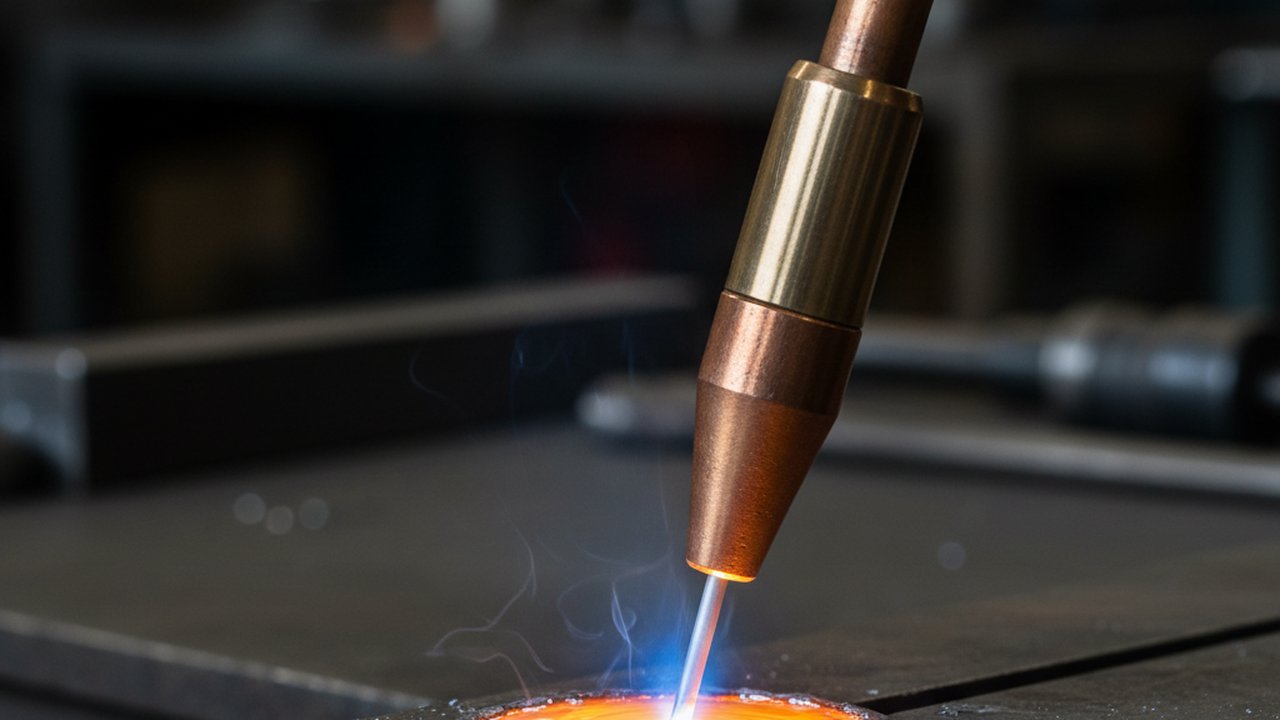
Pulsed GMAW is built around a single design target: one droplet, detached cleanly, on every current pulse. The power source alternates between a low background current that keeps the arc alive and a high peak current that pinches the molten wire tip until a droplet breaks free, and the whole point of tuning the program is making droplet rate and pulse rate match exactly, cycle after cycle. At normal viewing speed the arc just looks steady and quiet. At 480 fps the pulse-by-pulse rhythm is directly visible, which is what makes high-speed footage the fastest way to confirm a program is actually synchronized rather than only assumed to be.
This article maps the three parameters that set that rhythm — peak current, background current, and pulse frequency — to what each one controls in the footage, and then walks through the specific ways a mistuned pulse shows up on camera before it shows up as spatter or a defect in the finished bead.
Key takeaways
- Pulsed GMAW targets exactly one droplet detaching per current pulse; that one-to-one relationship is what “synchronized” means in this process.
- Peak current supplies the pinch force that necks and detaches the droplet; background current keeps the arc lit between pulses without transferring metal.
- Pulse frequency, together with wire feed speed, sets how much wire volume is available to melt into each droplet.
- A correctly tuned pulse shows one droplet, roughly equal in size, leaving the wire tip on every pulse at an even beat.
- A mistuned pulse shows up as an oversized droplet spanning multiple pulses, a pulse that fires without releasing a droplet, or a droplet that falls back instead of clearing the wire.
- These same visible failures are the ones that raise spatter and seed porosity, so reading the footage is a leading indicator, not just a diagnostic after the fact.
- A waveform trace alone cannot confirm that a given pulse released a droplet cleanly, or that it left on axis; a camera fast enough to resolve one pulse cycle as several frames can.
Watch the synchronization

The clip above is the reference case: every pulse produces exactly one droplet, launched cleanly across the arc gap into the pool. It is the companion footage to this article, held in full on its video library page. Everything below describes how the three pulse parameters produce that result, and what changes on camera when one of them drifts.
The three parameters that set the rhythm
Peak current — the force that detaches the droplet
Peak current is the high point of each cycle. While it is applied, the current density at the wire tip generates an electromagnetic pinch force strong enough to squeeze the molten metal into a neck and release a droplet clear of the electrode. Peak current has to be high enough, and held long enough, to complete that neck-and-release action once per pulse — no more, no less. Too low or too brief, and the neck never finishes forming before the current drops back to background level.
Background current — the phase between droplets
Background current is the low level the power source holds for the rest of each cycle. Its job is narrow: keep the arc ionised and the wire tip hot enough to stay ready for the next peak, without itself doing any metal transfer. Because it is low, background current contributes comparatively little heat to the joint, which is the reason pulsed transfer can hold a lower average heat input than continuous spray transfer running at a similar deposition rate.
Pulse frequency and wire feed speed — how much metal is available per pulse
Pulse frequency sets how many peak-background cycles happen every second. On its own that number means little; it has to be read against wire feed speed, because together the two determine how much wire volume is fed toward the arc between one pulse and the next. A synergic program raises pulse frequency as wire feed speed increases specifically to keep that volume — and therefore droplet size — roughly constant across its working range. Pushed outside that range in either direction, the volume available per pulse no longer matches what a single droplet at that peak current can cleanly detach, and the one-to-one relationship starts to break.
None of these three parameters is set from a fixed table in this article on purpose. Peak current, background current, and pulse frequency are supplied by the power source manufacturer’s synergic curves for a given wire diameter, material, and shielding gas, and the correct combination for your equipment is the one in that curve — not a number lifted from an unrelated setup.
Reading a correctly tuned pulse
A well-tuned program has a specific, learnable signature on high-speed footage. Watch several consecutive cycles rather than a single frame:
- One droplet per visible pulse. Each current rise corresponds to exactly one droplet leaving the wire tip — not zero, not two.
- Consistent droplet size. Successive droplets look close to the same volume, because the same wire length is being melted into each one.
- A steady, on-axis trajectory. The droplet leaves along the wire axis and lands inside the pool, not deflected to one side.
- An even beat. The time between droplets stays constant, which is the frame-by-frame evidence that pulse frequency and wire feed speed are actually matched.
This is the behaviour the reference clip above shows, and it is the pattern any pulsed program should be checked against on the equipment actually running it, not assumed from the fact that the process is nominally “pulsed spray.”
Six ways a mistuned pulse shows up on camera
| What you see on video | Likely cause | What it does downstream |
|---|---|---|
| A droplet visibly growing across two or more pulses before it separates | Pulse frequency too low, or wire feed speed too high, for the peak current in use — not enough pinch force arrives often enough to clear the accumulating volume | The oversized droplet detaches with more momentum than a normal one, raising spatter risk on arrival |
| A pulse that fires with no droplet release at all | Peak current or peak duration too low to complete the neck-and-detach action that cycle | Wire volume keeps accumulating into the next cycle, which is often the direct cause of the growing-droplet pattern above |
| A droplet that necks, then falls back toward the wire instead of clearing it | Peak current or duration marginal — enough to start necking, not enough to finish detachment | An inconsistent, unpredictable transfer that behaves closer to globular than spray from pulse to pulse |
| Droplets landing off the wire axis, scattered rather than centred | Arc wander, torch angle, or stick-out drifted from the qualified setup rather than the pulse waveform itself | Inconsistent bead profile and, in the worst case, incomplete fusion at the edge the droplet missed |
| A background phase where the arc visibly dims or flickers rather than staying steadily lit | Background current too low to sustain stable ionisation between peaks | Arc restrike difficulty at the next peak, and an unstable beat overall |
| The beat between droplets speeding up and slowing down across the same pass | Wire feed speed and pulse frequency out of synergic step with each other, or drifting during the pass | An uneven, inconsistent transfer rate that shows up as bead-width variation along the weld |
Any one of these is the camera showing a synchronization problem before it shows up as a measurable defect. The same visual signatures are the reason pulsed spray is distinguished from the other classical GMAW transfer modes by droplet pattern rather than by current alone — a waveform can look nominally correct while the droplets it is producing are not.
Why this matters: spatter and porosity, not just appearance
The visible failures above are not cosmetic. A droplet that grows across multiple pulses carries more mass and momentum than the program was designed for, and a larger, less predictable droplet disturbs the pool surface more on arrival — which is one of the direct mechanisms behind weld spatter. Spatter is treated as a process indicator precisely because it correlates with exactly this kind of transfer irregularity, not because the loose particles themselves are the primary concern.
Porosity risk follows a related path. A droplet that falls back toward the wire, or one that lands off-axis and disturbs the pool surface unevenly, can trap shielding gas or entrained air at the point of impact rather than letting it escape while the pool is still liquid. ISO 6520-1 classifies the resulting cavities under its own reference numbers, and ISO 5817 sets quality levels for them, without this article restating either standard’s acceptance values here — those belong in the standards themselves.
Step-by-step: checking your own pulsed program against video
- Confirm the synergic setting matches your actual wire diameter and gas, not a close approximation, before recording anything — a mismatched synergic curve produces exactly the drift described above even on correctly maintained equipment.
- Film a straight run at production wire feed speed with a camera fast enough to show several frames per pulse cycle, not just one blurred frame per cycle.
- Step through the footage pulse by pulse and count droplets against pulses over at least ten consecutive cycles — one droplet per pulse, every pulse, is the pass condition.
- Check droplet size and trajectory consistency across those same cycles, not only the count, since a correct count with growing size variation is an early sign of drift.
- Repeat at the top and bottom of your working wire feed speed range, because a program that holds one droplet per pulse mid-range can lose synchronization at either edge.
- If any of the six patterns above appears, verify torch stick-out, contact tip condition, and shielding gas flow before touching the pulse parameters — a mechanical or gas-flow cause produces the same visible symptom as a genuine waveform mismatch, and adjusting the wrong variable will not fix it.
Verification: proving the synchronization holds, not just that it started that way
A program that shows one droplet per pulse at the start of a shift is not proof it holds for the whole shift. Contact tip wear changes electrical stick-out gradually, and a wire feed mechanism under load can drift wire feed speed slightly from its set point — either one shifts the same balance between pulse frequency and available wire volume described above, without any alarm from the power source, because the current and voltage the source is delivering can still look nominally correct.
The check that actually verifies durability is the same one used to set the program up, repeated later in the shift: film a short run, count droplets against pulses, and compare the result against the reference footage taken when the program was first qualified. A 480 fps weld-pool camera recording alongside the thermal stream keeps that comparison running through the whole shift rather than only at scheduled spot checks, so a drift toward multi-pulse droplets or missed detachments is on record while the pass happens instead of only at the next scheduled review. Its thermal counterpart, HeatCore AI, flags the downstream heat-signature and process-drift patterns that a mistuned pulse eventually produces, from the same weld.
From this clip to your own line
Reading pulse-by-pulse transfer on someone else’s footage is the training step. Confirming it on your own equipment, at your own wire feed speed, on the joint you actually run, is the verification step, and the two are not interchangeable. A 480 fps weld-pool camera mounted torch-side turns that verification from an occasional lab exercise into something that can run every shift, and a welding camera built for the arc environment is what makes the footage usable at all instead of washed out by arc glare.
FAQ
What does one droplet per pulse mean in pulsed GMAW? It means the welding program is set so that exactly one metal droplet detaches from the wire on every current pulse, no more and no less. Each pulse delivers enough electromagnetic pinch force to neck the molten tip once and release a single droplet before the current drops back to background level, so droplet rate and pulse rate track each other one to one.
What are peak current, background current, and pulse frequency in pulsed GMAW? Peak current is the high current level during each pulse that supplies the pinch force to detach a droplet. Background current is the low current held between pulses that keeps the arc ionised and the wire tip hot without transferring metal. Pulse frequency is how many peak-background cycles occur per second, which together with wire feed speed sets how much wire volume is available to melt into each droplet.
How can you tell from video that a pulsed GMAW program is correctly tuned? A correctly tuned program shows one droplet leaving the wire tip on every visible current pulse, at an even beat, each droplet roughly the same size and following the same trajectory into the pool. There is no droplet that grows across two or more pulses, none that falls back onto the wire instead of into the pool, and no pulse that fires without producing a visible droplet.
What does a mistuned pulse look like on high-speed video compared with a correctly synchronized one? A mistuned pulse breaks the one-to-one rhythm: droplets that visibly grow across two or more pulses before separating, a pulse that fires but releases nothing, a droplet that detaches late and lands off-axis, or one that necks and then falls back toward the wire instead of clearing it. Any of these is a synchronization failure between the pulse waveform and the wire feed speed feeding it.
Can pulsed GMAW transfer be verified without a high-speed camera? Partially. A current and voltage waveform trace shows whether each electrical pulse is shaped and timed consistently, which is useful evidence, but it cannot show whether a given pulse actually released a droplet cleanly or whether the droplet detached on axis. High-speed video is the only view that closes that gap, because detachment is a mechanical event the electrical trace does not directly record.
Does pulsed GMAW transfer look the same at every wire feed speed? No. A synergic pulsed program adjusts peak current, background current, and pulse frequency together as wire feed speed changes, aiming to keep one droplet per pulse across its working range. Pushing wire feed speed past the top of that range, or running it below the bottom, is a common way the one-droplet-per-pulse relationship breaks even though the base waveform shape is unchanged.
Why does a mistuned pulse increase spatter and porosity risk? An oversized droplet formed across multiple pulses carries more momentum and detaches less predictably, which raises the chance it disturbs the pool surface and throws spatter on arrival. A droplet that fails to clear the wire and falls back, or one that detaches late and lands off-axis, can trap gas at the point of impact rather than let it escape, which is one of the mechanisms behind pulsed-transfer porosity.
Is pulsed GMAW the same as spray transfer? Related but not identical. Conventional spray transfer runs above a transition current continuously and produces a steady stream of small droplets without any low-current phase. Pulsed GMAW achieves a spray-like droplet size and axial trajectory while spending most of each cycle at a low background current, which is what keeps its average heat input lower than continuous spray at a comparable deposition rate.
Verify the pulse, not just the waveform
PoolDrop is a 480 fps torch-side weld-pool camera that keeps watching droplet transfer through the whole shift, alongside the thermal stream, so a mistuned pulse is on record while the pass is still running.
Talk to an engineer See the thermal side: HeatCore AITherness solution: Welding camera — Thermal and high-speed imaging that watches the arc, the pool and the cooling seam while the weld is made.
Frequently Asked Questions
What does one droplet per pulse mean in pulsed GMAW?
It means the welding program is set so that exactly one metal droplet detaches from the wire on every current pulse, no more and no less. Each pulse delivers enough electromagnetic pinch force to neck the molten tip once and release a single droplet before the current drops back to background level, so droplet rate and pulse rate track each other one to one.
What are peak current, background current, and pulse frequency in pulsed GMAW?
Peak current is the high current level during each pulse that supplies the pinch force to detach a droplet. Background current is the low current held between pulses that keeps the arc ionised and the wire tip hot without transferring metal. Pulse frequency is how many peak-background cycles occur per second, which together with wire feed speed sets how much wire volume is available to melt into each droplet.
How can you tell from video that a pulsed GMAW program is correctly tuned?
A correctly tuned program shows one droplet leaving the wire tip on every visible current pulse, at an even beat, each droplet roughly the same size and following the same trajectory into the pool. There is no droplet that grows across two or more pulses, none that falls back onto the wire instead of into the pool, and no pulse that fires without producing a visible droplet.
What does a mistuned pulse look like on high-speed video compared with a correctly synchronized one?
A mistuned pulse breaks the one-to-one rhythm: droplets that visibly grow across two or more pulses before separating, a pulse that fires but releases nothing, a droplet that detaches late and lands off-axis, or one that necks and then falls back toward the wire instead of clearing it. Any of these is a synchronization failure between the pulse waveform and the wire feed speed feeding it.
Can pulsed GMAW transfer be verified without a high-speed camera?
Partially. A current and voltage waveform trace shows whether each electrical pulse is shaped and timed consistently, which is useful evidence, but it cannot show whether a given pulse actually released a droplet cleanly or whether the droplet detached on axis. High-speed video is the only view that closes that gap, because detachment is a mechanical event the electrical trace does not directly record.
Does pulsed GMAW transfer look the same at every wire feed speed?
No. A synergic pulsed program adjusts peak current, background current, and pulse frequency together as wire feed speed changes, aiming to keep one droplet per pulse across its working range. Pushing wire feed speed past the top of that range, or running it below the bottom, is a common way the one-droplet-per-pulse relationship breaks even though the base waveform shape is unchanged.
Why does a mistuned pulse increase spatter and porosity risk?
An oversized droplet formed across multiple pulses carries more momentum and detaches less predictably, which raises the chance it disturbs the pool surface and throws spatter on arrival. A droplet that fails to clear the wire and falls back, or one that detaches late and lands off-axis, can trap gas at the point of impact rather than let it escape, which is one of the mechanisms behind pulsed-transfer porosity.
Is pulsed GMAW the same as spray transfer?
Related but not identical. Conventional spray transfer runs above a transition current continuously and produces a steady stream of small droplets without any low-current phase. Pulsed GMAW achieves a spray-like droplet size and axial trajectory while spending most of each cycle at a low background current, which is what keeps its average heat input lower than continuous spray at a comparable deposition rate.