If your team is under pressure to prove welding quality with objective, traceable data, ISO 17662 welding monitoring is one of the most practical standards to operationalize.
Most plants already log some parameters. The real problem is consistency: which instruments are calibrated, which checks are just informal, which records are audit-proof, and how fast you can retrieve evidence when a customer or auditor asks.
This guide explains how to apply ISO 17662 in daily operations, how it connects to your broader quality stack (ISO 3834, WPS/WPQR, inspection), and how to translate it into a scalable digital workflow.
Calibration is not only a metrology task. In welding, it directly affects process stability, defect risk, and your ability to defend quality decisions during audits and customer claims.
What ISO 17662 covers in welding monitoring workflows
ISO 17662 defines requirements for calibration, verification, and validation of equipment used to control welding-related process variables. In practical terms, it helps you answer three high-impact questions:
- Is this instrument accurate enough for the variable we control?
- Is it still performing as expected in production conditions?
- Is the entire monitoring setup fit for purpose for this welding application?
For quality teams, this is the bridge between a written WPS and repeatable execution on the floor — the discipline behind any trustworthy weld monitoring system.
Useful references for context:
Calibration vs verification vs validation in digital welding QA
These terms are often mixed together in plants, which creates avoidable audit findings.
Calibration
Calibration compares instrument output to a traceable reference and quantifies measurement error. Typical examples:
- Current/voltage channels on welding power sources
- Temperature devices for preheat/interpass monitoring
- Time and gas-flow-related instrumentation where specified in procedures
Verification
Verification is the periodic check that the instrument remains within acceptance criteria in operational use.
- Example: in-shift or scheduled checks using known references
- Goal: detect drift before it impacts weld quality
Validation
Validation demonstrates the monitoring method is suitable for the intended application.
- Example: showing that your sensor setup and data pipeline reliably represent critical process behavior for a specific joint type or process window
Plants may calibrate devices annually but skip robust production verification logic. That gap can invalidate traceability when quality incidents happen between calibration intervals.
How ISO 17662 supports ISO 3834 and WPS/WPQR traceability
Most manufacturers do not fail audits because they lack documents. They fail because records are disconnected.
A stronger model is:
- WPS/WPQR defines required process variable ranges
- ISO 17662 discipline ensures measuring equipment is trustworthy
- Digital records link each weld/batch to the monitoring evidence
For teams already working on digital quality systems, you can combine this with structured workflows from:
- Digital Welding Quality Records: WPS/PQR, Continuity, and Traceability
- ISO 3834 & EN 1090 Audit Checklist for Welding Manufacturers
- SPC for Welding: X‑bar/R Charts, Cp/Cpk, and Thermal Limits
- Welding NCR Management Software: ISO 3834 Workflow for Faster Root Cause and CAPA
ISO 17662 implementation roadmap for production teams
Below is a practical rollout framework used in multi-line welding operations.
1) Map critical variables by process and product risk
Start with the variables that materially affect acceptance criteria and downstream performance.
Examples by process:
- GMAW/FCAW: current, voltage, travel speed, heat input proxies
- Resistance spot welding: current profile, force, weld time, dynamic resistance indicators
- Laser welding: power, focus condition, seam alignment indicators
Do not over-monitor from day one. Prioritize variables with direct links to defect modes and customer requirements.
2) Define instrument classes and acceptance criteria
Create a register for all relevant devices:
- Device ID and location
- Measured variable
- Required accuracy/tolerance
- Calibration interval
- Verification interval
- Responsible owner
This turns tribal knowledge into governed quality infrastructure.
3) Build verification routines into shift operations
If verification only lives in quality binders, it will be skipped under production pressure.
Operationalize it through:
- Shift-start digital checklists
- Exception alerts when checks are missing/overdue
- Clear escalation path when tolerance is exceeded
4) Connect records to weld traceability IDs
Link each production lot, seam, part number, or weld ID to:
- Device status at weld time (in-calibration / out-of-calibration)
- Last verification result
- Operator and machine identifiers
- Associated WPS revision
This is where software has real leverage: rapid retrieval of evidence for audits, customer complaints, and internal CAPA.
5) Use nonconformance loops to refine intervals
Calibration and verification intervals should evolve with process behavior.
- Stable devices/processes may allow optimized intervals (as allowed by your quality rules)
- High-drift conditions may require tighter intervals and preventive maintenance actions
Trend data from NCR/CAPA events should continuously feed this decision.
Audit-ready evidence package: what customers and auditors ask for
When a quality issue appears, stakeholders usually ask for:
- Which procedure and acceptance criteria were applicable?
- Was the measuring/monitoring equipment in valid state?
- Can you prove parameter control during production?
- Were deviations detected and handled with documented corrective action?
A mature ISO 17662 workflow answers these with objective records rather than reconstructed narratives.
External references often used by engineering and quality teams:
- AWS D1.1/D1.1M:2025 Structural Welding Code—Steel
- IIW (International Institute of Welding)
- NIST Manufacturing Engineering Laboratory
- Welding (Wikipedia)
KPI set for ISO 17662 welding monitoring programs
To keep implementation business-relevant, track performance with a compact KPI layer:
- On-time calibration rate (%)
- On-time verification completion (%)
- Out-of-tolerance findings per 1,000 welds
- Time to produce audit evidence (minutes/hours)
- NCR rate linked to process variable drift
These KPIs help operations and quality leaders move from compliance-only behavior to measurable process control maturity.
For enterprise buyers, the strongest message is not “we collect more data.” It is “we reduce quality risk with traceable, standards-aligned evidence that survives audits and customer claims.”
Where HeatCore and the HeatCore QMS workflow fit
ISO 17662 gives the framework. The execution challenge is orchestration across machines, shifts, and documents.
In practice, teams use:
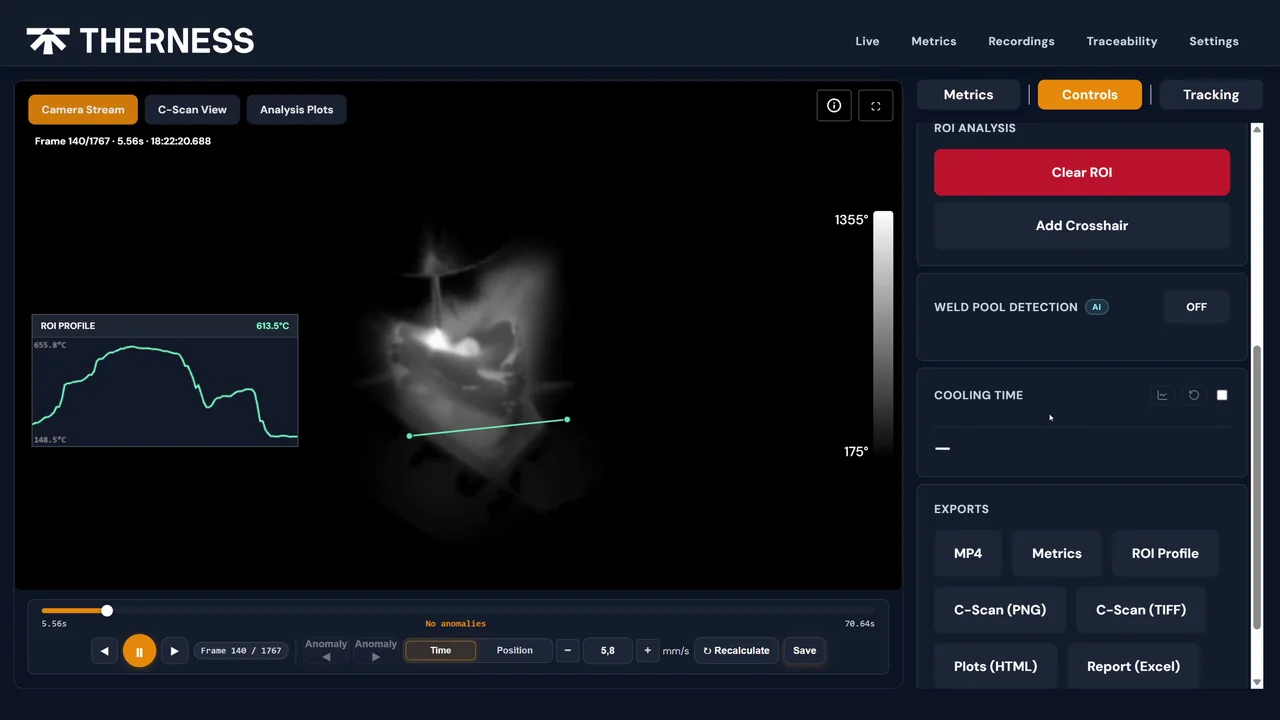
- HeatCore to centralize thermal/process monitoring signals and event timelines
- the HeatCore QMS workflow to tie deviations, NCRs, CAPA actions, and audit evidence into one quality workflow
- HeatScan when field or external thermal checks are needed to complete root-cause context
The HeatCore monitoring products support faster incident response and stronger customer confidence in your welding quality system. See a full system overview of how the pieces fit together.
Need an ISO 17662-ready monitoring workflow?
Book a demo2026 compliance checklist for plant managers and welding coordinators
Use this quick checklist as a monthly governance rhythm:
- Confirm all critical-variable instruments have a valid calibration status.
- Review verification completion by line, shift, and process family.
- Escalate every out-of-tolerance event with documented disposition.
- Confirm WPS revisions are synchronized with monitoring templates.
- Run one traceability drill per month: retrieve a full evidence package for a selected weld within 30 minutes.
A practical target is to reduce “time-to-evidence” quarter after quarter. If an auditor, customer, or quality manager asks for records, retrieval speed is an objective signal of system maturity.
Typical pitfalls when implementing ISO 17662 welding monitoring
Even strong teams hit the same traps:
- Too many variables, too early: teams collect everything and govern nothing.
- No ownership model: calibration tasks sit with maintenance, verification tasks sit with quality, and accountability is fragmented.
- Unlinked data: records exist in machine logs, spreadsheets, and PDFs, but not in one traceable chain.
- No closed-loop learning: repeated drift events happen because NCR and CAPA insights are not fed back into interval and maintenance decisions.
The fix is cross-functional governance: welding engineering defines technical requirements, quality owns compliance logic, operations enforces execution discipline, and digital tools create end-to-end traceability.
Final takeaways
If your team is scaling production, adding new lines, or facing stricter customer audits, ISO 17662 welding monitoring should be treated as a core quality capability, not a side document.
The practical priority is simple:
- Define critical variables and measurement trust requirements
- Enforce calibration + verification routines in daily operations
- Link monitoring evidence directly to weld traceability and NCR workflows
That is how you turn standards compliance into a measurable operational advantage.
For organizations serving automotive, energy, and pressure-equipment customers, this discipline also strengthens customer confidence during supplier qualification and annual surveillance audits.
For teams qualifying new procedures, see also ISO 15614 Welding Procedure Qualification: Digital Workflow for Faster WPQR Approval in 2026.
Therness solution: Welding monitoring system — Every weld inspected in the cycle, with defect flags and the ISO 3834 / ISO 17635 evidence kept per weld.