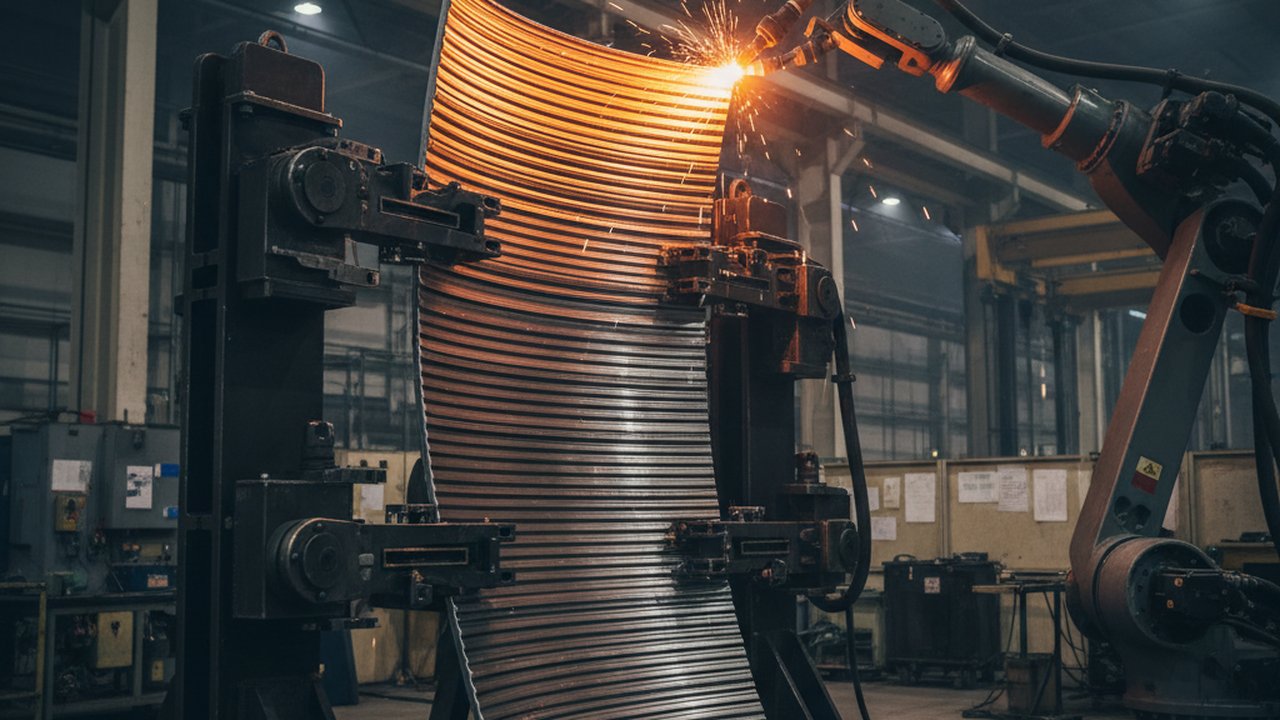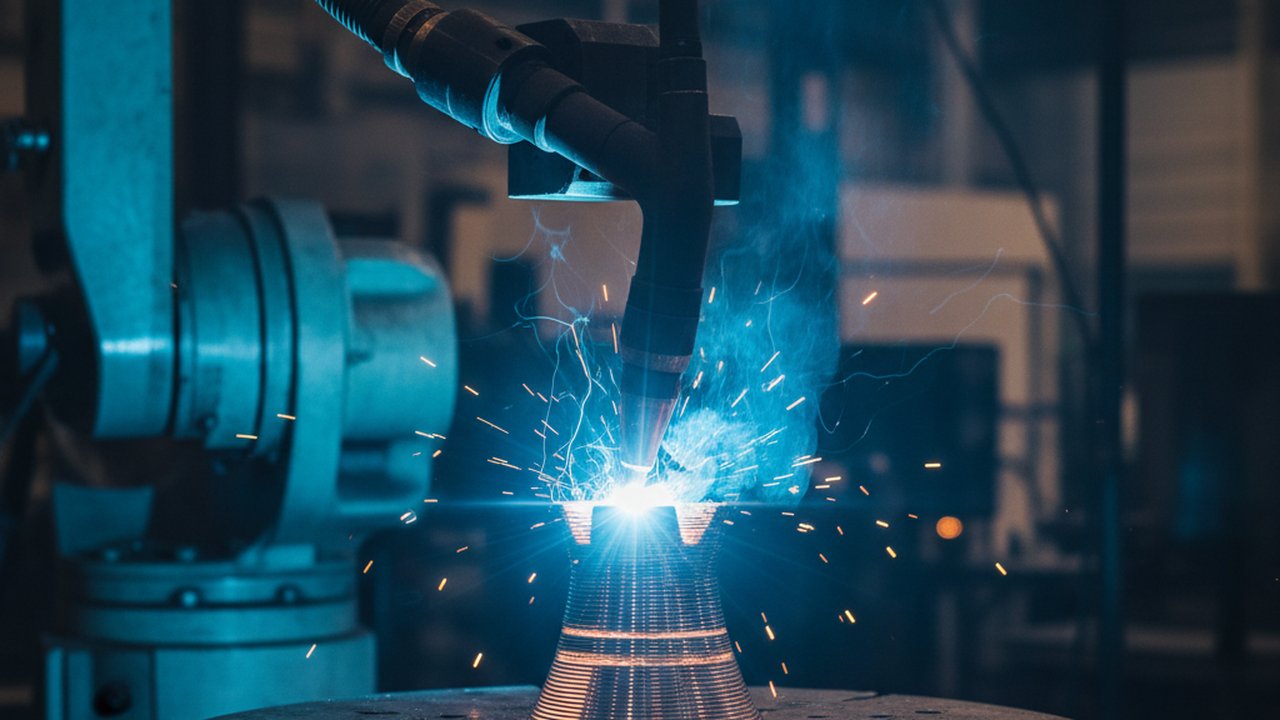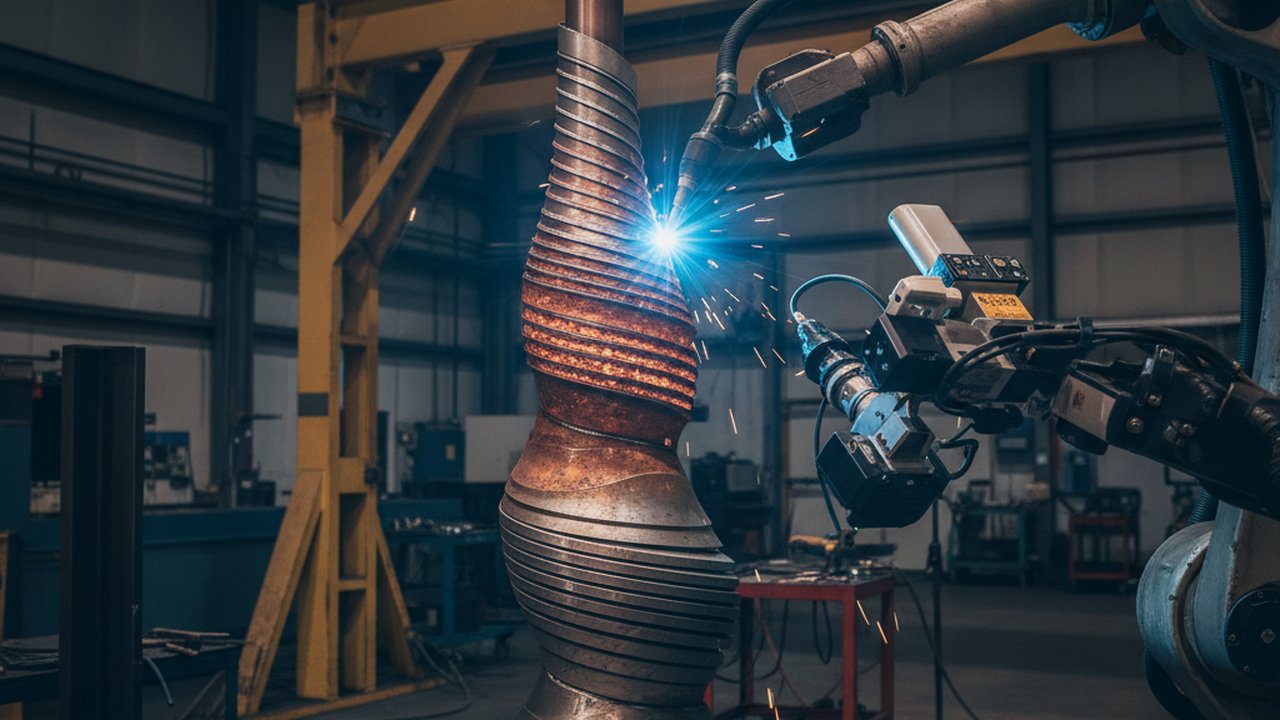
A WAAM cell throwing an alarm mid-build raises one question: fix it live, or kill the arc now? The answer splits by deviation type. Interlayer temperature is usually corrected through a dwell between layers, not mid-pass. Bead height and width correct continuously, inside the pass, through wire feed and travel speed. Arc instability is detected fastest of the three, but only worth correcting if the power source can respond before the bead has already changed. And some things — a jam, a shielding loss, a collision, a geometry error already too large — are not correction cases at all: they are stops. Below is which is which, what sets the latency, and how to tell a correction that is working from one that is only delaying a stop.
Key takeaways
- Interlayer temperature correction is a pause-and-resume dwell between layers, not a live edit inside a pass.
- Bead height and width correct inside the pass, through wire feed speed and travel speed, at the speed of the control loop.
- Arc instability is fastest to detect, but correction latency is set by the power source’s response time, not the detection speed.
- A live correction assumes the deposited material is still sound; once that breaks, a stop is the only option.
- The same deviation can be a correction one build and a stop the next — the boundary is a qualified rule, not a fixed property.
- A correction that keeps recurring on the same layers is a heat-balance or parameter problem, not evidence the correction is sufficient.
What “correct during the build” actually means
Real-time monitoring on a WAAM cell watches thermal signature, melt-pool geometry and arc behaviour as each layer deposits. But “real-time” only says the system saw the deviation quickly — it says nothing about whether the deviation can then be fixed without stopping. Those are separate questions, and a system that flags an excursion in the first frame is only as useful as whatever correction is available once it has flagged it.
Three deviation types cover most of what shows up on a WAAM build, and each has a different answer to “corrected how, and how fast.”
Interlayer temperature: correction as a dwell, not a live edit
Interlayer temperature drives bead geometry directly: too hot and the pool spreads and the wall widens; too cold between layers and fusion to the layer below can suffer. The correction available is not a parameter tweak inside the current pass — the pass is already committed once the arc is running. It is a dwell: the controller holds the arc off at the end of a layer until the measured temperature drops back under its setpoint, then resumes.
That is genuinely “during the build” — the build never aborts, and the next layer proceeds once conditions are back in range — but it is not instant the way a mid-pass adjustment is. The latency is however long the part takes to cool by radiation and conduction to the procedure’s setpoint, a physical cooling time, not a control-loop response time, and it lengthens as a tall wall’s conduction path to the baseplate grows. The mechanics of that loop — where to measure, how much margin under the qualified limit, sensor-loss behaviour — are covered in Wire Arc Additive Interlayer Temperature Control Loop Design.
A dwell that resolves the temperature for one layer and then sees it climb again on the next is not a working correction — it is evidence the parameters are producing more heat than the part can shed at that height. Treat a recurring dwell as a signal to re-qualify the parameters, not as the correction succeeding repeatedly.
Bead height and width: correction inside the pass
Bead height and width respond to wire feed speed and travel speed while the arc is running, which makes them correctable inside the pass. If a vision or laser-profilometry signal shows the bead running wide, reducing wire feed speed relative to travel speed changes the deposition ratio for the rest of that layer. The mechanism connecting those parameters to bead geometry is covered in Wire Feed Speed and WAAM Bead Width: How Layers Take Shape.
The latency here tracks the control loop’s own cycle time, not a cooling process — commonly well under a second, though the exact number depends on the power source and the loop closing it. That is an estimate, not a spec: verify it on a given cell by logging the correction command’s timestamp against the timestamp the bead geometry actually recovers.
One limit worth stating: a wire-feed or travel-speed correction changes the geometry from that point forward. It does nothing for the bead already laid down before it fired — the acceptance question for that section still has to be answered by measurement, not inferred from the correction having been applied.
Arc instability: fast to see, correction limited by the power source
Arc instability — voltage or current fluctuation, an unstable droplet transfer mode, a fume plume changing shape or brightness — is fastest of the three to detect, because the arc changes state in milliseconds and both its electrical signature and visible behaviour reflect that immediately. The physics behind reading plume shape as a stability signal is covered in Why Weld Fume Plume Shape Signals Arc Stability in Real Time; arc energy shifts as a consequence of those corrections, since it is derived from the same voltage, current and travel speed values the correction is adjusting.
Fast detection does not mean fast correction. The correction — usually a voltage, wire feed, or waveform adjustment — can only happen as fast as the power source’s control electronics respond, a property of that specific equipment, not of the monitoring system watching it. A system that flags instability in milliseconds but hands the fix to a slower power source gets a latency set by the slower of the two.
Sustained instability that does not settle after one or two correction cycles is itself a signal that something upstream has changed — contact tip wear, contamination, a shielding gas problem — that a parameter tweak cannot fix. That moves the situation into the stop category below.
What forces a stop
A parameter correction assumes the material already deposited is sound and the process just needs steering back toward target. That assumption breaks in a genuine stop case:
- A wire feed jam or lost shielding gas, long enough to let atmosphere reach the pool — the deposited layer’s soundness is now a question for inspection, not the control loop.
- A collision or mechanical fault in the deposition head or fixturing, which changes physical geometry a thermal or bead-width correction has no authority over.
- A geometric deviation already too large to qualify the next layer over, regardless of what the thermal or arc signals currently say.
- Instability that does not resolve across more than a cycle or two — an equipment or consumable problem, not a process variation to manage.
The dividing line is whether the part’s physical state is still recoverable by adjusting the process going forward, a threshold set by whoever qualified the procedure — not something the monitoring system can derive from one reading.
A stop is also not automatically a scrapped part. Depositing more material on top of a section that is already out of tolerance does not fix it, but the build can often resume once the cause is addressed: a jammed wire feeder cleared, a leaking gas fitting replaced, the head re-referenced after a collision. What changes at a stop is who decides and on what basis. A correction inside the loop runs on the logged signal alone; restarting after a stop asks whether the deposited geometry up to that point still qualifies, and that answer usually needs the same inspection method the finished part would get, applied early rather than waiting for the last layer. Treating every stop as an automatic scrap event wastes material a short inspection would have cleared for continued build, and treating every stop as automatically resumable skips the inspection step the interruption exists to force.
Building the decision into the monitoring setup
- Separate detection latency from correction latency. A vendor figure usually describes signal speed, not how fast the physical process responds — measure both on your own cell.
- Define the dwell, the correction range, and the stop threshold per deviation type during procedure qualification, not ad hoc when the first alarm fires.
- Log every correction event in the per-layer build record, and route a recurring correction on the same layers to re-qualification rather than letting the loop keep absorbing it.
From reading the signal to acting on it
Watching thermal, geometry and arc signals is only half the system; the other half is knowing which deviation can be corrected in place and which needs the arc to stop. HeatCam IR-C and HeatCam IR-S supply the thermal signal behind the interlayer dwell decision, and HeatCore AI scores the thermal signature per layer and raises the alert while the controller or operator can still apply the correction — or the stop — it calls for, logged against the layer that produced it.
For the full video this article is built around, see Real-time WAAM monitoring at 480 fps.
FAQ
Can interlayer temperature be corrected during a WAAM build, or only after it? During the build, but as a pause-and-resume dwell between layers, not a live edit inside a pass. The controller holds the arc off until the measured temperature crosses back under the setpoint, then resumes. The build never aborts.
How fast can a WAAM monitoring system react to bead height drifting off target? Bead height and width correct inside the pass, through wire feed speed and travel speed, so the reaction tracks the control loop cycle time — commonly well under a second on a modern controller, though the exact figure depends on the power source and the loop, and should be measured on the specific cell rather than assumed.
What makes arc instability the fastest signal to react to in WAAM? The arc changes state in milliseconds, and its electrical and visual signatures (voltage, current, fume plume shape) are available at the same timescale. Correction latency is then set less by the signal and more by how fast the power source can respond to the corrected command.
Which WAAM deviations require stopping the build entirely rather than a live correction? Anything that changes the physical state of already-deposited material in a way a parameter adjustment cannot undo: a wire feed jam, a shielding gas loss long enough to let atmosphere into the pool, a collision, or a geometric deviation already too large to qualify the next layer over.
Does correcting a deviation mid-build remove the need to inspect the part afterward? No. A correction changes what happens next, not what already happened. The layers deposited before it took effect still need whatever post-build inspection the procedure calls for, and the correction event itself belongs in the per-layer build record.
Why does the same deviation sometimes get corrected and sometimes force a stop? The threshold is a decision about how much accumulated drift is still recoverable, not a fixed property of the deviation. A first small interlayer excursion is a dwell; a sustained climb a dwell cannot bring down before geometry drifts becomes a stop. That boundary is set by whoever qualified the procedure.
Does a real-time monitoring system need a human in the loop to correct these deviations? Not for the routine cases — a dwell, a wire feed nudge, a travel speed adjustment can run closed-loop. A human belongs in the stop decision, at least until a site has enough logged history on that stop condition to automate it.
What signal tells an operator a correction is working rather than just delaying the problem? The trend after the correction, not the event itself. A dwell that keeps temperature under setpoint for the following layers is working; one that resolves it for a single layer and then climbs again is masking a heat balance problem the correction cannot fix.
See which deviations your process can correct in place
Therness scores the thermal signature per layer and raises the alert while your controller or operator can still apply the correction — or the stop.
Talk to an engineerTherness solution: Welding parameter monitoring — Current, voltage, wire feed and gas recorded per weld, as WPS/PQR and heat-input evidence.
Frequently Asked Questions
Can interlayer temperature be corrected during a WAAM build, or only after it?
During the build, but as a pause-and-resume dwell between layers, not a live edit inside a pass. The controller holds the arc off until the measured temperature crosses back under the setpoint, then resumes. The build never aborts.
How fast can a WAAM monitoring system react to bead height drifting off target?
Bead height and width correct inside the pass, through wire feed speed and travel speed, so the reaction tracks the control loop cycle time — commonly well under a second on a modern controller, though the exact figure depends on the power source and the loop, and should be measured on the specific cell rather than assumed.
What makes arc instability the fastest signal to react to in WAAM?
The arc changes state in milliseconds, and its electrical and visual signatures (voltage, current, fume plume shape) are available at the same timescale. Correction latency is then set less by the signal and more by how fast the power source can respond to the corrected command.
Which WAAM deviations require stopping the build entirely rather than a live correction?
Anything that changes the physical state of already-deposited material in a way a parameter adjustment cannot undo: a wire feed jam, a shielding gas loss long enough to let atmosphere into the pool, a collision, or a geometric deviation already too large to qualify the next layer over.
Does correcting a deviation mid-build remove the need to inspect the part afterward?
No. A correction changes what happens next, not what already happened. The layers deposited before it took effect still need whatever post-build inspection the procedure calls for, and the correction event itself belongs in the per-layer build record.
Why does the same deviation sometimes get corrected and sometimes force a stop?
The threshold is a decision about how much accumulated drift is still recoverable, not a fixed property of the deviation. A first small interlayer excursion is a dwell; a sustained climb a dwell cannot bring down before geometry drifts becomes a stop. That boundary is set by whoever qualified the procedure.
Does a real-time monitoring system need a human in the loop to correct these deviations?
Not for the routine cases — a dwell, a wire feed nudge, a travel speed adjustment can run closed-loop. A human belongs in the stop decision, at least until a site has enough logged history on that stop condition to automate it.
What signal tells an operator a correction is working rather than just delaying the problem?
The trend after the correction, not the event itself. A dwell that keeps temperature under setpoint for the following layers is working; one that resolves it for a single layer and then climbs again is masking a heat balance problem the correction cannot fix.