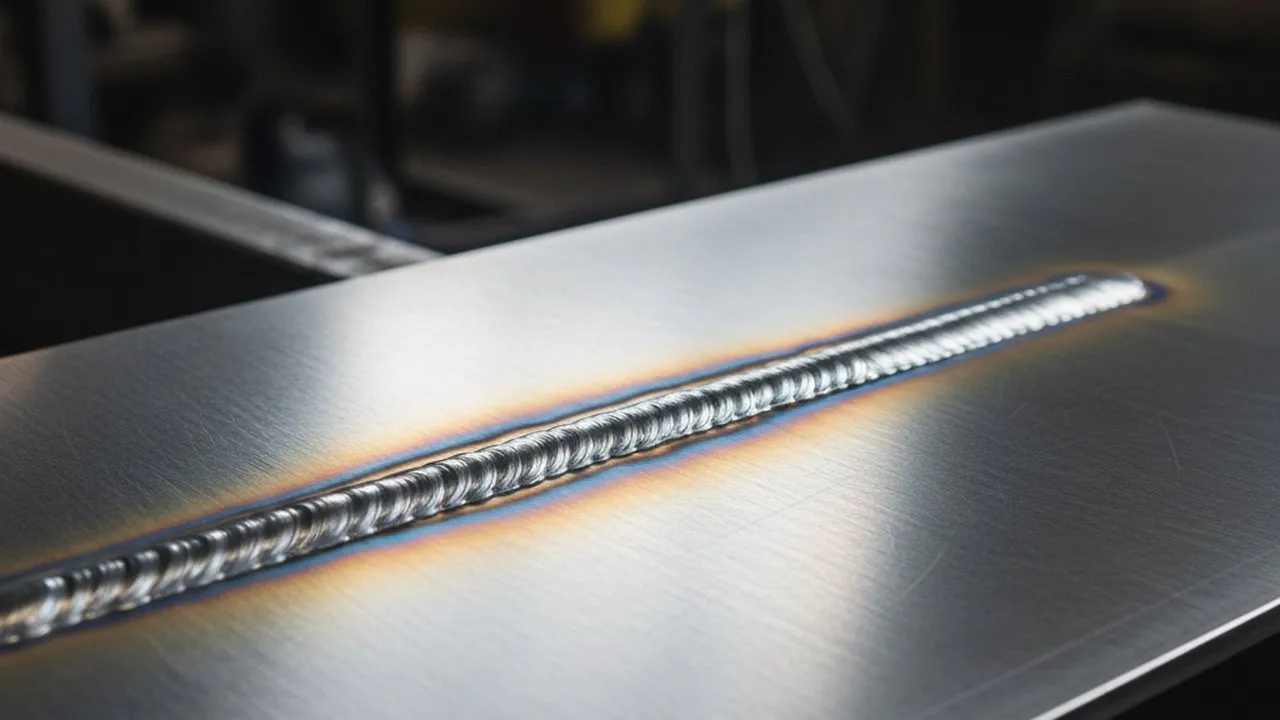
A weld has two materials that everybody inspects — the weld metal and the parent plate — and one that sits between them and is rarely looked at until something goes wrong. The heat-affected zone never melted, so it has none of the porosity, slag or lack of fusion that radiography and ultrasonic testing are tuned to find. What it has instead is a history: every point in it was heated to a different peak temperature and cooled at a different rate, and that history is written into its microstructure. When a welded joint cracks after welding, or fails an impact test, the HAZ is very often where the answer is.
This article treats the zone as an engineering problem rather than a definition: the bands it is made of, the variables that make it wider or harder, how a qualification test examines it, and what a production record can show about it. The short definition is in the heat-affected zone glossary entry.
Key takeaways
- The HAZ is a set of bands, each defined by the peak temperature it reached: coarse-grained, fine-grained, intercritical and subcritical.
- In ferritic steels the coarse-grained band next to the fusion line is usually the one that limits hardness, toughness and cracking resistance.
- Width and properties are both set by the thermal cycle: heat input, preheat or interpass temperature, thickness and the material’s conductivity.
- Multi-pass welding reheats earlier HAZ material, which can refine it or create small brittle regions.
- Macro sections, hardness traverses and impact tests sample the zone on a coupon; they do not see production joints.
- Recording the thermal cycle of each production weld shows whether the HAZ was formed under the conditions that were qualified.
The four bands, and why they exist
Picture the temperature in the plate at the moment the arc passes. At the fusion line the material is just below melting; a few millimetres further out it is barely warm. Every point between those two reaches its own peak temperature, and in a ferritic steel the peak decides which transformation that point goes through.
- Coarse-grained HAZ. Heated far above the upper transformation temperature, close to melting. Austenite grains have time to grow, and large grains transform on cooling into coarser, more hardenable structures. If the cool is fast, this is where hard martensite or bainite with low toughness forms.
- Fine-grained HAZ. Heated just above the upper transformation temperature. The steel fully transforms but grains have no time to grow, so it usually ends up with a refined structure that is often tougher than the parent.
- Intercritical HAZ. Heated between the lower and upper transformation temperatures, so only part of the structure transforms. The newly formed regions can be enriched in carbon and harden on cooling, leaving a mixed structure.
- Subcritical HAZ. Heated below the lower transformation temperature. Nothing transforms; the effect is tempering, ageing or, in a cold-worked or quenched-and-tempered steel, loss of strength.
The boundaries between these bands are lines of equal peak temperature. That is why they follow the shape of the fusion line, why they widen where the joint ran hotter, and why two welds made to the same WPS can have visibly different HAZ profiles if the conditions on the day were different.
What makes the zone wider, narrower, harder or softer
Width and properties are two outputs of the same thermal cycle, and four inputs control that cycle.
Heat input. More energy per unit length raises the peak temperature at every distance from the fusion line and pushes each band outwards. It also slows cooling. The arithmetic is covered in the heat input calculation guide; the point here is that the HAZ responds to the heat actually delivered, not to the nominal figure on the procedure.
Preheat and interpass temperature. Starting from a warmer plate has a small effect on peak temperature and a large effect on cooling: the material spends longer in the transformation range, so the coarse-grained band is less likely to harden. This is the whole purpose of preheat in hardenable steels, and it is why preheat and interpass control sits next to heat input in every procedure for those materials.
Thickness and joint geometry. A thick plate draws heat away in three directions, a thin one essentially in two. For the same heat input a thicker section cools faster, so its HAZ is narrower and, in a hardenable steel, harder. A fillet on a heavy flange behaves differently from a butt weld on thin sheet even when the parameters match.
The material. Its composition decides how readily the coarse-grained band hardens — summarised for steels by the carbon equivalent — and its thermal conductivity decides how fast heat leaves. High-conductivity alloys spread the heat and produce wider, gentler zones; low-conductivity alloys keep it concentrated.
The single number that ties these together for structural and pressure steels is the cooling time from 800 to 500 °C, t8/5: the time the HAZ spends in the range where its final microstructure is decided. A short t8/5 means hard, narrow; a long one means softer, wider and, past a point, coarser and weaker. How heat input and cooling time translate into microstructure is developed in the t8/5 and microstructure article.
Multi-pass welds: the HAZ gets reheated
In a single-pass weld each point in the HAZ goes through one cycle. In a multi-pass weld every new bead reheats material that earlier beads have already transformed, and the result depends on how hot the second cycle gets.
A later pass that reheats coarse-grained material above the upper transformation temperature refines it — the reason temper-bead and controlled-deposition techniques exist. A pass that reheats the same coarse-grained material only into the intercritical range can do the opposite: it leaves small, isolated regions of hard, carbon-rich microstructure inside an already coarse band. These regions are small enough that a hardness traverse with its usual spacing may pass between them, and they matter most for toughness at low temperature.
What decides which of the two happens is bead placement, the overlap between passes and the temperature of the joint when the next pass starts. All three are recorded poorly in most shops: the WPS gives an interpass maximum and sometimes a minimum, and the actual value between passes is a contact thermometer reading on a sheet, if it exists at all. The multi-pass thermal monitoring article covers what changes when that value is recorded for every pass.
Not every material behaves like carbon steel
The four-band picture is specific to steels that transform on heating and cooling. Other materials have heat-affected zones with different problems.
Austenitic stainless steels do not transform, so they do not harden in the HAZ. Their risk sits in a mid-temperature band where chromium carbides can precipitate at grain boundaries and leave the material locally prone to intergranular corrosion; see the article on HAZ sensitization in stainless steel.
Heat-treatable and work-hardened aluminium alloys lose strength in the HAZ, because welding heat over-ages the precipitates or anneals the cold work that gave the parent its properties. Design codes for welded aluminium account for that softened zone explicitly.
Quenched-and-tempered and thermomechanically rolled steels can soften in the subcritical and intercritical bands while still hardening near the fusion line, which is why their procedures often set a maximum heat input as well as a minimum preheat.
One variable, opposite limits. For hardenable steels the usual concern is cooling too fast, so procedures push for a minimum preheat or heat input. For high-strength or quenched-and-tempered steels the opposite limit appears as well: too much heat softens the HAZ and coarsens its grains. A qualified procedure can therefore bound the thermal cycle from both sides.
How the HAZ is examined on a test piece
Because the HAZ cannot be seen on a finished joint, it is examined destructively on a procedure qualification coupon, and each test samples it differently.
Macro examination. A section across the weld is cut, ground, polished and etched. The HAZ appears as a band of different contrast beside the fusion line, which shows its extent and shape, the penetration profile and any cracks in the section. The scope of the examination standard is set out on the ISO 17639 page.
Hardness traverse. A line of indentations runs from parent through HAZ and weld metal and out the other side, so the peak hardness near the fusion line can be compared with the limit the specification sets. Layout, spacing and what invalidates a result are covered in the HV10 traverse article.
Impact testing. Where toughness is required, Charpy specimens are notched in the HAZ at positions the applicable standard or project specification defines, usually including the fusion line and points just outside it. The result describes the material at those notch positions on that coupon; it is covered in the Charpy testing guide.
All three are valid evidence that the procedure can produce an acceptable HAZ. None of them says anything about the HAZ of a joint made three months later on a colder morning, with a different gap, by a different welder. That link rests on the assumption that production joints went through the same thermal cycle as the coupon.
What production can record about the HAZ
Nobody sections production welds, so in production the HAZ is managed through its causes. The WPS fixes ranges for current, voltage, travel speed, preheat and interpass temperature; if every pass stays inside those ranges, the HAZ is assumed to match the qualified one.
The weak point is that the assumption is checked against the inputs, not against the thermal cycle. A joint can sit inside every parameter range and still cool faster than the coupon did — because the part is heavier, the shop is colder, a fixture is drawing heat, or preheat was reached on the surface but not through the thickness.
A thermal record closes part of that gap. A thermal camera aimed at the joint records the surface temperature field around the weld during and after each pass. From that record it is possible to read, per joint and per pass:
- the temperature of the joint when the pass started, rather than a value written on a sheet;
- the peak surface temperature at a defined distance from the weld toe;
- the cooling curve through the transformation range, and from it an estimate of t8/5 at that point;
- the time between passes, and how much the joint cooled in between.
These are the conditions that form the HAZ, measured on the part itself. They do not give the zone’s width, hardness or toughness: a surface temperature record is not a metallurgical measurement, and the estimate of t8/5 depends on where it is read and how the measurement is calibrated (see measuring cooling rate with thermography). What the record does give is a per-joint answer to the question the qualification test cannot answer: did this weld cool the way the qualified one did?
What to record per joint
For a joint where the HAZ matters — hardenable steel, impact requirements, sour service, high-strength or quenched-and-tempered material — a useful production record holds:
- the joint identity, material and thickness, and the WPS it was made to;
- preheat as measured on the part at the start of welding, and where it was measured;
- per pass: interpass temperature at the start, heat input from the recorded current, voltage and travel speed;
- per pass: the cooling curve or t8/5 estimate at a fixed reference point, compared with the window the procedure was qualified for;
- any pass that fell outside its window, and what was done about it.
The first three are what most procedures already ask for and most shops record by hand. The fourth is what links a production joint to its qualification coupon. Together they turn “made to procedure” from a declaration into something an auditor or an engineer investigating a crack can actually read. Where hydrogen cracking is the concern, the same record supports the hydrogen-induced cracking controls that depend on preheat and cooling.
Related reading
- Heat-affected zone: definition
- Heat input and t8/5 cooling time: from formula to microstructure
- Welding heat input formula and WPS limits
- Hardness testing welds: the HV10 traverse
- Charpy impact testing of welded joints
- t8/5 cooling time calculator
Record the thermal cycle that formed every HAZ
Therness thermal monitoring records the temperature of the part before each pass and the cooling curve after it, with t8/5 cooling-time analysis, so a production joint can be compared with the procedure it was qualified under instead of assumed to match it.
Request a HeatCore AI quote or demoTherness solution: Welding monitoring system — Each weld compared with a reference in the cycle, with anomaly flags and the ISO 3834 / ISO 17635 evidence kept per weld.
Frequently Asked Questions
What are the subzones of the heat-affected zone in steel?
Moving away from the fusion line in a ferritic steel: the coarse-grained zone, heated far above the upper transformation temperature so the grains grow; the fine-grained zone, heated just above it so the grains refine; the intercritical zone, heated between the lower and upper transformation temperatures so it only partly transforms; and the subcritical zone, heated below the lower transformation temperature, where the effect is tempering or ageing rather than transformation. The boundaries are set by peak temperature, so they are bands of equal heating, not lines on a drawing.
Which part of the HAZ is usually the weakest?
In carbon and low-alloy steels it is usually the coarse-grained zone next to the fusion line. Large grains raise hardenability, so a fast cool can leave hard, low-toughness microstructures there, and that is also where hydrogen cracking tends to start. In multi-pass welds, coarse-grained material that a later pass reheats into the intercritical range can form small brittle regions that a single hardness reading easily misses.
What determines how wide the heat-affected zone is?
The amount of heat put into the joint per unit length, the temperature the material was at before the pass, how fast the parent material conducts heat away, and the thickness and geometry of the joint. More heat input and a higher preheat or interpass temperature widen the zone; thicker sections and materials that conduct heat well narrow it. In arc-welded steel it is typically a band of a few millimetres.
Does a narrower HAZ always mean a better weld?
No. A narrow zone usually means the joint cooled quickly, and in a hardenable steel a quick cool is what produces hard, brittle structures near the fusion line. A wider zone that cooled slowly may have softer, tougher material but coarser grains and lower strength in some alloys. The target is a cooling behaviour inside the window the procedure was qualified for, not the smallest zone possible.
How is the HAZ examined on a qualification test piece?
A cross-section is cut, polished and etched so the zone shows as a distinct band; hardness is measured along a traverse that crosses weld metal, HAZ and parent material; and where toughness is required, impact specimens are notched at positions in the HAZ defined by the applicable standard or specification. Each test samples the zone at the positions it is taken from, on one coupon.
Can a thermal camera measure the heat-affected zone?
Not its width or its hardness. A thermal camera records the surface temperature history next to the joint — how hot the material got, how long it stayed hot, and how fast it cooled through the range that matters, such as the time from 800 to 500 °C. Those are the conditions that form the HAZ, so recording them on each production weld shows whether a joint was made inside the thermal window the procedure was qualified with. The metallurgy itself is still confirmed by sectioning and testing.